"The Dead Man: Face of Evil" by Lee Goldberg and William Rabkin

With The Dead Man: Face of Evil, Lee Goldberg and William Rabkin have inaugurated what looks to be a promising new genre-bending series of novellas. This first entry introduces us to Matthew Cahill, a lumberjack whose life seems pretty stable—he has a good job, his childhood friend Andy still acts like a buffoon, and his colleague Rachel has been flirting with him (but he still misses his wife). But after a skiing accident, Cahill’s life takes a nightmarish turn, and now he’s questioning everything he sees. Are those rotting corpses he sees walking amidst the living? Cahill doesn’t know what is going on, or who he can trust.

Like any good cliffhanger serial should, Face of Evil smartly hooks readers with a number of mysterious elements that remain unsettled at the end of this first adventure. I, for one, am already anticipating the next entry in the series, Hell in Heaven (also penned by Goldberg and Rabkin).

If you check out The Dead Man blog, Lee Goldberg gives the backstory of the series, which began as a television pitch. This episodic structure seems to have influenced the novels, as Face of Evil reads much like a pilot episode. It offers plenty in the way of atmosphere, suspense, and action, but little in the way of answers, which is why you have to tune in for the next episode.

So, what makes me want to check back for the next installment? Matt Cahill, for one. The book begins with a stable character, one described as “a practical man, not one for pondering the philosophical meaning of things. He took events as they came.” The book ends a man who is now questioning everything around him, even his own perceptions. He’s still pragmatic, something every action hero should be (to some extent). Cahill’s character is just beginning to evolve, and I’d like to see where Goldberg, Rabkin & Co. are going to take him.

There’s also a good amount of humor in the book. When Matt gets overwhelmed by the nightmare spinning around him, Matt’s instinct is that “he needed to chop some wood.” And as soon as he gets out of the hospital, regardless of how screwed up everything is, he still wants his two hotdogs. Humor is an organic part of his character—a sign of his pragmatism—but it’s also a clever counterpoint to the supernatural craziness that is only just beginning to build. Also, I am hoping that soon Matt’s axe skills will be used on something other than logs.

A third reason that I’m looking ahead to the other books is the lineup of authors in store for the future. More of Goldberg and Rabkin, plus James Reasoner, Bill Crider, Mel Odom, Matthew P. Mayo, Harry Shannon, Marcus Pelegrimas, David McAfee, Joel Goldman, James L. Daniels, Burl Barer, and Matt Witten. That’s one hell of a lineup in store for The Dead Man, and I’m looking forward to seeing what sort of hell they can drag Matt Cahill through. These writers span any number of genres—horror, crime, mystery, western, and more—so I am curious to see how this diversity will affect the evolution of The Dead Man series.

Purchase The Dead Man: Face of Evil here, or visit The Dead Man Blog for more info.

New to Kindle: Beat to a Pulp Round 1

Just a heads up that Beat to a Pulp: Round 1 is now available for Kindle!

Here's a list of all the pulpy punches included in the volume:

Maker’s and Coke -- Jake Hinkson
A Free Man -- Charles Ardai
Fangataufa -- Sophie Littlefield
You Don’t Get Three Mistakes -- Scott D. Parker
Insatiable -- Hilary Davidson
Boots on the Ground -- Matthew Quinn Martin
Studio Dick -- Garnett Elliott
Killing Kate -- Ed Gorman
The Strange Death of Ambrose Bierce -- Paul S. Powers
Heliotrope -- James Reasoner
The Wind Scorpion -- Edward A. Grainger
Hard Bite -- Anonymous-9
Crap is King, a “Miles Jacoby” story -- Robert J. Randisi
The All-Weather Phantom -- Mike Sheeter
Pripet Marsh -- Stephen D. Rogers
Ghostscapes -- Patricia Abbott
Off Rock -- Kieran Shea
At Long Last -- Nolan Knight
A Native Problem -- Chris F. Holm
Spend It Now, Pay Later -- Nik Morton
Spot Marks the X -- I. J. Parnham
Hoosier Daddy -- Jedidiah Ayres
The Ghost Ship -- Evan Lewis
Anarchy Among Friends: A Love Story -- Andy Henion
Cannulation -- Glenn Gray
The Unreal Jesse James -- Chap O’Keefe
Acting Out -- Frank Bill

Day Keene Excitement

Day Keene seems to be in the air, which is great news!


Over at Stark House Press, Greg Shepard and David Laurence Wilson have cooked up a trio of Keene novels: Dead Dolls Don't Talk, Hunt the Killer, and Too Hot to Handle. If the novels themselves weren't reason enough to buy the collection, David Laurence Wilson has been hard at work on an introduction to the novel. His past essays for Stark House on authors like Harry Whittington and W.R. Burnett have been extraordinary--comprehensive and lovingly detailed. I look forward to reading what he has to say about Keene.

If you happen to have known Day Keene, David Laurence Wilson invites you to contact him at boiledoverbooksn@yahoo.com.

And over at Ramble House, Fender Tucker and friends have been organizing a terrific series of Keene's short stories. Gavin L. O'Keefe is providing the artwork, and the introductions have been written so far by Ed Gorman, Bill Crider, and John Pelan.

I'm very much looking forward to reading both of these endeavors. And many thanks to Stark House and Ramble House for undertaking these projects which are giving Keene the overdue attention that he deserves.

"Murder on the Aisle" by Ed Gorman

For those who like movies as much as they like murder, Ed Gorman’s Murder on the Aisle is a dark delight. Think Day Keene meets Siskel and Ebert. The book mixes a classic, Gold Medal-style plot about an innocent man accused of murder and blends it with some funny and spot-on cultural commentary, as well as some of the most rancorous characters I’ve encountered in Gorman’s novels.

Tobin and Dunphy are film critics who host the television show Peeps, “a pseudo-intellectual version of mud-wrestling.” They’re notorious for their on-screen bickering and are known to throw the occasional punch – but no one expected Dunphy to wind up with a knife in his back. Suspected of murdering his co-host, Tobin must find the real killer before the cops catch him or the scandal kills his career.

The story is cleanly plotted and the twists are never overly complicated, which allows more room for the characters to grow, and that is one of the aspects that keeps me coming back to Gorman’s work. The pretext of the murder mystery allows Gorman to explore a milieu so conniving, acrimonious, and duplicitous that one almost envies the deceased Dunphy for no longer having to take part in the whole charade. There’s nothing glamorous about this world or its petty inhabitants, but there is a lot of pain and resentment, and a lot of it feels very real.

Part of what makes the book so much fun is how accurately Gorman gets the New York film scene. His descriptions of the critics and their pretensions still holds true today, as does his description of film students (trust me, I’m one of them): “If there is a group more insular and arrogant than film students, it is still in the experimental stage and has not been mass-released yet.” Tobin’s tastes don’t earn him a lot of fans, and it’s fun to argue and agree with his different opinions throughout the book. He takes John Sayles over John Hughes, Nicholas Ray over Michelangelo Antonioni, Richard Corliss over David Ansen, and Chuck Norris over Sylvester Stallone.

Murder on the Aisle also has what I’d like to nominate as one of the best pickup lines of all time: “Do you like In a Lonely Place?” I’m not sure which is better – that Tobin uses Nicholas Ray’s movie to hit on a girl, or that the movie he picked is so filled with doomed relationships that anyone who knows it should sense another failed relationship on the horizon. (Or perhaps that Dorothy Hughes' source novel is about a man who stalks and kills women. Either way, it's not the right foot to start any romance on.)

Broken families, of both the personal and professional variety, occur throughout Gorman’s books, from his first, Rough Cut, all the way to his latest, Stranglehold. Marriages collapse, spouses cheat, colleagues betray, businesses fall apart. Gorman uses these themes to explore how reprehensible our own actions can be. His protagonists are never innocent victims, and are well aware of how they’ve screwed up their own lives as well as those around them. What redeems his main characters is that, after causing so much pain, they don't explicitly try to hurt others anymore, and instead try to put themselves in places where their loneliness will keep others safe. After four failed marriages you don’t see Tobin running off to get into a fifth. It might have taken a while, but he’s learned something about himself. As Gorman describes Tobin, “He missed seeing his children, and thought of his dead father, and worried in a dumbstruck way that he was just as shallow and amoral as he sometimes feared.” This self-awareness is part of what makes his protagonists so relatable and likable. Gorman’s not an idealist, but that doesn’t mean he rejects ideals – he’s just down to earth and recognizes humanity for what it is.

In Gorman’s world, there’s something noble about professionalism: dedication, craft, and courtesy. Tobin doesn’t always have it, but that’s one of his failings, and Gorman doesn’t easily forgive him for it. Tobin’s not surprised when a colleague is eager to try and squeeze himself into the television show only days after Dunphy was killed. Tobin is, however, genuinely surprised when another colleague offers to help get him assignments in his magazine, if the show should ever get canceled. That small, sincere gesture opens Tobin’s eyes more than any of the corruption he uncovers in the course of his investigation. Those small but human touches are some of the fondest moments in Gorman’s novels.

Some writers would turn this story into a concept mystery or a one-note parody, but Gorman doesn’t let that happen. The cultural references aren’t superfluous but serve to flesh out Tobin’s character and show how dicey his reputation is with audiences. As we’ve come to expect of Gorman, his characters are maturely crafted and full of surprises. Gorman also resists the temptation to let the story become too fantastic and implausible. Even his sex scenes (which too many authors let run wild and ridiculous) show a rare sophistication. After going to bed with a young woman, Tobin wakes up to find her aloof and staring out of window, and after breakfast she treats him less like a lover than a substitute father. The fantasy never lasts in Gorman’s books: reality always kicks in at the wrong moment, but those are the moments that make the stories ring true.

Murder on the Aisle was originally published in hardcover by St. Martins in 1987, and in paperback by Ballantine in 1989.

Two of my favorite quotes:

“What he wanted to say, of course, was how could any generation that had such fine and noble ideas as world peace and feeding the hungry end up here – grinding out sex as lonely as masturbation and affairs as doomed as the prayers of TV ministers. And he knew he was no better than the rest of them…”

“No,” he said. “People never are what you expect, are they?”

-------------

For more Forgotten Books this Friday, check out Patti Abbott's blog.

"Trouble Rides Tall" by Harry Whittington (Crest, 1960)

Harry Whittington never wrote a better epithet for his own work than this, a telling snatch of dialogue from Trouble Rides Tall:

“Men in hell have no choice.”

Whittington’s characters, male or female, are always in hell, and their actions are motivated by their perceived lack of options. Sometimes their hopelessness is self-imposed, like in To Find Cora, when a jealous husband chases his wife and finds himself hostage to his own doppelganger. In the case of Bernice Harper, the title of her book says it all: Fires that Destroy. She gets the money, gets away, and gets the man she wants—but in the end, her desires ensure her own self-destruction.

In Trouble Rides Tall, Marshall Bry Shafter’s hell begins when a local prostitute is found brutally murdered on the outskirts of town. All of Pony Wells shows up to exhibit their contempt for the woman. Only Shafter is sympathetic, because he finally realizes that, in the eyes of the townsfolk, he is no different from the deceased woman. The town hired them both for a job, and they had no human value beyond it. Shafter served his purpose—“cleaned up” the wild folk, and made Pony Welles safe and sanitary on the surface—and now he’s no longer needed. But what Shafter now realizes is that he only institutionalized crime, corruption, gambling, prostitution, exploitation—he made it possible for the local politicians to profit from these practices without calling too much attention to themselves.

And they have Shafter to thank.

Trouble Rides Tall is a different sort of story for Whittington. For one, its main character, the “Trouble Marshall” Bry Shafter, is older than most of the author’s protagonists. Shafter is nearing 40 which, for a Marshall who cleaned up Dodge City, Abilene and Cheyenne, is a ripe old age. Also, instead of the usual “man on the run” or “vengeance” scenario, Shafter’s self-loathing and unpleasant self-knowledge fuel the plot. The book is as driving and intense as Whittington’s best, but it is also more reflective and elegiac.

Much of the drama of Trouble Rides Tall unfolds internally, as Shafter comes to terms with the fact that he’s not the hero he once thought he was. Supposedly he is looking for the killer, but most of the scenes involve Shafter confronting the townsfolk and realizing how quickly he lost control of his life: his job cost him his relationship with the woman he loves, the community he policed for years is now trying to get rid of him, and now there’s a young gunfighter in town itching to make his mark by taking down the notorious “Trouble Marshall.”

Whittington excelled at writing frantically paced, dynamic novels that pillaged a protagonist’s soul. He knew how to keep the surface-level entertaining, but also provide enough depth to make it resonate. His characters weren’t as psychotic as Jim Thompson, he wasn’t as lyrical as David Goodis, and he didn’t have the psychological precision of Peter Rabe, but Whittington had his own thing going for him. He knew how to distill a story to its essence, and have it unfold on the page almost in real-time. Few (if any) ellipses in time, just a plot that ticks by like runaway dominos. Whittington didn’t write ensemble stories, but usually invested the novel’s energy into a single protagonist. When the formula worked, Whittington ended up with a great novel like Trouble Rides Tall. It’s not one of his best-known works, but it’s an exceptional example of Whittington in his prime. It’s currently out of print, but those who can track down a copy won’t be disappointed.

A few of my favorite quotes from the book:

“A trouble marshal was a breed apart, a lonely man.”

“The world was no longer good or secure or warm. He was frightened and lonely and sick with horror. The world had turned as black as dirty water.”

“Its very openness gave it a kind of isolation. A sand-washed boulder stood like a huge grave marker atop the knoll, greasewood and mesquite tangled into a thicket. The rocks and thin crusted sand rendered the place worthless and shunned, a barren spot nobody wanted.”

“No. When you’re my age, Maudie, and know nothing, you realize what a bad spot you’re in. You know one job. The job you’re in. You might be too old for it, but it’s all you know.”

“We can’t tell our nerves when to go bad, or our conscience when it is convenient to paralyze our will. I don’t know how it happens, Shafter, just that it does. I suppose it’s a kind of compensation. A man cannot go on doing what he innately feels is wrong forever without paying for it. Perhaps in my own brilliant way I have just explained sin and atonement to you.”

"Horsemen From Hell" by Homer Hatten (Gold Medal, 1955)

Horsemen From Hell has two volume settings: eleven and three. Homer Hatten’s style shifts between being fierce and intense at full blast to tedious and monotonous. It makes for an uneven book, but with occasionally inspired moments.

The book opens with Melissa McCutcheon stepping off the riverboat at a small, portside town on the Mississippi where she hopes to secure passage up north to Springfield. Her husband is a fugitive on the run, and she wants to track him down. The first few chapters are written with vivid details of decay and violence: a muddy wasteland with dilapidated houses whose roofs and walls are collapsing inward. Within seconds of entering the local saloon/hotel, Melissa is under attack from its crazed, libido-frenzied owner. Clothes are torn and tables are crashed. She throws boiling grease on his face, and sets his clothes on fire.

It’s one hell of an opening—savage, exciting, and atmospheric. Like Dudley Dean, Homer Hatten delights in putting his characters through intense physical punishment. As one character thinks in the midst of a fight, “There was nothing real except the brutally swinging boot.”

The next chapter is equally violent. Melissa hides in the attic while Burr Keltin and his Swampers duke it out in the saloon with Dale Mallonee and his band of Cherokees. Dale comes to Melissa’s rescue, and agrees to oversee her trip to Springfield, where he is looking for his former business partner who ran off with all his money. Needless to say, Dale’s partner will do anything to prevent Dale from reaching Springfield…

After a great opening, the plot tones down considerably. Melissa and Dale’s searches are, of course, linked, and Homer Hatten takes way too long setting up the context necessary for the final showdown atop an icy cliff during a storm. It’s well worth it to get to the end, when the action and atmosphere get kicked back up to 11, but it’s a long slog through exposition to get there. Even Hatten seems to get lost—Dale is absent for most of the story, and his “horsemen from hell” barely play any role in the story.

Most of the characters are one-dimensional, but at least Hatten shows us a different and refreshing dimension. The female characters defy the clichéd dichotomy of virgin/whore. Melissa is not so different from Charlotte Sherwood, the presumed “wife” of Dale’s adversary: they’re both intelligent, strong-willed women who fled the oppressive, restrictive morality of their homes. Proto femme fatales, they realize the men around them are easily manipulated by sex, and they’re not afraid to use it to further themselves. What makes them feel modern is that Hatten doesn’t villainize them for their sexuality or the way they use it.

Horsemen From Hell was published in 1955, one year after its author, Homer Hatten, committed suicide. His obituary stated that he had two novels left unfinished. I’m uncertain if Horsemen From Hell was one of them, but the novel’s inconsistent tone and sloppy structure makes me wonder if perhaps Hatten had intended to do more work on this novel, or if another unaccredited writer hastily completed the book from Hatten’s notes. I haven’t read other books by Hatten, so I can’t comment on whether it is stylistically consistent with his other Gold Medal Westerns. I just received Conquest and Westport Landing, so I will report back soon with more details. As it stands, Horsemen From Hell is a Gold Medal curiosity from an author deserving of more attention.

Some quotes I liked from the book:

“Her world had shrunk into a tight little circle that contained nothing except her aching body and a filthy gag that choked her when she tried to breathe and a tight-pulled rope that had long since rubbed the flesh away from her ankles so that now they were raw and tender and burned like fire.”

“Good whisky’ll put a man on his horse and drive a woman outta her petticoats.”

“For Mallonee, it was a nightmare, a furious, deadly madness of desperation, this clawing for a finger hold on the icy edge of a precipice.”

--------------
Cover art by Frank McCarthy

"The Mysterious Elaine" by Larry Withers

Over at Shooting Pool with David Goodis, Aaron Finestone has posted a new essay by Larry Withers called "The Mysterious Elaine." It originally appeared in the 2010 NoirCon program. It's about Goodis' enigmatic first wife, Elaine Astor, and the influence she had on his work.
"She could be Cassidy's Girl. I've heard tell she's the Blonde on the Street Corner. Behold, Clara Ervin is another possible incarnation. She's the mysterious Elaine, Mrs. David Goodis, my mother. There's speculation whether she was an inspiration for Goodis' more domineering female characters, or did he seek her out to fulfill his vision of womanhood? I recognize this woman, but what the truth is, we'll never know. Still, even at her worst, David treats this archetype with a certain reverence and humanity, as with all his characters."
Goodis fans won't want to miss this, and it will give new meaning to some of Goodis' best work. Check out the whole essay here.

Withers also directed the documentary David Goodis...To a Pulp. I got the chance to see it on opening night at NoirCon 2010 (see my coverage for more details). It's a fond and informative tribute to Goodis, filled with insightful and candid remembrances from those who knew him. Withers' fascinating trail of research is impressive, and it's brought to light many important details about Goodis' life and career. Buy it here from On Air Video.

---------------------
Photo: Elaine Astor, David Goodis (center), and unidentified friend., Los Angeles, about 1943 (Photo courtesy of Larry Withers via Shooting Pool with David Goodis).

Heath Lowrance's All Women Are Bad

Who doesn't like bad girls? They may kick our ass, they might rob us, or run us over, and heck they might even kill us -- but we still love 'em!

Heath Lowrance has started a new blog dedicated to just such girls called All Women Are Bad. Lowrance promises more "Bad girls, dangerous dames and voluptious vixens from all eras" and that "They've got groovy, wiggly tails. They've got horns on their heads." First two posts up are about Tura Satana and Julie Newmar.

Check it out and look for more updates soon!

(Also: Thanks, Heath for the great review of Beat to a Pulp: Round One!)

"Wagon Train Woman" by Alan Henry (Gold Medal, 1953)

What is an unarmed, unmarried, and flat broke woman to do when she’s abandoned along a wagon trail? Alan Henry’s Wagon Train Woman (Gold Medal, 1953) starts with a promising premise, but it doesn’t take long for the book to run out of steam.

Bethenia Saunders was on her way to California with her lover when he came down with cholera. Their wagon train abandoned the couple and continued westward without them. Along comes Eban Clark, another would-be prospector who brings Beth back to his group of travelers. Eban and his band are torn: some want to kick her out, while others (Eban included) begin fighting amongst themselves over possession of her. As the group threatens to break apart, their dreams of striking rich in California seem further away than ever.

The narrative of Wagon Train Woman feels stunted. Most of the plot revolves around a few characters arguing about what to do with Beth, rather than doing anything about it. And when she finally takes initiative and runs away, they bring her back and start arguing all over again. It’s boring, repetitive, and strangely confusing to read. Even though there are only a few characters, it is hard to keep track of who is doing what and why.

Devoid of the physical details that make the journey believable, and it’s easy to forget that these are gold prospectors crossing a desert. Geographically, it’s not only non-descript, but seemingly invisible—it’s hard to ever picture exactly where any of the story is going on. There’s not much action, and the one-dimensional characters lack enough credibility to be either likable or sympathetic.

Wagon Train Woman also seems to miss one of the profound themes of The Western. A great irony of The Western is that despite the freedom and opportunity promised by the open landscape, the characters in the stories often have no choice when it comes to their actions. Moral conviction, past experience, and fight-or-flight scenarios dictate the Western protagonist’s decisions. Ultimately, it is futile to figure out what drives the characters in Wagon Train Woman: they all lack either credible or logical motivation.

All in all, Wagon Train Woman is a rather dull read. It’s unfortunate, too, because I like the idea of exploring the challenges that face a female character alone on the Western frontier, and the different options she was left with. The author doesn’t seem to know what to do with this premise, however, and reverts to focusing on the male protagonists who treat her like property. Once in a while she speaks up and says that she’ll make up her own mind about what to do – only she never does. It also seems that neither did Alan Henry.

Looking on the positive side, there were a few good lines:

“A man was left with a fury around him and a fury in himself, drawn to a woman like Beth whose kind already scarred him.”

“Beth’s fists were small but her knuckles were cruel and sharp, tearing across Eban’s cheek. Then abruptly she drew away, leaving Eban with a searing memory of the heat that was in her.”

“Always a man ran, and it seemed whatever direction he took, he wound up in the same place, or worse. He ran hardest when he was never as sure that only fool’s legs carried him.”

Any silent film fans out there?


For any of you interested in silent cinema, I just started a new blog where I'll be posting occasionally about silent movies, and filmmakers and actors from the era. The blog is called Silent Film Chronicle. The first piece up is a re-edited version of an article I published last year on Janet Gaynor, the first ever winner of the Academy Award for Best Actress.

So, if this seems like it is up your alley, drop on by and say hello!

"Cold Shot to the Heart" Interview with Wallace Stroby

Wallace Stroby kicked off the year in crime fiction with a knockout. Cold Shot to the Heart is as gripping as it is because Stroby matches a riveting heist scenario with volatile and electric characters who never let the pace slow, not even for a second. The story revolves around two characters whose paths – and guns – are about to cross.

Crissa Stone is a professional thief as intelligent as she is cunning. She plans things perfectly, never takes an unnecessary risk, and always walks away clean – and always with the money. But with her partner-in-life-and-crime behind bars, she needs a hefty sum to pay off the right people to ensure he gets paroled. When Crissa accepts a job knocking off a high stakes poker game, little does she realize she's about to run up against Eddie the Saint, a real live-wire, coldblooded killer just out of prison. He's getting in touch with his old partners, collecting debts, and figuring out how to get back on top – and stay there.

Meticulously paced and inventively plotted, its ensemble cast of well-rounded, compelling characters that really takes Cold Shot to the Heart to the next level. Over the years (decades, really), there's been a trend in crime fiction of one-upping the levels of violence and psychopathy. Stroby doesn't walk down that path, though to be fair Eddie the Saint does his share of killing, and he's plenty psychotic. But what makes his character so menacing isn't always what he does so much as what he won't do--and as the story unfolds, you realize there's very little that Eddie won't do. The ambiguity of his limits, and his proven determination, make him unpredictable and unstable, as well as so captivating to read about. Balancing the tone of the novel is Crissa, who is the opposite of Eddie – she's got her warm, human side, as well as her cold, calculated mind when it comes to business. She also has clear lines she will not cross. However, she's also just as determined as Eddie, and so as the plot thickens and things begin to go wrong, Stroby reveals her vulnerable side, and the question arises of how far she'll go to fight back in order to save herself and her loved ones.

Jed Ayres, who (for my money) has one of the finest tastes in crime fiction, has a great review of Cold Shot to the Heart over at Ransom Notes where he calls the novel "a slick, fast-paced, straight-forward thriller with great characters."

Cold Shot to the Heart is out now from Minotaur. Check with your local independent bookstores for print editions; it is also available for Kindle.

Wallace Stroby was kind enough to speak with Pulp Serenade about his work.

Pulp Serenade: What was the genesis for COLD SHOT TO THE HEART? A character, an incident -- what was the trigger that got the ball rolling for you as a writer?

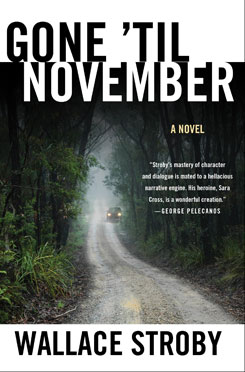
Wallace Stroby: I’ve always admired the minimalist crime writers – Peter Rabe, Donald Westlake, Lawrence Block and the like – and wanted to write something in that style. A few years back, I talked briefly with Charles Ardai, publisher of the Hard Case Crime line, about doing a project for him. Nothing came of the idea, but it did put me in mind to write a lean and mean crime novel – 55,000-75,000 words – that would be sort of an homage to some of those books I read and loved. At the same time, as in GONE ‘TIL NOVEMBER, I wanted it to be about a female protagonist, someone who was struggling to make her way in a man’s world.

PS: I read in another interview that for GONE TIL NOVEMBER you didn't use an outline. Did you also not use one for COLD SHOT? What was the process of constructing the novel?

WS: I never outline. I like to have an idea of who the characters are, what the story’s going to be, and roughly where I want things to wind up (though that always changes). Once I know all that, I feel confident enough to start writing, and what happens along the way happens. That’s the exciting part – the leap of faith that things are going to work out. Unfortunately, it’s often counteracted by the looming fear that they won’t.

My friend Mark McGarrity, who wrote mystery novels under the name Bartholomew Gill, liked to quote Ray Bradbury on that subject: “Sometimes you have to jump off the cliff, and build your wings on the way down.”

PS: As a reader, first lines are some of my favorite parts of books, and you start things off with a bang. "Three minutes after she walked in the front door, Crissa had the manager and two clerks facedown on the floor, their hands bound behind them with plastic cuffs." The whole paragraph is one concise sentence, one strong image. How did you settle on this? Were there other openings you considered?

WS: I’m big on first lines. I’m a firm believer in Mickey Spillane’s “The first line sells that book. And the last line sells the next.” I never feel a book’s ready until I have a first line I really like. I rewrote the COLD SHOT opening maybe a dozen times, in different variations, trying to get the cadence right.

Westlake, in his Richard Stark books, was an absolute master of that. The opening line from THE RARE COIN SCORE is one of the best in crime fiction. Cornell Woolrich was brilliant in that respect as well. And George Higgins’ first line from THE FRIENDS OF EDDIE COYLE practically reinvented the style in which crime novels were written.

PS: The heist is very exciting to read, especially the repelling bits. Did you have first-hand experience repelling?

WS
: I’ve never rappelled, so I tried to glean as much as I could from internet videos and the like, though I probably should have done some more research. A friend who had a lot of rappelling experience in the Army read that scene, and was fairly critical of it. Unfortunately, his input came when it was too late to fix anything.

PS: What was the most challenging part of writing COLD SHOT?

WS: Doing research. Finding out how high-level armed robbers operate, how they think, how they interact with one another, isn’t easy. They’re not exactly forthcoming, and they’re a rare breed. I did find some useful interviews and books, and they gave me something of a glimpse into that subculture. But not a lot.

PS: How about the most fun part?

WS: Stripping the story down to its bare elements: Characters in place, check. Self-advancing plot, check. Then get it started, rev the engine and see where it goes. That can be a lot of fun.

PS: You write about music on your blog, and you were also the Entertainment Editor at the Star-Ledger for a number of years. If you were to create a soundtrack to COLD SHOT, what would be on it?

WS: I usually do have a soundtrack in my head, and for GONE ‘TIL NOVEMBER I actually put together a mix CD of songs I was listening to while I wrote it, some of which made it into the book. For COLD SHOT though, mostly what I listened to was Philip Glass, especially his film soundtracks, because it seemed to fit the tone of the novel. The only actual song I had in mind was Richard Thompson’s “Love in a Faithless Country,” because the lyrics seemed to speak directly to Crissa’s mindset.

PS: What is your writing station like, and what are your writing habits like? Any particular writing rituals?

WS: Small bedroom converted into an office. Bookshelves on two walls. Huge framed print of Edward Hopper’s 1939 painting “New York Movie” over my desk. It’s one of my favorite Hopper works, very evocative. Unfortunately, when you see it with 21st century eyes, it looks like the blond usherette is talking on a cell phone.

I try to write five pages a day – usually about 1,200 words – and that seems to work for me, because it feels less oppressive. If it’s mainly dialogue, that can go pretty quick. Depending on the day and the material, that five pages could take one hour or five.

PS: In addition to being a novelist, you are also a journalist. How do you see those two types of writing as being similar or different, and do they influence each other at all?

WS: Being a journalist – especially a daily print journalist – teaches you skills I think are invaluable for a fiction writer. You learn how to organize your material, how to write on deadline, how to rewrite, the importance of making your key thought – what we called a “nutgraf” – clear. Those are all crucial.

And in another sense, a novel is the news story of what happens in the narrative, and the characters are your sources. Once you get them talking, you’re on your way.

PS: What attracts you, as both a writer and a reader, to criminals and crime stories?

WS: Not to sound too pretentious, but I think it’s two things: alienation and empowerment. The criminal has either rejected society or society has rejected them, and their alienation has led them to the point where they don't want to be part of society anymore. But instead of wasting away, they flourish. They live by their own rules, do what they want, establish their own code and accept where it will take them - including possibly prison or death.

PS: To end things, how about a more fun question -- if you had to be any one criminal from history, who would it be?

WS: None. I’m a strong believer in karma. I’d rather lead a boring life, and make all this stuff up at the desk. I occasionally get a taste of what that life must be like, either through research or talking to people who are part of it, and that’s more than enough for me. In fiction, that lifestyle can be entertaining. In real life, not so much.

Overlooked Movies: Fritz Lang


For this week's edition of Overlooked Movies, I thought I would post a link to an article I wrote over at Moving Image Source called "The Other Fritz Lang: Cowboys, Swashbucklers, and Guerrillas in the noir master's non-noir films." The article looks at five overlooked movies from Lang's career that aren't his typical crime thrillers. They are his three Westerns (The Return of Frank James, Western Union, and Rancho Notorious), one Swashbuckler (Moonfleet), and a War picture (American Guerrilla in the Philippines).

Libby Cudmore Interview

Needle 3 has busted loose and is on the prowl. If you haven’t already gotten your copy, get it here now. If you have gotten then, then you already know all about Libby Cudmore’s powerful story “Until Proven Guilty.” It’s about a new prison guard named Christian who’s trying to keep his head on straight. On the one hand, there are his colleagues who take lecherous liberties with the inmates; and on the other there is Lily, the big house’s sole “lady lifer,” who tries to appeal to the more gentle side of Christian. Can he trust anyone? And who will lead him to the emotionally shattering doom we know is inevitable in the noir universe? “Until Proven Guilty” is as strong as it is sensitive, filled with both characters hell-bent for despair and hellishly potent writing.

To celebrate the release of Needle 3, Libby was nice enough to do a Q&A with Pulp Serenade.

Pulp Serenade: What was the genesis for "Until Proven Guilty"?

Libby Cudmore: This is going to sound so cheesy, but I think it came to me in a dream. I already had the character of Christian floating around in a few other stories (he shows up in “Props” over A Twist of Noir) and this was a way to give him a backstory. I dream a lot about TV shows I’m watching, and at that point, we were devouring Oz. I think there’s probably some unconscious notes of Vern Shillinger in the character Merv.

PS: Was there something in particular that drew you to the setting of the female cell block and its many inhabitants?

LC: Women are brutal. We’re nasty creatures. We are capable of cruelty that most people cannot even begin to comprehend, but, as in all my work, I didn’t want to do the whole “women in cages” fetish-y violence. I feel like that’s far too prevalent in modern crime fiction. I wanted to have characters who were tough, tender, manipulative, lost and yet, somehow in as much control of their fates as they could be.

PS: When you were writing "Until Proven Guilty," did you have the whole story figured out ahead of time, or did the story change during the writing process?

LC: The story sort of developed on it’s own. I’m not big on outlines. The only real change from the original draft to the one in Needle is the extra scene with Tina, where she says that Lily should just “take the rape.” Someone in a writing workshop actually said that phrase to me, “take the rape,” when we were workshopping this story. I thought it was such an awful thing to say—not just to a woman, but in regards to a story where it would destroy the entire 3rd act—so this was my way of getting back at her for saying what might be the dumbest, most offensive thing anyone has ever said to me.

PS: You have some great lines in the story, but this one is a hall of famer for sure: "She's a laundry room blonde, wood-chip roots like weeds sucking the vigor from the rest of her head." Is there any story behind this one?

LC: Yeah, and I’m sorry to say it’s a pretty dumb one. There’s a scene in Chicago where Renee Zellwegger dyes her hair blonde in the sink of her cell, and I thought it was such a great image that I borrowed it. I don’t know where the second half comes from.

PS: As both a reader and a writer, what draws you to the criminal element?
LC: The same person who inspired “Unplanned” over at Thrillers, Killers ‘n’ Chillers got me into Raymond Chandler in college, which is when I really started writing crime fiction . . . but looking back through my old notebooks, I realized I had been writing it for much longer than that. I’m drawn to frustration. I’m drawn to sadness. I like stories and songs about men and women in dark situations. Chandler aside, I love Tom Waits, Warren Zevon and The Smiths, all music with these tender, tragic, aching lyrics. But what I’m not drawn to is bitterness. I hate reading wry cynicism and it really annoys me in actual people. The best crime fiction is the kind with that last glimmer of hope. That’s something everyone can understand, something that everyone—no matter how cynical— can feel.

PS: When we met at NoirCon, you mentioned that you had traveled to other conferences and presented at some. Where have you traveled, and what did you present on?

LC: I’ve been to CrimeBake, Bouchercon and Sluethfest, where I sat on a panel about screenwriting. My story “Props” was made into a short film, so I talked a little bit about the process of making that. I’ve also presented at The End, a graduate academic conference at Indiana University and attended AWP for the last two years—I’ll be part of a reading series at this year’s AWP in DC, so swing by Busboys and Poets and say hi! And I just got back from a guest stint at the Stonecoast MFA program, where I sat on a roundtable about conferences, a panel about collaboration and showed “Props” at the 1st (hopefully) Annual Stonecoast Film Festival.

PS: You also mentioned that you were a huge fan of The Shield at NoirCon. I'm sort of ashamed to say that I still haven't seen an episode -- but it gives me the opportunity to ask you to convince me to watch it. So – convince away!

LC: Oh wow, The Shield. It’s the best-written show ever. It’s so complex, there’s no good or evil. Characters you like do bad things. Characters you hate do good things. The show lacks clichés, and just as you’re prepared to roll your eyes at what you think is inevitable, the story veers off course and you cannot believe what just happened. Going back to what I said earlier, there’s this sense that these characters really believe what they’re doing is right—in some form or another—and you watch as the stakes get higher and higher, as the crimes keep getting worse and worse, as the lies pile on top of each other and that light gets dimmer and dimmer. It’s this great slow, sad, sinking feeling, and I’ve never had that with any other show. Even my friend who hates cops loved The Shield—I can’t give a better endorsement than that.

I’m also in love with Walton Goggins, who plays Shane Vendrell, so there’s that. Kenneth Johnson, who plays Curtis Lemansky, is pretty dreamy too. But my guess is that doesn’t matter to a good chunk of your readers.

PS: What's the ideal writing environment like for you, and what is the typical environment that you write in like?

LC: I have a pretty great writing environment, actually. We’re renting a house this year, so I have my own office. I painted the walls purple, and I have my bookcase and my Tom Waits poster and all my weird desk stuff—voodoo dolls, tiny dinosaurs, action figures—and a space heater. It’s the warmest room in the house, so I have little reason to ever leave it, which helps me get a lot of work done.

PS: What have you been reading this winter?

LC: I’ve started a PI novel based on the Victor and Sheila stories that Crime Factory is serializing, so I’m going back and rereading Chandler books I’d only read once—The Little Sister, Lady in the Lake, Trouble is my Business—to keep myself in that PI frame of mind. I don’t read as much as I should.

PS: Lastly, any other publications or upcoming projects you can mention?

LC: I’ve got stories in current issues of Curly Red, Espresso Stories, Mysterical-E and stories forthcoming from Criminal Class Press, Connotation Press, All Things Girl, Hardboiled, Fridge and Emprise Review, the latter with my BFF and writing partner Matthew Quinn Martin.

------------
Be sure to visit Libby's blog, The Record of the Month Club.

NYC Hickey & Boggs Screening 1/22 8PM


Tomorrow, Saturday Jan 22nd at 8PM, I am presenting a screening of Robert Culp's 1972 Private Eye classic Hickey & Boggs at 92YTribeca. I'm doubly excited because not only do we have a 35mm print of the movie, but also because the dude who introduced me to the movie -- the awesome (and Edgar-nominated!) Duane Swiercznyski -- was kind enough to agree to introduce the screening. If you are in the NYC area, come on down to Tribeca and join the party!

Ticketing information available here.

And here's a link to my review of the movie.

"The Town Square" by Orrie Hitt (Swank, May 1964)

"The Town Square" is one of the few known short stories published by prolific novelist Orrie Hitt, and it appeared in the May 1964...