Showing posts with label Stories for Sunday. Show all posts

Stories for Sunday: Anthony Neil Smith

I'm not so good at math, but here is one equation that I'm sure of. Anthony Neil Smith + Beat to a Pulp = Awesome Pulp Lunacy. No doubt about that one. No going to the back of the book, no copying the smart kid's homework. ANS + BTAP = APL. The golden equation.

This week's story at Beat to a Pulp is "The King of Mardi Gras" by Anthony Neil Smith, editor of Plots with Guns and the author of books such as Psychosomatic, Yellow Medicine, and Hogdoggin'. His latest story is about a newbie in jail named Obie who has a flash of genius after stuffing a New Orleans guide book down his cellmate's throat.

Kreacher stopped when Obie slapped his bad arm, turned to the convicts, and proclaimed, "Gentlemen, we're going to have fucking Mardi Gras!"

As wild as it is original, "The King of Mardi Gras" embodies the qualities we've come to love about Anthony Neil Smith. Relentless, hilarious, more than slightly-psychotic, and impossible to put down.

Read the story, then check out his website which has links to all his books, and then buy the damn things.

Stories for Sunday: Seamans, Brazill, Russell

Stories for Sunday is back!

First off, if you haven't checked out Sandra Seamans' latest story over at A Twist of Noir, that should be your first stop. The story is called "In God's Own Time," and it is one of her best, as well as one of her darkest. The first paragraph hits you fast and hard and sends your head spinning and your gut turning. Things only get more harrowing from there, as it follows a woman just released from jail as she hitches a ride to her old home and the tragic memories she left behind so many years ago. The final twist is as brutal as it is remarkable. Don't expect any happy endings from this one.

"You know, I was seventeen and pregnant the afternoon my daddy died. Somebody put a shotgun to his head and blew his brains all over the Lazy Boy. Hell of a mess that was. I was told they had to toss that old chair out in the trash cause there just wasn’t no cleaning the blood and brains out of the fabric. Pity, it was a nice chair. Daddy’s favorite."

Also at A Twist of Noir is Paul D. Brazill, another master of the short form. "The Final Cut" originally came out of one of Patti Abbott's Flash Fiction Challenges and later was included at Radgepacket Online. It is a darkly funny tale of revenge about a man who finally gets even with his ex-wife who left him and became a movie star. Even if you've read it before, Bazill's deft control of the short story is worth revisiting. Lines like this are priceless: "Beside me, a fading French film star with a sandblasted face slurped his espresso with all the enthusiasm of an ex-con in a bordello."

And finally, the weekly punch over at Beat To a Pulp is Katherine A. Russell's "Icarus of the Cliffs," an intriguing and original story about a hang-gliding death that goes in pleasantly unexpected directions. The variety of voices and stories at Beat To a Pulp is one of their greatest assets, and I enjoy the risks they take.

That's it for now, but expect more Stories For Sunday in the future.

Stories for Sunday: "The Frog" by Reed Farrel Coleman

In anticipation of Reed Farrel Coleman and Ken Bruen’s collaborative novel Tower (due out next week from Busted Flush Press), this weeks edition of Stories for Sunday will highlight one of Coleman’s short stories: “The Frog.”

Originally published in Plots with Guns (#33, Nov/Dec 2004), “The Frog” concerns a private detective named Gulliver Dowd who has been hired to track down Alain DeGail, the former director of a French insurance company who has mysteriously gone missing. But instead of the well-dressed executive-type he expected, Dowd has come across a defeated man, a misshapen blob of flesh and rags. Even though he never requests details from his clients, Dowd understands all-too-well the man he was hired to track down.

“We walk. We fall. We walk. We fall. It’s only the heights from which we fall that distinguish us.”


Coleman’s Moe Praeger novels were characterized not only by his fatalistic wit (there’s humor even in the darkest of situations) but also an unceasing humanism. He feels genuine empathy for his fallen characters, but also knows that even with their best effort everything won’t always turn out for the best. Despite its unassuming brevity, “The Frog” shares these same attributes. Fans of Walking the Perfect Square won’t want to miss out.

Read “The Frog” by Reed Farrel Coleman here at Plots with Guns.

Stories for Sunday: Mega Catch-Up Edition

Work and other projects have side-tracked me from Pulp Serenade the past couple of weeks. In fact, it wasn't until a couple of days ago that I actually managed to find time to do any reading for myself. But -- last night on the job was kind of quiet, so I got some time to finish the book I was reading, so I promise a new review ASAP, and some other goodies coming up. And since I missed last week's Stories for Sunday, here's a Mega Catch-Up Edition will all the good stuff that's been going on during my absence.

First up is Nik Morton's "I Celebrate Myself" over at Beat to a Pulp. A couple months back I featured Morton's story "Spend Now, Pay Later" (which if you haven't already read, then take a break, read it, then come back). What both stories share is a keen awareness of social and economic plights that are empathetic rather than didactic, as well as a brooding anxiety over the fate of the next generation. In Morton's latest story, a police officer is called to dig through a trash compactor in the projects after someone claims to have heard a baby crying inside. Vividly caressed details make the characters and situation all the more real and relatable.
"The stench was overwhelming, a mixture of mildewed fast-food, feces, rotten fruit, used sanitary towels, crumpled tabloid sheets of the New York Daily News and God knows what. I gagged and fought back the bile that threatened to lead a revolt of my stomach as I crawled over trash in the shadows. If my husband could see me now, he'd have a fit."

Read Nik Morton's "I Celebrate Myself" here at Beat to a Pulp.

Speaking of Beat to a Pulp, Patti Abbott had a story there last week, "Esther Meaney," and it's really terrific (and we'd expect nothing less from her). In just the first paragraph of the story, a perceptive sentence like this reveals a world of pained memories outside of the story: "If other women took a baseball bat out of the basement when their husbands were away, Mom put hers down after Dad left." Reticent details like these are one of Abbott's specialities, and say more than a page full of labored lists ever could. Her latest story is about a twelve year old boy who gets a new babysitter, Esther Meaney, who surprises him by guzzling bourbon, chain-smoking cigarettes, reading comics – oh, and she robs convenient stores as well.
"Sometimes," she began, "a girl's got to do things she'd rather not." She looked at me closely. "Just to survive, that is."
Read Patti Abbott's "Esther Meaney" here at Beat to a Pulp.

You've heard me rave about Keith Rawson's stories before, and as long as he keeps pumping out stories I'll continue to push there here at Pulp Serenade. He has a new one over at A Twist of Noir called "What I Lost Along With My Keys" about a real estate salesman and his recently out-of-work wife and their growing estrangement. It's as bleak as it is hilarious, and everything comes to screeching, devastating, face-slapping halt in the last three paragraphs. I won't ruin Rawson's carefully orchestrated effect by telling you anymore, but I do want to quote one of the many pants-pissing funny moments in the story:
"I thought about buying her puppy, but I figured she’d end up drowning it in the bathtub in a fit of rage the minute the little furball took a dump on the carpet and would beat me unconscious with the corpse the second I walked through the front door; so I scratched the idea entirely and let her stew in her own juices."
Read Keith Rawson's "What I Lost Along With My Keys" at A Twist of Noir.

Another Pulp Serenade regular, Paul D. Brazill, has served up another of his specialties over at Blink Ink. This one's called "Bang!" – true to its title, it's a quick shot of Brazill's characteristic wordplay. Sometimes all you need is just 37 well-picked words.

Read Paul D. Brazill's "Bang!" here at Blink Ink.

Stories for Sunday: Rawson, Hinkson, and Brazill

Taking a nap after work on Saturday night is definitely not a good idea – nearly 5AM and I’m wide awake. Good thing the internet is abuzz with some crazy stories, and now I finally have the time to catch up with them. This week’s edition of Stories for Sunday is bigger than normal – three stories coming your way, two hot off the press and one classic.

First thing is first. Keith Rawson’s “Marmalade” over at Beat to a Pulp. I don’t know what sort of deranged rays are in that Arizona sun, but lets hope Keith keeps getting more of them. This might be his best yet – the story of the recently paroled Tom Shepard, who has exchanged life behind bars to life with his vegetable father and nagging mother and picking up dog shit off the front lawn. Life sucks just a little less than before, which should be an improvement. But then Tom starts hearing voices from his supposedly catatonic pops – and that’s where I'll stop the synopsis. Rawson takes the story in some wild and unexpected directions, reigning it all in for a gonzo finale that would do any of Jim Thompson’s warped protagonists proud. Seriously dark and funny as hell – a must read.

“He finally flashed on the face of the girl gritting her teeth, tears and terror sweat streaking her mascara, smudging her makeup. His stomach lurched into his throat; yellow bile burning his nostrils and mouth with memory.”

Read Keith Rawson’s “Marmalade” here at Beat to a Pulp.

Speaking of Beat to a Pulp – as if we needed one more reason to love that site, here’s a gut-punch from their archives, Jake Hinkson’s “Maker’s and Coke.” Officer Lowell has come to an unpleasant realization “This life is a faithless whore.” Unable to get Ellie off his mind, he buys a bottle of Maker’s Mark and Coke and locks it in his trunk before going on duty. But the thoughts of her just won’t go away, so he has a drink, which leads to two, and before he’s knows it he’s lost count. And things only get worse when he stumbles upon a robbery-in-progress. Hinkson writes about cinema and film noir over at his site The Night Editor, and you can get a sense of that cinematic sensibility in this story. The whole thing unfolds like some devastating finale, filmed in the bleakest black-and-white hues possible.

“Once I thought about it, I realized no one else loved me, either. I sat there and considered it. There was no one left on this earth who loved me. That wasn't self-pity; it was math.”

Read Jake Hinkson’s “Maker’s and Coke” here at Beat to a Pulp.

Topping off this triple bill is the latest from Paul D. Brazill “A Cold Day In Hell,” published over at Blink Ink. Brazill edits like no one else around, refining and condensing stories to their bare essentials. Embracing brevity, his stories are highly evocative, suggesting images and scenes that go beyond the bounds of the words on the page. Just take a look at the fifty words that comprise “A Cold Day in Hell” and you’ll see what I mean.

“The January night had long since waned when Nathan blasted Oliver’s brains over the snow covered street…”

Read Paul D. Brazill’s “A Cold Day in Hell” here at Blink Ink.

Stories for Sunday: "Running to Zero" by Jason Duke (Thuglit/A Twist of Noir)

First off, many thanks to Keith Rawson for suggesting I befriend Jason Duke on Facebook. I remembered his name from Keith’s blog, so I searched him out online and found a bunch of stories that knocked me on my ass in a big way. Especially “Running to Zero,” which I am featuring for this week’s edition of Stories for Sunday.

Originally published in Thuglit #30 and reprinted as A Twist of Noir #97, “Running to Zero” does for today’s world what Falling Down did for the early 1990s. It’s the ugliest, truest aspects of our anxiety, anger, and failure, writ uncomfortably large. “There are last place trophies for everything,” Duke reminds us, and his protagonist – Gerald Tyler – is none to happy to have come in last place in life. Deep in debt from online gambling, out of work for punching his boss and co-workers (honestly, they deserved it), and sick with the West Nile virus, Tyler is at once resentful and envious of the wealth, success, and health around him. A true and uncompromisingly noir protagonist, Duke is alienated from society in the most extreme fashion, which only fuels his sociopathic tendencies even more. He dreams of sitting in a mansion, order delivery, sitting online, and never seeing another awful human being in his life.

He wants to escape from that world.

And that, of course, is impossible.

“You run to make decisions.


You run to make choices.


You run to blame people for the consequences when things don’t work out right.


Gerald believes he is free to choose."


And so Gerald has made a choice. He’s grabbed an assault rifle and a handful of dynamite, and he’s making his way to Albertson’s supermarket…

Gripping and jaw droppingly-bleak, “Running to Zero” is exactly what I want to wake up to on a Sunday morning – a strong, bitter dose of reality to kick me back into gear. Hell, this is way better than black coffee any way you look at it.

Read “Running to Zero” by Jason Duke here at A Twist of Noir or here at Thuglit.

Stories for Sunday: "Greta at the Track" by Christopher Grant (Thrillers Killers 'n' Chillers, 2009)

She crossed her legs, looked over at Teddy and smiled.

Maybe my luck is changing, Teddy thought.

Think again, Teddy. Over at Thrillers Killers 'n' Chillers, A Twist of Noir editor and owner Christopher Grant offers up a story of his own called "Greta at the Track." It's a tight, finely constructed piece of flash fiction that clocks in at just under 600 words, and nothing goes better with your morning coffee than a quick, concentrated dose of crime fiction.

Teddy is the perfect name for a character who is certainly feeling the "squeeze." Down on his luck and deep in debt to his loan shark, Teddy is a terminal loser with all the wrong habits: blondes, betting, and a terminal belief that things will turn around for him. And he thinks today is the day, so with his last hundred and eighty dollars in his pocket, he throws it all on one horse and waits for it to come in.

Read "Greta at the Track" by Christopher Grant here at Thrillers Killers 'n' Chillers.

Stories for Sunday: Patti Abbott and Paul D. Brazill

The Internet has been especially generous this past week, giving us two spectacular new stores from Patti Abbott and Paul D. Brazill, both of which I am featuring for this week’s edition of Stories for Sunday.

Abbott’s “The Tortoise and the Tortoise” was published over at Pulp Pusher, and is a darkly comic gem you might describe as “nursing home noir.” George, the protagonist of the story, may be in the autumn of his life but he’s determined not to go quietly. The reigning king of bingo, Nintendo wii bowling champ, leader of the Mardi Gras parade – he’s the all-around life of the party who still knows how to piss in his bed to annoy the aides. But then comes the arrival of Father Ryan who threatens to steal all of George’s limelight, and George must do something to protect his territory. Like Margaret Millar, Abbott’s details focus on the all-too-human element of her characters and the reality of their situation.

Read Patti Abbott’s “The Tortoise and the Tortoise” here at Pulp Pusher.

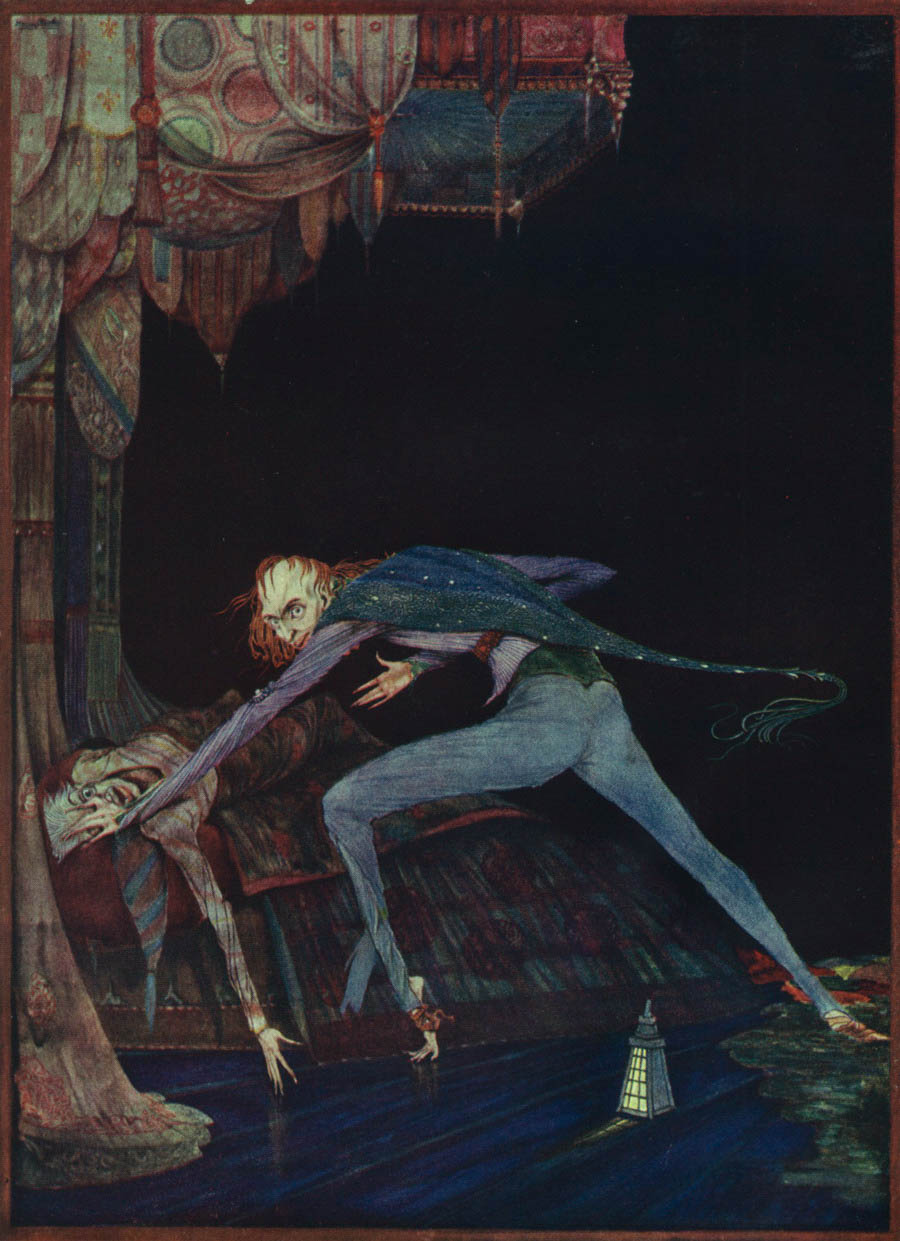
Brazill’s latest is the cleverly titled “The Tut” from the excellent online magazine Beat To a Pulp. With echoes of Poe’s “The Tell-Tale Heart,” Brazill’s story of a husband who has finally lost patience with his nagging wife and decided to shut her up…permanently. This is a corkscrew world inhabited by twisted characters unable to recognize their skewed perception until it’s too late to save themselves or their sanity. Only a fiendish mind like Brazill’s could make something this psychotic so thoroughly enjoyable.

Read Paul D. Brazill’s “The Tut” here at Beat to a Pulp.

(The above image is an illustration for "The Tell-Tale Heart" by Harry Clarke from 1919, courtesy of Wikipedia.)

Stories for Sunday: "Trapped in Silver" by Horace McCoy (Nickel Detective, August 1933)

This week’s selection for Stories for Sunday comes from one of the most searing, merciless writers of his day: Horace McCoy. He is best known for his Depression-era nightmare They Shoot Horses Don’t They (1935), about a hellish dance marathon and its myriad participants – all of them, literally, losers at the end of their ropes. Among his other excellent novels is No Pockets In a Shroud (1937) about an idealistic journalist who learns to keep his mouth shut the hard way; I Should Have Stayed Home (1938), a brutal account of the false-fantasies of 1930s Hollywood that stands alongside Budd Schulberg’s What Makes Sammy Run (1941); and Kiss Tomorrow Goodbye (1948), as ruthless an account of a gangster that has ever been published.

“Trapped by Silver” was originally published by Nickel Detective in August 1933 at a time when the author had already left his position as a full-time journalist and was trying to make a go at it in Hollywood. This seems to inform the somewhat mysterious first-person narrator, whose identity is never fully explained. It appears that he is a screenwriter, or filmmaker of some type, who is accompanying Police Sergeant Donovan as he investigates the seemingly natural death of a millionaire doctor. But as he begins to question those closest to the deceased, Donovan begins to suspect that there may be more than meets the eye.

“This is the kind of a thing,” Donovan said, “that makes me wonder whether I got promoted to the homicide squad or demoted to it.”


Classic McCoy, his dystopian vision is subtly on display in “Trapped By Silver.” As the story unfolds, several layers of greed and corruption become apparent – some even sanctioned by law. The backstory of the deceased’s immense wealth is that he accepted payments of land from impoverished patients, which unbeknownst to their owners was rich with oil. And even the narrator and the detective seem to be complicit in this merry-go-round of exploitation, as the story ends with a cynical quip that suggests this might become the foundation for a movie. There’s always more money to be made off a corpse – “trapped by silver,” indeed.

Click here to read Horace McCoy’s “Trapped by Silver” courtesy of PulpGen.

Cover image courtesy of Galactic Central.

Stories for Sunday: "Cranked" by Bill Crider (Busted Flush, 2006)

This Sunday morning was something special - my upstairs neighbor seems to have gone away for the weekend but forgotten to shut off their alarm, which beeped from 6AM until about 7:15 or so. Not sure if someone turned it off, or the alarm just got sick and tired of making all that racket. I sure did. Even with earplugs, my fan, and the rest of early-morning New York noise coming through my open window, the alarm was unmistakable, and unavoidable.

So, cranky that I was, I decided to read Bill Crider's "Cranked." Winner of the Derringer Award and nominated for an Anthony, "Cranked" was published in Duane Swierczynski's excellent anthology Damn Near Dead: An Anthology of Geezer Noir (Busted Flush, 2006). The cover advertises, "Old, Bold, Uncontrolled" - and if that has some unpleasant double meanings, then perhaps the other quote would be more appealing: "Every Story New!" Which means when you look at its great lineup (Jeff Abbott, Megan Abbott, Charles Ardai, Ray Banks, Mark Billingham, Steve Brewer, Ken Bruen, Milton Burton, Reed Farrel Coleman, Colin Cotterill, Bill Crider, Sean Doolittle, Victor Gischler, Allan Guthrie, John Harvey, Simon Kernick, Laura Lippman, Stuart MacBride, Donna Moore, Zoë Sharp, Jenny Siler, Jason Starr, Charlie Stella, Duane Swierczynski, Robert Ward, Sarah Weinman and Dave White), you have a whole lotta' great new stories to look forward to.

"Cranked" really hit the spot this morning. It's about how a quiet day at a gas station can suddenly turn into a fiery hell when the four wrong people run into each other at the wrong time. There's Karla, a female undercover agent for the drug squad who took a jail sentence for someone else; then there are a couple of crank-addicted rednecks with pistols, one of whom is responsible for Karla doing time; and there's Lloyd, a cranky old man with a stomach problem who just broke out of the nursing home.

Lloyd may be a senior citizen with false teeth, but when you get down to it, he's old-school hardboiled how knows how to kick some serious ass and still charm the ladies:

"He wondered how much fun a man his age could stand and how long somebody who was damn near dead would last with a woman like this one. By God, maybe he’d just find out."

Read "Cranked" online here courtesy of Busted Flush Press.

If you'd like to buy the anthology, you can order it from Busted Flush's website.

Stories for Sunday: "Hobbyist" by Fredric Brown

Try as we might, some Sundays we just have to spend catching up on work. So, for those of you who, like myself, have a long "to do" list, here's a real short story that you can read quickly, but that will certainly stay in your memory. It's called "Hobbyist" and is by one of my favorite writers, Fredric Brown. The story was originally published in the May 1961 issue of Playboy, and later in the collection Nightmares and Geezenstacks.

Since I've already gushed about how much I admire Brown's writing several times on this blog, I won't repeat myself, except to say that Fredric Brown never fails to deliver a gleefully fiendish tale. Such is the case with "Hobbyist," about a man who visits a pharmacist in search of an undetectable poison and winds up getting more than he bargained for.

Read "Hobbyist" by Fredric Brown.

Stories for Sunday: "Danny Denver," an episode of "Richard Diamond, Private Detective"

Today's edition of Stories for Sunday is a little different than usual. Instead of a short story, I am highlighting a script for an episode of Richard Diamond, Private Detective, a radio show that ran from 1949-1953 (and was later a television series). The radio version starred Dick Powell and was written by Blake Edwards. Last night I was lucky enough to catch a live performance of one episode, "Danny Denver" (#98, originally broadcast May 11, 1951), at my favorite bookstore, Partners and Crime. Once a month, they present W-WOW! Radio, a performance of old time radio mysteries complete with music, sound effects, and vintage commercials - all done live in-store. It's really a treat to see, if you're ever in the city you should definitely try to catch a performance.

In "Danny Denver," Richard Diamond is hired to commit a murder, but the victim isn't your typical soon-to-be-corpse. It is Danny Denver, a ventriloquist's dummy who has already been destroyed several times, and keeps coming back. Diamond reluctantly takes on the case, and soon finds himself amidst a screwy acting troupe who all think Danny is not only real, but also responsible for a murder, which means that Diamond now has two mysteries to solve.

The script, courtesy of Old Time Radio Researchers Group, includes handwritten notes meant for the final performance. It is certainly a unique and insightful historical document, as well as an entertaining read. For more information on the show, check out these comprehensive notes on the history of Richard Diamond, Private Detective by Frank Passage.

Read "Danny Denver" by clicking here.

Stories for Sunday: Brazill, Brown, and Rawson

One degree shy of 90 here in Brooklyn this morning - perfect weather for murder, counterfeiting, and arson - right? Well, the protagonists in these three stories don't fare so well as they hoped. So, grab a cold drink, turn on the fan (or AC, if you're lucky enough), and enjoy the stories.

1) "In the Shower, Thinking" by Keith Rawson. Originally published at A Twist of Noir, Rawson's story was the winner of their March contest - and rightfully so. A couple of guys from the office plot to drive a co-worker "postal" in attempt to gather fame and fortune for themselves. But driving a man crazy is hard work, and insanity can be rather contagious...

2) "This Old House" by Paul D. Brazill. The only thing better than finding a writer you like is to find one so prolific as Brazill. His latest, published at Thrillers Killers 'n' Chillers, follows a man down on his luck whose bright idea - burning down the house - isn't as uplifting as he hoped.

And finally, a classic:

3) "Don't Look Behind You" by Fredric Brown. A small-time printer hooks up with a con-artist to start a counterfeiting operation. Things go awry, and both the police and his irate cohorts are after the phony plates - only the printer has something else on his mind: revenge. Originally published in the May 1947 issue of Ellery Queen Mystery Magazine.

Image courtesy of Galactic Central.

Stories for Sunday: John L. Benton's "License to Hell" and "No Blood"

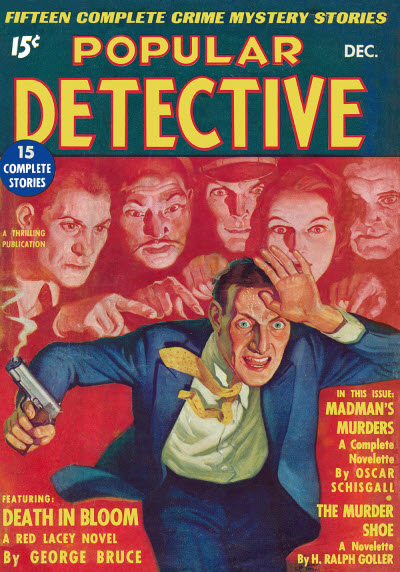
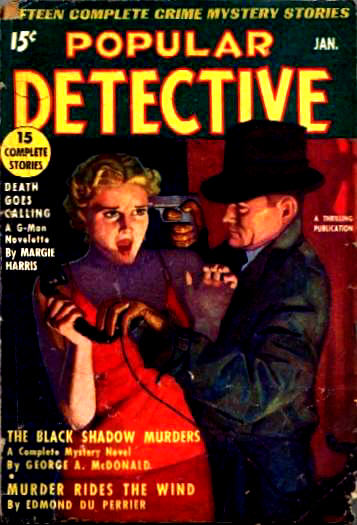
Perusing PulpGen for this week’s Stories for Sunday I took a chance on an author I had never heard of before – John L. Benton. Among the many stories on the site were two pieces of flash fiction, “License to Hell” (Popular Detective, December 1935) and “No Blood” (Popular Detective, January 1936). Both are savage stories of killers without mercy. Hardboiled to the core, and with a cruel sense of irony, Benton doesn’t allow anyone a happy ending. In a single page, he packs in a bleak worldview that is unmistakably noir.

A brief synopsis and quote for each story:

“License to Hell”
A wanted killer takes to the lam and forces a reformed crook to aid in his escape.
“Automatic gripped in gaunt hand, “Cop-Killer” Merkle jabbed its muzzle hard against the whimpering man before him. “

“No Blood”
Two siblings find themselves at opposite ends of the law: one is a ruthless criminal, the other a pitiless detective.
“His brother lay sleeping in the next room—a sleep from which he would never awaken, Graemlein was grimly resolved. He went carefully into the bedroom. In his hand he held the hypodermic syringe filled with a pale, deadly fluid of his own concoction.”

There seems to be scant information on Benton either in print or on the internet – and what little I could find is certainly conflicting. “John L. Benton” seems to have been the pseudonym for several different authors, all writing mystery fiction during the 1930s and 1940s. (An Amazon.com customer seems to have also been confused and left their trail of information in a review here.)

According to Steve Trussel’s a.k.a., Benton is one of many names used by Norman A. Danberg (1906-1995). Magic Dragon Memorabilia confirms this information, and has a short bio that states he attended college at Columbia University, New York University, and Northwestern University, and married a Dorothy Daniels in 1937. They also mention that he wrote 61 novels and hundreds of stories, though no particular titles are mentioned.

Phil Stephensen-Payne’s Galactic Central Publications has two listings for Benton. One is for Danberg (whom apparently also went by Norman Daniels) – though his birth date is listed as 1905, and not a year later as by Trussel. Elsewhere on the site, “John L. Benton” is credited as a house name used by multiple authors, none of whom are listed. Both bibliographies list different mystery stories being published during the same period of time, and in similar publications (such as G-Men Detective), but none of the stories appear on both lists.

Confused by this information, I dropped by my favorite local bookstore, Partners and Crime, where Steve consulted Allen J. Hubin’s Crime Fiction: A Comprehensive Bibliography. “John L. Benton” there is listed as the pseudonym for Thomas Albert Curry (1900-1976), who also published under the names Albert Jeffers and Stephan Duane. A post on Mystery*File about Gateway Books seconds this connection between Benton and Curry. Coincidentally, they also list “Norman Daniels” as a writer for this company, and give his penname as “William Dale,” which was also listed by both Trussel and Magic Dragon. Bill Pronzini has posted covers to a handful of Gateway titles online, including two novels by Benton – The Art Treasure Murders (1940) and Talent for Murder (1942).

So, who was this John L. Benton who wrote these stories? While I can’t say for sure, one thing is certain: these two stories are classic examples of high-quality hardboiled fiction.

And special thanks to Galactic Central Publishing for providing the images for both issues of Popular Detective. Be sure to browse their incredible archive here.

Stories for Sunday: Paul D. Brazill, Gary Dobbs, and Keith Rawson

It’s the end of “one of those weeks,” so I decided that this week’s edition of Stories for Sunday needs to be extra strong. A single shot wouldn’t do, nor would a double. So here it is – a triple shot of noir, three glasses of bleak poetry and macabre humor from three stellar writers: Paul D. Brazill, Gary Dobbs, and Keith Rawson. They’ve all been encouraging supporters of Pulp Serenade from the start, and they truly make the blog world seem like a real community. It’s always a pleasure reading their blog updates and their latest stories.

Line up the shots and get ready. Here are the stories.

1) “Loose Ends” by Gary Dobbs (A Twist of Noir #050). Frankie just stepped into the bar to drown his sorrows in a few (or maybe more than a few) drinks. He didn’t plan on witnessing a murder – or on recognizing one of the hitmen. This story represents the quintessential noir universe: merciless, coldly brutal, and not without an ironic sense of humor that always puts you behind the eight-ball. And none of this is lost on our antihero: reflecting on a fellow bar patron, Frankie thinks to himself, “No doubt he has a story just as I have a story but no one gives a fuck.”

2) “Pervert #16” by Keith Rawson (Powder Burn Flash #159). Talk about the world having a cruel sense of humor…the two teens at the center of Rawson’s story take others’ weaknesses and exploit them to their full advantage. They lure in lurking lechers and give them a surprise they’ll never forget. Rawson’s characters are scarily vibrant, their actions uncomfortably realistic – it’s a marvelously well-crafted story, one that is sure to disturb and fascinate at the same time.

3) “Swamplands” by Paul D. Brazill (Flashshots). Brazill’s flashfiction recalls the dark, twisted humor of Fredric Brown. In only 99 words, Brazill’s deft but evocative prose conjures up a noir nightmare in which the character’s past (literally) won’t let go of him. With the first line we are knocked straight into the noir paradigm: “Elvis awoke in a cold, dank sweat, hungover from bourbon and bad dreams.” Of course, in the world of noir, waking-up is no guarantee the nightmare will end. This is something Elvis must learn the hard way.

Be sure to check back with these authors often. I’m looking forward to reading many more of their stories. And in the case of Gary Dobbs, his first novel is set to come out this summer – The Tarnished Star under his penname of Jack Martin. Click here to order the book.

Stories for Sunday: "The Man Who Wasn't There" by D.L. Champion (G-Men Detective, Winter 1950)


Today's selection for Stories for Sunday is by an author who is still quite new to me: D.L. Champion. I first read about him in Marc Gerald's true crime anthology Murder Plus and was intrigued by Gerald's description of him:

"D.L. Champion contributed some of the most offbeat private-eye stories ever published in Black Mask and Dime Detective. His characters included a midget investigator; a hard-nosed, legless ex-cop; a gaudily dressed Mexican PI; and 'the unchallenged world's champion penny pincher.'"

Who could resist such temptation? Certainly not me. So, in my pursuit to learn more about Champion, I discovered he also published under the name Jack D'Arcy, and was one many writers who penned The Phantom Detective under the house-name Robert Wallace. The FictionMags Index has a comprehensive bibliography of Champion and D'Arcy.

While I have come across any of the bizarre characters that Gerald referred to, I did stumble upon this clever short story by Champion called "The Man Who Wasn't There," originally published in G-Men Detective (Winter 1950). It is about a man with considerable gambling debts who decides he can't wait for a wealthy relative to die of natural causes.

"Maxon thought of murder. Naturally, he had thought of it before. He had no qualms about snuffing out the old man's life, no moral scruples at all. But he had a great many scruples about getting caught."

I am going to keep looking out for more of Champion's work. If anyone else knows anything about him, or has read any of his stories, please let me know in the comments section!

Click here to read D.L. Champion's "The Man Who Wasn't There" courtesy of PulpGen.

"The Rag Tag Girl" by Norbert Davis (The Phantom Detective, May 1936)

Daylight Savings has thrown my schedule off a bit, so I'm off to a late start today. No worries - there's always time for some fast-paced, hardboiled action, and this week's selection for Stories for Sunday delivers just that. It's "The Rag Tag Girl" by Norbert Davis, originally published in The Phantom Detective (May 1936). As the story begins, an ex-Private Eye is paying a visit to his former partner...in jail.

Lunsford glowered at him. "So now you're in jail again!"

"Yes, Karl," Saunders said meekly.

"And for murder! Why do you always have to pick out the worst thing possible? Why couldn't you make it manslaughter or mayhem or something?"


Reluctantly taking the case, Lunsford's investigation leads him from a crooked gambler found dead in a ditch to a missing whippet -- and what story would be complete without a couple of gat wielding hoodlums?

Make up for that lost hour with a quick dose of the hardboiled! Read "The Rag Tag Girl" by Norbert Davis online here (courtesy of PulpGen).

Stories for Sunday: "Knock" by Fredric Brown and "The Unreal Jesse James" by Chap O'Keefe

This week’s edition of Stories For Sunday is a double dose of sci-fi. First up is Fredric Brown’s “Knock,” originally published in Thrilling Wonder Stories (December 1948). When not penning surreal, nightmarish crime fiction masterpieces such as Here Comes a Candle, Brown was churning out science fiction novels and stories such as this one. (Nor is he the only pulp writer who was proficient in multiple genres - Harry Whittington, for instance, wrote both mystery and western fiction). "Knock" begins with the memorable line, “The last man on Earth sat alone in a room. There was a knock on the door…” Brown then cleverly backs up and analyses the two sentences for the reader: “The horror, of course, isn’t in the two sentences at all; it’s in the ellipsis…” From there, Brown continues the story by answering the question as to what is knocking on the door.

What a better way to start off Sunday than by laughing about the ending of the world? Read Fredric Brown’s “Knock” by clicking here.

Still not enough sci-fi? Didn’t think so. In that case, head over to Beat To a Pulp and read Chap O’Keefe’s “The Unreal Jesse James,” a clever genre-bender that re-imagines the legendary outlaw as being the human form of an alien from the future. And while you’re enjoying the story, get ready for Wild West Monday! Support Western literature by visiting your local independent bookstore and showing your love for the genre.

Stories for Sunday: "Killer Ace" by David Goodis (The Lone Eagle, February 1941)


For this week's Stories for Sunday I am featuring a story by noir master David Goodis - but not one of his mysteries. Like many of his era, Goodis learned his craft by pumping out stories for pulp magazines, nor was he limited to only one genre. In addition to mysteries, Goodis was a prolific action-adventure writer, and "Killer Ace" is one of the many aviation yarns he penned in the early 1940s.

Originally published in The Lone Eagle in February of 1941, those familiar only with the introspective, minimalist narratives of Black Friday or The Blonde on the Street Corner are in for an eye-opening surprise. "Killer Ace" is chock full of action on every page - whizzing planes, streams of bullets, and broken jaws. Written ten months before Pearl Harbor, the story concerns an American student named Dane Kern studying physics at Oxford who enlisted in the British military because of his interest in aviation. As the story opens, he is the sole survivor of a disastrous mission in which the German pilot Von Krim killed everyone else in Kern's squadron. Nor is this the first time Von Krim and his crew have defeated the British pilots. Kern is convinced that someone must be giving the Germans advance information about their plans, and he thinks he has an idea who is behind it all...

Here are a few examples of Goodis' pen in action, including the sizzling first line:

"The German plane came hurtling out of the sky like a pain-crazed eagle. Trigger fingers jabbed death-filled lead through the air four thousand feet up. Von Krim's mouth twisted in a devilish grin. He looked like Satan himself as he dove for the Englishman's tail, raced a pattern of dots up the fuselage, and then shrieked in eerie delight as that death-line reached the cockpit. The English pilot slumped down in his seat, his brain riddled by bullets."

"They were fighting like madmen. The tears in their eyes were not tears of fright or horror. They were tears of sorrow, tears of rage, tears of vengeance. But the English flyers needed more than sobs to combat the ruthless von Krim and his squadron of devils."

"They went down like tall grass before a scythe, those Nazis."

Liven up your Sunday morning with "Killer Ace" by David Goodis, courtesy of PulpGen.

Stories for Sunday: "Sleeping Dogs" by Robert Leslie Bellem (Spicy Detective, September 1934)


Starting today I am beginning a new series of posts called “Stories for Sunday.” Every week, I will post a link to a different mystery story online.

This week’s story is “Sleeping Dogs” by Robert Leslie Bellem, originally published in Spicy Detective (September, 1934). The story stars Bellem’s iconic private eye, Dan Turner, who is hired to investigate a young Hollywood starlet who is being blackmailed for a skin flick she made a long time ago. This story is typical of Bellem – fast paced, plenty of violence and sex (for it’s time), and full of playful prose. Here are some examples:

“The door opened. I shoved my .38 square in her face and said ‘How would you like a mouthful of bullets?’”

“I grabbed the inkwell from my desk and let him have it square behind the ear. He dropped like a poled ox.”

“I aim to get my pile and quit before the law of averages lays for me with a gut-full of steel-jacketed pills.”

If phrases like this would make your Sunday just a little more enjoyable, then this is the story for you. Click here to download a PDF of the story courtesy of PulpGen.

For those of you looking to relive the experience of reading this story in a magazine, Vintage Library has reprinted the entire original September 1934 issue of Spicy Detective.

"The Town Square" by Orrie Hitt (Swank, May 1964)

"The Town Square" is one of the few known short stories published by prolific novelist Orrie Hitt, and it appeared in the May 1964...