Showing posts with label Harry Whittington. Show all posts

From Gil Brewer to Harry Whittington

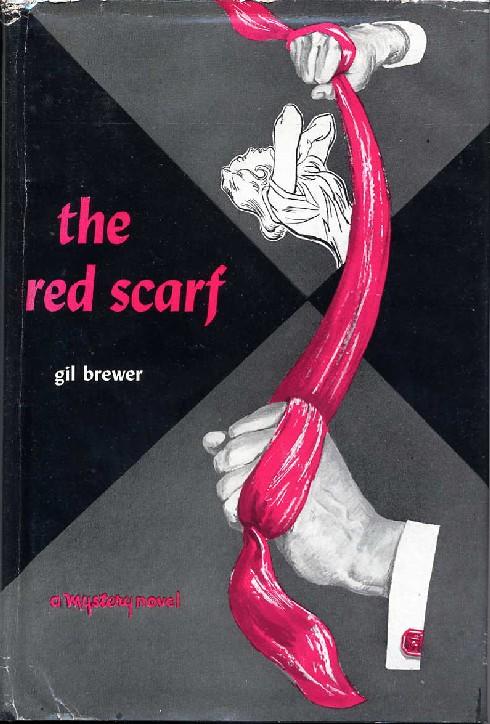
I'm suffering from some serious book envy today. Royal Books has a first edition hardcover of Gil Brewer's The Red Scarf for sale, inscribed from Gil to Harry Whittington and his wife Kathryn with some writerly tough-love motivationFor Harry and Kathryn:

Harry, if you don’t sit yourself down and write the honest to God book of your guts very soon, I’m sure as hell going to bash you over the head with a sledge hammer.

I mean it.

Since I can't afford this treasure, I'll have to be content with the images posted by the seller. 


"Rapture Alley" (1953) / "Winter Girl" (1963) / "Strictly for the Boys" (1959) by Harry Whittington

Stark House Press continues their revival of Harry Whittington with their third anthology of deep cuts from the "King of the Paperbacks." The nickname is well deserved. During the renaissance of the paperback originals in the 1950s and 1960s, Whittington was one of the hardest working pros, pumping out multiple titles a year. Ultimately, he published over 170 novels in his three-decade-long career. More than just prolific, he was one of the most reliably entertaining and distinctive paperback writers of his era. Whittington wasn't a flashy plotter: he shot from the hip, and when he hit the bull's-eye, it stuck. His were stories of intensely driven characters living out their unlucky lives as the world closed in on them. He might not have been as bold as Jim Thompson or as plaintive as David Goodis, but Whittington's novels, like the work of those two titans, were character-driven tragedies, at times more realistic and recognizable than those of his more lauded contemporaries. Like Day Keene and Orrie Hitt (both of whom Stark House has also reprinted), Whittington wrote of people you'd find across the street, down at the corner, or sitting next to you in the bar. He turned commonplace situations into frenzied odysseys of obsession and self-destruction.

The three novels selected for this anthology have never been reprinted before, and two of them never even appeared under Whittington's own name. To long-time Whittington fans, this volume will provide a revelation of the depth and diversity of the author's talent, while newcomers will find plenty of reasons to dig deeper into the author's seemingly endless backlog.

Rapture Alley, originally published in 1953 under the pen name "Whit Harrison," charts an aspiring model's descent into heroin addiction: "It seemed that her life had become a bad dream, an endless nightmare in which everything continually worsened." Whittington's rendering of Lora's condition may be, at times, melodramatic, but he nails his portrait of the psychological strain and self-loathing that surround addiction. The doomed relationship-and the impossibility of a truly happy ending-are hallmarks of the author's worldview.

Winter Girl was originally released in 1963 as A Taste of Desire, under the "Curt Colman" byline, by the sleaze specialist Corinth, with numerous scenes added by hacks to spice up the text. Thanks to editor David Laurence Wilson, who restored the novel to Whittington's original version, we're finally able to see the book in its intended form, and it's a real treat. The final product is sort of a "boy and his dog" meets "backwoods tramp" mash-up set in the Deep South. Among its author's more unusual creations, it stands out for its sensitive yet unsettling coming-of-age narrative. The motivating crime - the search for the narrator's stolen prized pet - is nothing compared to the more pedestrian tragedies he faces on a daily basis: alcoholic fathers, abused mothers, rampant unsatisfied ambitions and desires, and the gradual realization that he's fated to become just like everyone else in his crummy, beaten-down town.

The real prize of the anthology, however, is Strictly For the Boys, originally published in 1959, and the only one of the three to bear Whittington's own name. The story is about a battered wife attempting to flee an abusive husband who refuses to let her, her mother, and her new boyfriend alone. Downright disturbing in its realism and sobering depiction of domestic violence, Strictly For the Boys displays a social consciousness that was prescient for its time, and which continues to be relevant today.

Editor and scholar David Laurence Wilson deserves special commendation for his tireless efforts to restore Whittington's reputation (and, in the case of Winter Girl, to restore the text itself). Wilson and Stark House publisher Greg Shepard give their books scholarly attention on par with the Library of America. Meticulously researched and lovingly edited, Stark House presents these forgotten paperback novels not as pulp curios, but as real literature, and set the bar high for other reprint series.

(Originally published January 23, 2012 at the Los Angeles Review of Books)

"Hell, Hurt, Blood and Rapture" at Los Angeles Review of Books

My most recent post at the Los Angeles Review of Books is called, "Hell, Hurt, Blood and Rapture." Check it out for reviews of Jake Hinkson's Hell on Church Street (New Pulp Press), Reed Farrel Coleman's latest Moe Prager book, Hurt Machine (Tyrus Books), John Rector's Already Gone (Thomas & Mercer), Alan Glynn's Bloodland (Picador), and a Harry Whittington anthology from Stark House Press that includes Rapture Alley, Winter Girl, and Strictly For the Boys.

Read the full article here.

Excerpts below:

Hell on Church Street is one of the rare novels that actually deserves the over-used comparison to Jim Thompson, not just because Webb follows in the footsteps of such crazed protagonists as Lou Ford (The Killer Inside Me) and Nick Corey (Pop. 1280), but because Hinkson takes a risk and deviates from Thompson’s iconic moulds.


Rector writes hardboiled noir with a rare poetic élan, tight, almost violently compressed action, and reticent melancholy... He’s already proven himself among the freshest and most stylistically austere voices working in the thriller field. In fact, labeling his books “thrillers” feels too limiting. There’s a tonal ambience and doleful vibe that permeates his work, which comes as a surprise, considering how action-packed and tense his narratives tend to be. Acutely visual, Already Gone pulses with cinematic urgency and visceral punch.


Reed Farrel Coleman’s Moe Prager saga, about a Brooklyn ex-cop turned reluctant wine merchant and occasional PI, is that rare series that improves with each new entry. Coleman is now up to the seventh book, Hurt Machine, and it’s not only the best one yet but also the darkest... Coleman’s novels, like Ed Gorman’s, impress not with distractingly complex plots (though they’re both certainly capable of spinning real page-turners) but with their profound clarity and expert simplicity. Coleman’s characters don’t need grand schemes or million dollar payoffs as motivations: as Moe too frequently discovers, there’s enough potential for lifetimes of pain in our everyday lives.


Alan Glynn’s Bloodland, a loosely related follow-up to 2009’s Winterland, is a stunningly intricate and timely piece of globalization noir... In its depiction of immoral business practices and the increasingly blurred lines between criminals and politicians, Bloodland is like an amped-up 21st-century version of Dashiell Hammett’s The Glass Key. From the exploitation of human labor through umpteen middlemen to who-knows-where, Bloodland captures the fragmentary and alienating mechanism of international affairs with prismatic clarity.


The real prize of the anthology, however, is Strictly For the Boys, originally published in 1959, and the only one of the three to bear Whittington’s own name. The story is about a battered wife attempting to flee an abusive husband who refuses to let her, her mother, and her new boyfriend alone. Downright disturbing in its realism and sobering depiction of domestic violence, Strictly For the Boys displays a social consciousness that was prescient for its time, and which continues to be relevant today... Editor and scholar David Laurence Wilson deserves special commendation for his tireless efforts to restore Whittington’s reputation (and, in the case of Winter Girl, to restore the text itself). Wilson and Stark House publisher Greg Shepard give their books scholarly attention on par with the Library of America. Meticulously researched and lovingly edited, Stark House presents these forgotten paperback novels not as pulp curios, but as real literature, and set the bar high for other reprint series.

Harry Whittington Slideshow from Bill Crider

I was going to sit down this evening and compile Harry Whittington's paperback covers...but then I discovered that Bill Crider already did this back in 2006. More impressively (but not surprisingly), they're all from his own collection! I think it might be time to nominate Bill's library as the Eighth Wonder of the World.

Without further ado...here's Bill Crider's Fabulous Harry Whittington Paperback Slideshow!

Thanks, Bill!

“Scream-Proof Paradise” by Harry Whittington (Adam Bedside Reader 26, Dec. 1966)

Harry Whittington short stories are hard to come by. So, when I saw one advertised in a magazine on eBay, I jumped at the opportunity. “Scream-Proof Paradise” was originally published in Adam Bedside Reader #26 (Dec. 1966).

The setting isn’t a typical one for Whittington. While he was a versatile writer, most of the books I’ve read of his centered around middle- and working-class characters. This story is set amongst the high and mighty of New York’s theatrical community, who have gathered at the grand New England home of director Cecil Hogan. The star of the party is Hogan’s latest writing discovery—a young man named Nick Jones. Jones has secretly been having an affair with the leading lady of the play, Talcie, who also happens to be Cecil’s wife. As the party winds down, Nick has to decide whether or not to go through with his plan to kill Cecil and make Talcie his forever.

Once the story kicks into gear, the style is pure Whittington. That tense mixture of gut-churning anxiety and driving neuroses that can propel a character make extreme decisions—often extremely bad ones. Here’s a short passage where his inimitable voice shines:

“Footsteps rattled behind a closed door. His heart pounded. He swore. If nerves were shot so that sudden sounds almost disemboweled him, he’d better abandon this action right now.

“He could enter Talcie’s bath, wash his hands, relieve the tension twisting his kidneys, return downstairs. No one would ever know what was burning his mind, driving him…and he and Talcie would be sentenced to go on sharing this heaven that opened upon hell.”

Whittington’s prose also has the occasional poetic flourish, such as the repeated phrase at the end of this line: “And then, with desperate irony. ‘Oh, yes – I’m lost, too. I’m lost, too.”

Though the title would indicate something a bit more lurid, the final product is on the tame side, considering the publication in which it appears. Overall, “Scream-Proof Paradise” is a very entertaining suspense story, albeit a tad conventional and predictable. But even with Whittington’s best novels you can sometimes predict the ruinous outcomes. The pleasure isn’t where the story ends, but how the characters wind up there, and the long, twisting, bleak roads they travel along the way.

Catching up with Greg Shepard and Stark House Press

Greg Shepard is like a literary archeologist, digging into depths of forgotten fiction and unearthing bookish treasures. Through Stark House Press, Greg shares his discoveries with readers around the world. Classic crime fiction is the Stark House forte, but they’re not afraid to branch out to sci-fi, fantasy, film scholarship, or original novels, as long as they’re well written. Stark House has superb taste. If you see their logo, you can bet it’s going to be well worth reading.

Back in Fall 2009, I interviewed Greg about the start of Stark House, as well as the Harry Whittington trio that had just come out. Almost two years later, Stark House is still going strong. 2011 has already seen the release of Peter Rabe’s The Silent Wall / The Return of Marvin Palaver and a collection of rarities by Don Elliott (an early pseudonym of Robert Silverberg), and there is more Day Keene, Harry Whittington, and Orrie Hitt to come. Greg was kind enough to answer a few more questions for Pulp Serenade about the recent Elliott/Silverberg publication, as well as what Stark House has in store for readers.

Pulp Serenade: How and when did you first encounter Nightstand/Midwood paperbacks?

Greg Shepard: As a collector, I’ve been aware of Nightstand/Midwood for a while. I’ve acquired a few of their books over the years, including some of the Elliotts. I never sought them out as such, but I’ve certainly been intrigued by them as publishing’s forbidden fruit for at least 25 years.

PS: What was it like working with the great Robert Silverberg?

GS: Bob is a pleasure to work with. There isn’t much else that needs to be said. He is one of the great gentlemen of the publishing world. And I hope to work with him again.

PS: Was it difficult to convince Silverberg to reprint these? Did he have any reservations?

GS: Curiously, I had contacted Bob about 3-4 years ago about reprinting some of the Elliott books, but he wasn’t interested. Polite but firm. Then out of the blue, he contacted me a year ago and asked if I were still interested. If he had any reservations, it was about how to market the books. He didn’t feel that he wanted the Silverberg name on the books as in “ROBERT SILVERBERG WRITING AS DON ELLIOTT.” He has a keen sense of his audience and didn’t want to confuse the sf readers with his erotica writings. Nor did he want them marketed as “Sleaze Classics” as many of these books are known today. He feels, quite rightly, that the books stand on their own, and that there is nothing inherently sleazy about them. So once we worked out the parameters, the project went very smoothly.

PS: Why Gang Girl and Sex Bum? Were there other titles you considered?

GS: Bob picked out the titles. Considering how many books he’s written as Elliott, not to mention his other adult pseudonyms, I thought I’d bow to his greater knowledge in this case. Once I read them, Gang Girl appealed to me because it was one of the first Elliotts, and Sex Bum because of its obvious crime angle. I’m not sure if there’s a perfect way to pick two titles out of 150 and come up with the ideal selection, so going with Bob’s choices seemed a good way to start.

PS: Did you hear from Earl Kemp (who originally published the Elliott books) at all while you were working on this reprint? If so, did he have anything to say about seeing these works in print again?

GS: Didn’t hear from Earl. I’d love to hear what he thinks about the reprints.

PS: What is the total amount of time it takes to put something like this Don Elliott anthology together, from conception to seeing the final bound product?

GS: That’s an interesting question. In this case, it took almost exactly a year between Bob’s initial email and the publishing of the book. It doesn’t have to take that long due to production, but because Stark House is only publishing four books a year, I have a schedule that is always at least two+ years out. I slotted the Elliott book in as soon as I could once the contract was signed, but if I were publishing more books a year, I probably could have had it out in less time--8-10 months easily. And if it ever becomes possible to publish Stark House full time, I probably will have the books out sooner.

PS: These two books were reprinted over fifty years ago. Do you think anyone involved thought they would be around today?

GS: Man, I seriously doubt it. I never asked Bob, but at the rate he was cranking them out back then, I can’t imagine he thought these books were going to have another shelf life 50 years on. I wouldn’t have.

PS: What is it about them that makes them still interest readers today?

GS: Bob Silverberg is just basically a great storyteller. You get caught up in his books. I recently re-read The World Inside. Completely different experience from the Elliott books. In the case of the Elliott books, story predominates. In the case of World Inside, theme is more important. But in both cases, the characters matter and the story propels you on. Gang Girl is the story of a woman who tries to manipulate her way into leadership of a gang. Sex Bum is about a guy who wants to be head of the mob. They both want power. They reach for it and fail. But in their reaching for it, they touch upon that basic instinct in us all to better ourselves, to strive, to achieve. I think they both have stories that are pertinent to today for the simple reason that they both involve the conflict between not having and wanting. It doesn’t get much more basic than that.

PS: And now for a couple questions about some upcoming Stark House Releases…You are working again with David Laurence Wilson on two collections: one of Day Keene and one of Harry Whittington. They both have so many great books out of print, how did you decide on these three?

GS: You can blame the Day Keene collection on me. I read a bunch of Keene books, and picked my three favorites. I’m not saying that there aren’t better Keene books—David is a big fan of Joy House, for example--just that these were my three picks from the books I read at the time. As for the Whittington collection, David and I discussed this back when we did the last Whittington book. I particularly like Rapture Alley and Strictly for the Boys, two of Harry’s social novels. David thought they’d work well with A Taste of Desire, one of the “lost” novels he wrote about earlier. So we put them together in one volume, another 3-in-1.

PS: I also see you have an Orrie Hitt collection coming up later this year. What can you tell us about the two novels that you are reprinting?

GS: The Cheaters is one of Orrie’s best noir novels, with a great crooked cop antagonist pitted against a guy who just wants to manage his bar while having his way with the previous owner’s wife. Dial M for Man has the distinction of having a TV repairman as noir hero Hitt’s characters are a bit larger than life, but they’re a lot of fun to read. I have no idea how well these books will do, but I’ve enjoyed working with Orrie’s daughters and some of the Hitt fans like Brian Ritt and Michael Hemmingson to produce the book.

PS: Lastly, does Stark House have any plans to offer ebooks in addition to print volumes in the future?

GS: I don't want to say anything against progress, but I'm not much interested in ebooks personally, and have a hard time getting excited about offering Stark House Books in this format generally. I could change my mind. It's not inconceivable. But at present, I don't have any plans to create an ebook line.

PS: Thank you very much for your time, Greg. It’s always a pleasure to have you at Pulp Serenade.

"Trouble Rides Tall" by Harry Whittington (Crest, 1960)

Harry Whittington never wrote a better epithet for his own work than this, a telling snatch of dialogue from Trouble Rides Tall:

“Men in hell have no choice.”

Whittington’s characters, male or female, are always in hell, and their actions are motivated by their perceived lack of options. Sometimes their hopelessness is self-imposed, like in To Find Cora, when a jealous husband chases his wife and finds himself hostage to his own doppelganger. In the case of Bernice Harper, the title of her book says it all: Fires that Destroy. She gets the money, gets away, and gets the man she wants—but in the end, her desires ensure her own self-destruction.

In Trouble Rides Tall, Marshall Bry Shafter’s hell begins when a local prostitute is found brutally murdered on the outskirts of town. All of Pony Wells shows up to exhibit their contempt for the woman. Only Shafter is sympathetic, because he finally realizes that, in the eyes of the townsfolk, he is no different from the deceased woman. The town hired them both for a job, and they had no human value beyond it. Shafter served his purpose—“cleaned up” the wild folk, and made Pony Welles safe and sanitary on the surface—and now he’s no longer needed. But what Shafter now realizes is that he only institutionalized crime, corruption, gambling, prostitution, exploitation—he made it possible for the local politicians to profit from these practices without calling too much attention to themselves.

And they have Shafter to thank.

Trouble Rides Tall is a different sort of story for Whittington. For one, its main character, the “Trouble Marshall” Bry Shafter, is older than most of the author’s protagonists. Shafter is nearing 40 which, for a Marshall who cleaned up Dodge City, Abilene and Cheyenne, is a ripe old age. Also, instead of the usual “man on the run” or “vengeance” scenario, Shafter’s self-loathing and unpleasant self-knowledge fuel the plot. The book is as driving and intense as Whittington’s best, but it is also more reflective and elegiac.

Much of the drama of Trouble Rides Tall unfolds internally, as Shafter comes to terms with the fact that he’s not the hero he once thought he was. Supposedly he is looking for the killer, but most of the scenes involve Shafter confronting the townsfolk and realizing how quickly he lost control of his life: his job cost him his relationship with the woman he loves, the community he policed for years is now trying to get rid of him, and now there’s a young gunfighter in town itching to make his mark by taking down the notorious “Trouble Marshall.”

Whittington excelled at writing frantically paced, dynamic novels that pillaged a protagonist’s soul. He knew how to keep the surface-level entertaining, but also provide enough depth to make it resonate. His characters weren’t as psychotic as Jim Thompson, he wasn’t as lyrical as David Goodis, and he didn’t have the psychological precision of Peter Rabe, but Whittington had his own thing going for him. He knew how to distill a story to its essence, and have it unfold on the page almost in real-time. Few (if any) ellipses in time, just a plot that ticks by like runaway dominos. Whittington didn’t write ensemble stories, but usually invested the novel’s energy into a single protagonist. When the formula worked, Whittington ended up with a great novel like Trouble Rides Tall. It’s not one of his best-known works, but it’s an exceptional example of Whittington in his prime. It’s currently out of print, but those who can track down a copy won’t be disappointed.

A few of my favorite quotes from the book:

“A trouble marshal was a breed apart, a lonely man.”

“The world was no longer good or secure or warm. He was frightened and lonely and sick with horror. The world had turned as black as dirty water.”

“Its very openness gave it a kind of isolation. A sand-washed boulder stood like a huge grave marker atop the knoll, greasewood and mesquite tangled into a thicket. The rocks and thin crusted sand rendered the place worthless and shunned, a barren spot nobody wanted.”

“No. When you’re my age, Maudie, and know nothing, you realize what a bad spot you’re in. You know one job. The job you’re in. You might be too old for it, but it’s all you know.”

“We can’t tell our nerves when to go bad, or our conscience when it is convenient to paralyze our will. I don’t know how it happens, Shafter, just that it does. I suppose it’s a kind of compensation. A man cannot go on doing what he innately feels is wrong forever without paying for it. Perhaps in my own brilliant way I have just explained sin and atonement to you.”

Harry Whittington Returns to Stark House Press

Just saw on the Stark House Press website that there will be a third volume of Harry Whittington's novels. The collection will include Rapture Alley, A Taste of Desire, and Strictly for the Boys. Scholar David Laurence Wilson will be providing an introduction. His past essays on Whittington and Fleischman have been spectacular, and I am greatly looking forward to reading more of his fine scholarship and criticism.

Stark House's website says the book will be released Winter 2011/2012. So, looks like we'll have to wait a little while longer. In the meantime, you can brush up on Whittington with either of their fine volumes. One includes A Night for Screaming and Any Woman He Wanted, and the other includes To Find Cora, Like Mink Like Murder, and Body & Passion. The latter collection I reviewed here.

Previously on Pulp Serenade, I interviewed David Laurence Wilson, as well as Stark House publisher Greg Shepard.

Check the Stark House Press for more updates.

Rapture Alley / A Taste of Desire / Strictly for the Boys
1-933586-36-2

$21.95

Three rare novels of death and desire.

“Plenty of twists, turns and complications.” Eric Peterson, The Restless Kind.

New introduction by David Laurence Wilson.

WINTER 2011/12

"Desert Stake-Out" by Harry Whittington (Gold Medal, 1961)

Harry Whittington writes first pages like time bombs. Once the clock starts, there’s no stopping until it is all over. He hurls you headfirst into the story, tossing you in with a cast of severe characters already on their last leg even before the eleventh hour has begun. And when that inevitable moment comes, you can bet your bottom dollar you’ll see their most unsavory sides. Especially in his Westerns, as grimy and sweaty as they come, the sun bakes the humanity out of Whittington’s characters: out there in the barren landscape, there’s not much they can hide, even from themselves. Which is why Whittington’s characters are probably so tormented.

Desert Stake-Out, published in 1961, is as tough, lean, and gritty as any of his other Gold Medal Crime novels. Blade Merrick, a freelance driver for the military, is traveling through Apache territory to deliver medicine. Along the way, he rescues a group of people from the Apaches, and they seek shelter at the Patchee Wells water hole, the only salvation in the Arizona badlands. However, things don’t go as planned. Blade’s new companions threaten to kill him if he doesn’t turn around and forget about delivering the medicine. But Blade has his own ulterior motives, and he’s not so easily deterred.

A cinematically paced novel, once the story begins, Whittington doesn’t leave his characters, not for a second. No narrative ellipses, no digressions, tangents or flashbacks. If you read the book cover to cover, you can really appreciate Whittington’s streamlined plotting. Desert Stake-Out doesn’t just flow, it's torrential.

More than just succinct, Whittington’s writing is as nuanced as it is terse. His characters are always well-rounded and compelling, and they aren’t your average sagebrush clichés, either. Psychological complexity was one of Whittington’s strengths. With ample emotional and physical scars weighing down on him, Blade rises above the archetype of the honorable drifter. And despite his dark impulses, he actually turns out to be one of Whittington’s more admirable characters, which is a nice surprise considering the author’s penchant for amoral protagonists.

Desert Stake-Out stands out amidst Whittington’s already outstanding body of work as one of his best.

As always, a few excerpts from the book:

“It’s hell, Mary Beth, he thought. It’s a grim hot hell when you can’t forget.”

“He wanted to get drunk; she was a poison in his bloodstream and he had to drink her out.”

“Somewhere in the dark there was a lonely cry, and no matter how long you’d been out here, sometimes it was hard to convince yourself it was the crying of the wind.”

“Perch struck against the wall, flat, and the sound was like a goatskin tight with water dropped on stones.”

"Prairie Raiders" by Harry Whittington (Ace, 1963)

One of the hallmarks of a Harry Whittington book is a protagonist driven by an all-consuming obsession, a mission that rises above morality, a cause that is more important that their lives. It is characteristic of both his Crime novels as well as his Westerns. In To Find Cora, Joe Byars hunts for his missing wife and eventually finds her in the clutches of another man as fanatical and as himself. In Shadow at Noon, Jeff Clane wasn’t supposed to survive the set-up duel, but he did, and found himself in more trouble than ever—only his thirst for vengeance keeps him going. And men, money and murder can’t satiate Bernice Hopper’s desire for happiness in Fires that Destroy, a title that is the perfect metaphor for many of Whittington’s characters and their desperate pursuits.

Clay Webb belongs to this same lineage of tormented, relentless protagonists. Prairie Raiders was originally published in 1963 as an Ace Double (along with Drygulch Town). The story is about a Marshall who was ready to hang up his gun belt for good and settle down with Mary Amerson. But on their wedding day—which was also his retirement day—one of the men Webb put behind bars, Les Patton, showed up looking to take back those five years he lost. Patton challenged Webb to a duel, but it wasn’t Webb who took the fatal bullet but Mary.

With all his dreams of serenity shattered, Clay Webb picks up his guns once more and takes to the range in search of revenge, in search of Les Patton. Along the way he is mistaken for a cattle rustler and captured by the rancher Shaffner and his possee who are on a hunt of their own. Mel Terrell, a member of the posse, wants to hang Webb. In order to save his own neck, Webb will have to prove to Shaffner and Terrell that he is innocent, and help find the real rustlers, all the while Les Patton’s trail grows colder and more distant everyday.

A lean 103 pages, Prairie Raiders bolts along with the same force and intensity as Clay Webb. Whittington’s prose is fast and hard, the Western action stirring, and with a strong sense of psychology and character (two of the author’s strongest suits). There’s not a moment or a word wasted in this book. Chalk up another winner to the prolific writing machine that was Harry Whittington.

Here are two of my favorite paragraphs from the book that best capture Whittington’s style:

“He couldn’t talk about the pain and agony that sent him riding with a badly-healed bullet wound in him looking for a man named Les Patton, but inside it was bright-clear like the blaze of the noon sun, burning out his guts, drying his lips, killing him with thirst. Thirst for something that was dead—dead and forever gone, and nothing could bring it back on earth.

“A few months ago he’d been a lawdog, and people respected him, and some men feared him. But inside he was troubled by something he could not put in words. A lawman had to believe he was right, had to believe in his right to make quick judgments, quick draws, and mete out quick death. And he had lost this belief…”

Other Harry Whittington-related posts on Pulp Serenade:

-Interview with David Laurence Wilson

-"Mourn the Hangman" by Harry Whittington (Graphic, 1952)

-Harry Whittington on Words and Writing

-------------------------------------------
More of Friday's Forgotten Books can be found on Patti Abbott's blog.

Interview with David Laurence Wilson

Previously on Pulp Serenade I reviewed Stark House Press’ latest trio of Harry Whittington titles (To Find Cora/Like Mink Like Murder/Body and Passion) and also interviewed Stark House editor and publisher Greg Shepard. Another of the pivotal figures in that collection was David Laurence Wilson, whose drive helped to uncover many of Whittington’s once-thought “lost” works. His essay that opens the collection, “Harry and His Bastard Children,” shows not only the depth of his knowledge about Whittington, but also an instinctive empathy with his working methods and thematic preoccupations.

Recently I had the pleasure of interviewing David about the story behind the book’s publication, as well as his other endeavors, including his rubber stamp company. You can see a couple of his designs peppered throughout the interview.

Pulp Serenade: You’ve spent a long time researching and writing about Harry Whittington, including working with Stark House Press to publish two anthologies, A Night for Screaming/Any Woman He Wanted, and most recently To Find Cora/Like Mink Like Murder/Body and Passion. How did this collaboration begin?

David Laurence Wilson: In the early eighties I contributed to the McGraw-Hill Encyclopedia of Frontier and Western Fiction. Mostly I wrote about guys I considered friends or mentors, among them Niven Busch, Oakley Hall and Sid Fleischman. When it looked like there was going to be a revision of the encyclopedia, a chance to fix my mistakes, I also wanted to add Whittington because I really enjoyed his work. Later the encyclopedia became less likely, though I still wanted to publish the story on Whittington.

Ed Gorman responded to a comment I made on the Rara-Avis Internet discussion group. I told him there was a book I wanted to do, a collection of Whittington’s short stories, one of Harry's last, unsold efforts. Gorman put me in touch with Greg Shepard, at Stark House, who wanted two novels and an introduction. I suggested A Night For Screaming (because it's so good) and Any Woman He Wanted (mostly because it was a second Mike Ballard novel, after one of Harry's best, Brute In Brass). They were also two completely different types of stories, a good example of Whittington’s variety.

PS: How about this latest trio of Whittington titles? In your introduction, you mention that you have been tracking down his 38 lost books for quite some time, ones published under varying pseudonyms that were previously nothing more than a mysterious footnote to his career.

DLW: I was close to identifying these books as early as 2000, but I dropped the effort for two reasons. Harry's widow, Kathyrn, was uncomfortable with the packaging of the books and the way they were promoted. Also, I'd questioned the editor at Corinth, Earl Kemp, and he gave me an education: Harry had believed that the books were published by Ember. I figured that I knew Harry's style well enough to be able to identify his books from among the others (somewhere over 100 novels). Well, Kemp assured me that there was no such thing as a “writer” for Ember. Books came to the publisher, Corinth, and were released as a “Midnight Reader,” “Nightstand,” “Ember,” basically, any imprint that needed a story. That gave me thousands of possibilities for the Whittington novels. The margin of error was increased by a factor of twenty. I didn't want to make any mistakes in identifying these books and I didn't want to contribute to anyone else's misinformation. I felt that if I didn't have at least one book that I was sure had come from Harry I couldn't make the identifications. I had to start with something that I was sure about. As it turns out, none of the books I’d been reading were Whittingtons, and only one of the novels was published as an Ember Book. I found that one, mostly, by chance.

Two things happened in 2005. Kathyrn Whittington passed away. Identifying the books, showing the world the fullness and endurance of Harry's career, would do nothing to trouble her now.

For my part, I was diagnosed with Stage Three Melanoma. I was entering a year and a half that I cannot completely account for. I received two surgeries and I spent a year in a clinical trial. To explain my attitude, I put aside a book I'd been working on for years, a history of stuntwork in American films, and I began assembling and shaping my interviews, essays and photographs of crime fiction writers like W.R. Burnett, Jonathan Latimer, Dorothy Hughes, and George Harmon Coxe. Before this I had no title for the project. Now I named this book Deathstyles and my idea was to introduce each of the writers by their means of death. I figured that I would be joining them soon enough. I wasn't expecting to finish it. I just wanted to get it into shape so that someone else could take over, and I was considering how I could do this.

I felt like everything was...now or never!

I also figured that I had a commitment to Harry and his family, whom I knew from my work on the essay in the A Night For Screaming collection. Kathyrn had been very supportive and enthusiastic about what I had written in the introduction. Though we never met in person, I have fond memories from our correspondence and phone calls.

PS: So how did things finally come together?

DLW: After Kathryn’s death, twenty-seven books were found in a cardboard box at Harry’s house. None of them were Embers but they were all published by Corinth. Once I got the titles I started hunting for the books, so I could see if they actually were 27 of Harry’s missing books.

Years before this I had obtained Howard Whittington's address from the writer and book dealer Lynn Munroe. Lynn knew I was writing about Harry and I’d used him as a resource. Among other things, Munroe is the authority on Corinth. It was awkward not to fill him in on the whole picture. Finally I shared my research in an email.

I had a handful of books using the pseudonym Curt Colman. There were just a couple more Colman books published by Corinth so we made the assumption that all the Colmans were Harry. I read them, and this was true. Lynn also came up with Passion Hangover, the American version of Like Mink Like Murder, and Flesh Snare, which was the rewrite of To Find Cora (or, alternately, Cora is a Nympho). It was a lot of fun to have someone else with whom I could discuss the search, and whenever I slowed, Lynn seemed to be there with new titles for me to consider. There were several “possible” Whittington novels that I rejected.

PS: How about those short stories Whittington wrote? Before this, I've never heard anyone mention them, only his novels, and the occasional reference to his True Crime pieces. Was he as prolific with short stories as he was with novels? Are they also crime- and noir-related?

DLW: I have 54 of Harry's shorter pieces, and there are probably another 20 or 30 pieces I don't have. This does not include the early, unpublished writing, which was destroyed. In the beginning Harry wrote private detective serials for King Features with the character Pat Raffigan. I have several stories but would like to find copies of the rest of them. It would be fun to put together a collection of the Raffigan stories but I have yet to find a market for it.

Harry wrote crime shorts and often he returned to them for the plots and themes of his novels. He also wrote in other fiction categories: western, romance, and true crime shorts. I've discovered a couple of the romance stories but they were usually published without a byline, so I can't even find a pseudonym for this group. I have several of the true detective stories but have yet to read them. I'm keeping the short stories at arm's length, for now, in case I have the opportunity to prepare them as a collection in the future. Harry’s title was going to be Why A Writer?

For Harry, “compulsive” may be a better description than “prolific,” and I don't think he was alone in this. Once his career got going Harry wrote almost all the time. Whatever the problems in his life – and most of them were economic – he looked to writing as the solution.

PS: That's a great title for a collection. And I'm sure it is a question Whittington must have asked himself many times. What are your thoughts on why he wasn't able to weather changes in the market in the 1960s like other crime writers (such as Ed McBain)? Did he ever try and publish outside the realm of paperback originals?

DLW: Harry was by no means unique in his difficulty surviving as a writer in the early sixties. It's just like today, in that everyone's personal finances are affected by the overall economy, and Harry had the added problem of having financed an unsuccessful film, Face of the Phantom, that put him into debt. Harry took his reverses personally. He wasn't really close enough to the marketplace or to a lot of other writers to be philosophical about it. He did, in fact, drop out of the writing scene for a while, but again, he was not unique in this. He was, however, near the top of the game, so when he fell, he had further to go. He adjusted in the same way that many others did: instead of writing suspense and adventure for an adult male audience he tried writing for children, including a hardback book for children based on the Bonanza series. He wrote several stories for the Man From U.N.C.L.E. digest. He wrote for women, with a female pseudonym, and he wrote the sexually themed novels. During this time he was also trying to write screenplays.

You use Evan Hunter as an example but he was writing for Corinth, just as Harry was, and using several pseudonyms. One strategy was to produce series characters, and this just did not work for Harry. He even tried this with Corinth, and was not successful.

PS: Since you've spent so much time reading and writing about Whittington, what was it that initially attracted you to his writing?

DLW: I’d been doing stories for a news and crime-fiction digest called Mystery, interviews with Burnett, Latimer, and John Bright (the screenwriter of Public Enemy), with more planned. Then the magazine folded. I had faith in the effort, and I kept going. In 1983 my wife and I drove around the U.S. in a VW bus so I could interview crime fiction writers. I knew of Whittington – I wrote for “The West Coast Review of Books” (which had praised his later historical novels) but I had never read his books. Later, I began reading him and I really loved his work – the plotting, the pace, just the way he wrote a sentence – and I regretted that I had not tried to contact him in Florida. I had the feeling that he would have appreciated the attention, and it might have made a difference in how he felt about his career. To a degree, I'm trying to make up for that now.

PS: Has your research for this Stark House anthology changed your impression?

DLW: After working with Harry's manuscripts, looking through his papers, and getting to know his family, I feel no different about those words on the page. They just seem right to me. Maybe it's a guilty pleasure. Sometimes, I think, just because of the haste with which he wrote, there are what I would consider mistakes in his sentences. After revising Like Mink Like Murder I went back again and just looked at those sentences, and made little fixes wherever I thought I could make an improvement, to keep the flow of the words and the action going, taking out anything that would slow Harry’s narrative.

I figure I'm connected to Harry for the rest of my life, as an authority and a friend. This might include a documentary or a graphic novel, but at the least I want to complete one more essay that deals with Harry's efforts as a filmmaker. I'm an intuitive sort, and I feel that between Harry's writing and myself – we just sort of found one another. In a way, I feel that I got the cancer because I was not doing what I should have been doing with my life. I shouldn’t have been working in the sun as a house painter. I also had (and still have) a rubber stamp business, first Hard-Boiled Rubber and then Ready-Made Rubber. I had great collaborations and a wonderful base of customers, but I felt guilty about getting away from writing. Now I feel that working on these books is an antidote to the cancer that nearly killed me. I’m betting that submerging myself in crime fiction can be as healthful as laughter – so take that, Norman Cousins. Rational or irrational, however that sounds, I plan to keep going.

I’m four years out from my diagnosis and I’ve worked on six books for Stark House. Four years without a recurrence is considered to be a “cure”, but I continue my checkups, the next coming up soon. As you may guess, I get a little nervous when it’s time for my scans. I hope everyone reading this will use sun screen, wear hats, and have periodic skin checks with a dermatologist. Early detection is what can save your life. Melanoma used to be rare. Now the incidence of Melanoma is increasing faster than any other form of cancer.

Reading Harry today is just as exciting as when I read my first Whittington book. I get away from him, for other efforts, but I'm always happy to return. Harry left us a lot of stories.

Interview with Greg Shepard of Stark House Press

Stark House Press’ lineup is a veritable Who's Who of classic crime fiction. Harry Whittington, Gil Brewer, W.R. Burnett, Peter Rabe, Wade Miller – the list goes on, and thankfully continues to grow. Stark House is one of the most prominent advocates for pulp literature out there, keeping all your favorites in print and introducing you to a whole lot more. And their double- and triple- bills are easily some of the best deals around. Their new collection of three Harry Whittington novels – To Find Cora, Link Mink Like Murder, and Body and Passion (reviewed here) – is phenomenal, and it introduces American readers to a book previously only available in French.

Recently I had the pleasure of interviewing Greg Shepard, head editor and publisher over at Stark House, about the Whittington trio, how the company got started, and what directions it will be going in.


Pulp Serenade
: To start things off, how did Stark House Press come into being?


Greg Shepard: Stark House Press began as a family affair back in 1998. We pooled our talents. My dad, Bill Shepard, is a retired editor, my mom, Joanne, a proofreader. My ex-wife is a painter and my brother Mark is a graphic design artist. And I had been a buyer, seller and distributor of books, and had the contacts. The initial concept was to specialize in genre fiction. Everyone but my brother dropped out, which left me to pursue what I wanted, which was mystery reprints, mostly hardboiled.


PS: What do you look for in prospective titles?

GS: I look for a good story, preferably one that I’ve read more than once that grabbed me as much the second time as the first. I also like to offer more obscure titles, as I did with Elisabeth Sanxay Holding and the new Harry Whittington. I have my favorites like Peter Rabe and Gil Brewer as well, and these are authors I keep coming back to for reprints.


PS: The recent collection of Harry Whittington titles – To Find Cora, Like Mink Like Murder, and Body and Passion – is like a treasure that most readers didn’t even know existed (particularly Like Mink Like Murder). From the introduction by David Laurence Wilson, it seems he and Lynn Munroe were researching these for quite some time. When did Stark House come on board in the project?

GS: David and I had talked about a follow-up to A Night for Screaming/Any Woman He Wanted even before that one was printed, so that would have been around three years ago. He had access to some of the rarer books like Cora is a Nympho, and somewhere along the line he tempted me with an English language version of a book he was then calling Mink, which had only been published in France. I was interested immediately.


PS: Were other Whittington titles considered? How did you all decide on these three particular titles out of the thirty-six recently rediscovered, or all the rest of his out-of-print work?

GS: If memory serves, I mentioned to David that I wanted to do Rapture Alley, the story of a woman’s descent into drug addiction. But he thought Cora and Body and Passion worked better with Mink, and suggested we pair Rapture up with another of Harry’s social mysteries down the line. Harry had written so many books, so many great stories, and David was right in the midst of researching them, I was more than willing to take his suggestion. And of the rediscovered books, we picked Passion Hangover — reverting to Harry’s original title, Like Mink Like Murder – for the simple reason of its complicated history and intriguing backstory. That and the fact that it was another great story.

PS: Since you specialize in pulp literature, where do you think its importance lies? Why are they continuing to survive and impact readers, when they were initially thought to be ephemeral, disposable books?

GS: For me the importance begins in the stripped-down simplicity of the story. Within that framework, there are so many marvelously unique voices – Thompson, Goodis, McCoy, Burnett, Williams, Rabe, Brewer, Packer, Williford, Chase, MacDonald, Woolrich, etc. — each with their own story to tell. And in revisiting these “disposable” books, we get to relive and experience the mores of another era, which by its very distance seems like a simpler, less complicated time — and that, too, has its appeal. But first and foremost, these are all great writers who continue to impact because of the quality of their work. 


PS: What was your initial foray into pulp fiction? Any particular titles or authors stand out that got you into the style?

GS: The first books that made a big impact on me were the young adult mysteries of Phyllis A. Whitney. Then for years I read mostly science fiction. Somewhere along the line I discovered Conan Doyle and Sax Rohmer. But probably the first real pulp I read were the Honey West books by G. G. Fickling. The show was on TV when I was a teenager, and I gobbled up the books in all their delightful risquéness. Same with the Man from U.N.C.L.E. books (so I guess my first Whittington book was U.N.C.L.E. #2 back in the mid-60’s).

But in the mid-80’s I discovered the Black Box Thrillers edited by Maxim Jakubowski from England. And that, ironically enough, is where I got hooked on Jim Thompson, David Goodis, W. R. Burnett and Horace McCoy. After that I started collecting old paperbacks - back when you could still find them for a buck or less at used book stores - and reading them like crazy. That really was the start of my mania.

PS: I see on your website that Stark House has several non-crime fiction titles available – Algernon Blackwood, Storm Constantine, and a collection of essays on Invasion of the Body Snatchers edited by Kevin McCarthy & Ed Gorman. Is Stark House planning to branch out into other genres or non-fiction?

GS: The idea behind Stark House Press was that it would be rooted in genre fiction but not restricted to any one category. So we always felt open to offer science fiction, fantasy, horror, even westerns. We started with Storm Constantine, who writes fantasy and sf, because I simply loved her books. I contacted her and she was happy to work with us. I reprinted the Blackwood books for the same reason. I love his mystical fiction. But except in a general sense, there are no plans to branch out from the mysteries we’re doing now. But no plans not to either. I like to stay flexible. 


PS: Have you ever considered publishing paperback originals yourself?

GS: I don’t really think of myself as an editor, and have resisted the notion of publishing originals until recently. I enjoy my niche. But a few months ago, Ed Gorman suggested I read Charlie Stella’s new book, Johnny Porno, and I couldn’t say no. It was too good to pass up. It’s a great story and Charlie is a helluva writer. So I will be publishing one original next year in April. Whether I publish more, I just don’t know. I don’t want to encourage anyone to send in manuscripts at this point, though, because the main emphasis of Stark House will continue to be classic reprints.


PS: How do you feel about digital publishing. Is this a direction Stark House might venture into in the future?

GS: I prefer hard copy books myself. I’m not personally interested in digital publishing. I could see making our books available on Kindle as a way to support the authors, but I’m not pursuing it at the moment. I’m a fairly retro guy, and I just can’t get away from the notion of a book as a physical object. I like the look of a book, the smell of a book. You mentioned ephemeral earlier. To me, digital publishing is just that.


PS: Lastly, any upcoming titles that you can hint at?

GS: Well, we’ve just updated the website where we’re promoting a few future titles. We’ve got two classic turn-of-the-century mysteries from E. Phillips Oppenheim, including his rarest book, The Amazing Judgment, of which there are only about three or four known copies in the world. We’ve got two more South Sea adventure mysteries by A. S. Fleischman, Danger in Paradise and Malay Woman. I love his stuff. I always seem to see Robert Mitchum as the main character as I’m reading them.

We’ll be publishing another standalone title next year called One for Hell by Jada M. Davis. This has got to be the penultimate bad cop story, and if I could find another good Davis story to pair with it, I would. This is a one-hit wonder, but it’s a killer.

I also just signed a contract to publish two of Peter Rabe’s unpublished manuscripts, The Silent Wall and The Return of Marvin Palaver. That’s pretty exciting. The one is a mafia tale set in Sicily, and the other a rollicking revenge story.

We’ll also be working with Ann Marlowe to publish Stephen Marlowe’s autobiography, Confessions of a Wandering Writer, hopefully late 2010. I’d publish more books a year if I could afford to, but I’m happy with the ones we’ve got coming up in the next year.

"To Find Cora; Like Mink Like Murder; Body and Passion" by Harry Whittington (Stark House Press, 2009)

Harry Whittington writes of characters whose intense loneliness is equaled only by their unshakable paranoia. Their fantasies and nightmares are intertwined so as to be inseparable from each other – and they always come to fruition. Sometimes things work out; often they don’t. Either way, the end result is of little consequence compared to the relentless psychological anguish and physical suffering they endure along the way. And it is these pains that Whittington so acutely transmits to the reader. The unstable psyche of his protagonists infects us: panting and desperate, and unable to see things clearly, just the warped perceptions and pipe dreams of those who have lost the only thing they had to live for, and for whom finding it means death. For these characters, even in winning, there's only losing.

“Prolific” hardly seems a sufficient description of Whittington, often referred to as “The King of the Paperbacks.” Numbers vary depending on source, but he penned at least 170 novels in his career which began in the mid 1940s, hit its stride and peaked in the 1950s, slumped in the 1960s, effectively died in the 1970s, then was revived in the 1980s. It’s a career that anyone would be proud to have lived, though it’s hard to say if anyone would have volunteered for it if they knew of all the ups and downs and still more downs that they would have to weather. And weather them Whittington did – and with the help of Stark House Press and David Laurence Wilson, Whittington’s legacy will hopefully only continue to grow in the years to come.

To Find Cora, Like Mink Like Murder, and Body and Passion have just been collected in a single volume by Stark House (available to purchase HERE), along with an essay by Wilson called “Harry and His Bastard Children,” detailing his quest to track down 39 “lost books,” including an elusive novel published only in France (translated, of course) and in a severely altered form under a pseudonym in America. That book turned out to be Like Mink Like Murder, and until now it had never seen the light of day in its original form as Whittington intended. The other two in the collection were also long unavailable and out-of-print, making their reappearance both long awaited and worthy of celebration.

Wilson’s essay goes beyond a mere background check – his is an archeology of a legacy, and in coming to terms with the personal, artistic, political, economic, and particularly editorial forces that all collided during Whittington’s career, Wilson effectively writes one of the most thorough, evocative descriptions of what it meant to a writer in the early days of the Paperback Original. From dealing with publishers to dealing with the FBI; the pressures of rising sales to the pressures of declining sales; the pride of seeing multiple books all declaring your name to seeing your work appear nameless, or to not even know what name it was published under; and from being an overlooked, forgotten writer to one who is remembered and celebrated once again. I’d rather not spoil the riches of Wilson’s deep insight and meticulous research by trying to synopsize his essay, so I’ll leave it at this: the twenty-page introduction is worth the price of the book alone.

Though lesser known, the three Whittington novels selected can hold their own against any of the better-known Whittington titles. They all share in the same paranoid psychosis, which by page one is already running at 100% and only continues to rise throughout their swift, nerve-jittering 100-ish pages. On the very first page of To Find Cora (1963, originally Cora is a Nympho!), Joe Byars is already an emotional and mental wreck, distraught without his wife Cora, and crisscrossing the country looking for her. All it takes is one paragraph of Like Mink Like Murder (1957, T’as des Visions! 1965, Passion Hangover, under the pseudonym J.X. Williams) for Sammy Baynard’s past to come back to haunt him. And Body and Passion (1952, under the pseudonym Whit Harrison) is no different: on page one Jeff Taylor is already hunted and hiding, and about to make a last-ditch effort to save his hide that will wind up burning down the only hideaway he has ever known.

When at his best, Whittington was an innovator, often turning archetypical characters and plots on their head, and finding wild and new ways to tell stories from unusual angles. The first half of To Find Cora occurs almost in real-time. Highly cinematic, each successive paragraph comes like the next in an unalterable domino-like effect. After being tipped off by the police, Byars heads to a small farm in search of his wife and winds up the prisoner of man whose possessive angst and delusions he understands all too well. The man thinks Byars has come to steal his wife and will do anything to keep her – and to make sure that Byars will never leave. Whittington writes in the first-person frenzy of man to whom reason is always secondary to impulse. Byars’ warped worldview overtakes the narrative, and we are compelled to follow his feverish trail to the bitter, uncompromising end.

Like Mink Like Murder starts with a paragraph that could rightly preface any of Whittington’s novels: “When I got back to the office from my delivery, I was sweated down, and only partly because it was another hot morning and I had run, trying to stay ahead of my thoughts. It was a losing battle…” Whittington’s characters are doomed by the very nature of their preoccupations: they worry too much. Worrying about worrying, about what has happened, what will happen, they are too busy worrying to even consider what is happening in front of them. Sam Baynard is a reformed ex-con with a steady job as a milkman and, for once, a nice girl who he dreams of marrying. Then Elva comes back into his life (even her name is 3/4s “evil”), and with her come his old partners-in-crime who want him back for one last job, or else they’ll put him right back behind bars for jewelry heist he’s still wanted for. Whittington’s protagonists are never wholly good or bad, and Baynard is a perfect example of these conflicting inner-tensions. His identity is constantly in flux: the world won’t let him be good, and he won’t let himself be bad. And the truth is, there’s a little bit of both within him, and never will ever be entirely absent, no matter how much he tries to eradicate either part of his identity.

The most experimental of the three is Body and Passion, which begins with suspected murderer Jeff Taylor kidnapping Ben Young, the crooked lawyer who has framed him in order to help further his campaign for governor. But when the cabin catches fire during a struggle, only one man makes it out alive – though no one knows who he is. Both men were burned beyond recognition, and the survivor is suffering from extreme amnesia and has no memories. Referred to throughout only as “X,” the survivor is caught between both identities: Taylor’s gang wants their boss back, and the Young family wants their son back. Neither milieu is as loving as they pretend, nor are Taylor and Young as different as they once seemed. The use of “X” is also a clever way to make the reader identify with the protagonist. A line like, “X was thinking, there’s still trouble, still confusion and I’m still in the middle of it,” is basically an invitation to insert your own name and your own life.

The lack of a distinct boundary between hero and villain – or cop and robber, or whatever variation you prefer – has always been a preoccupation in crime fiction. “The two men in that cabin were very similar,” reminds the doctor, “in build and in many bodily characteristics. The differences have been – if you will see it that way – dissolved by the fire.” In Mickey Spillane’s One Lonely Night, Mike Hammer is lambasted by a judge for acting like the punks he kills than the knight he calls himself, and in Touch of Evil Orson Welles’ Hank Quinlan orchestrates crimes in order to frame those he is certain are guilty of something. Other similar examples proliferate the genre, but few are as focused on this blurred identity as Whittington is in Body and Passion, who probes the matter so deeply that X’s identity remains a mystery until the final pages of the book.

Fans of Whittington need no urging to pick this one up. Those that haven’t read him would do well to start with this collection, as it serves as a great introduction to one of the most distinct voices of classic crime fiction.

And now for a couple of quotes from each of the three books:

To Find Cora


“I turned slowly toward the sound of his voice. It was like something crazy, like something that had no relation to reality, but it was real all right.”


“He shivered all over. He saw now he was wrong. This didn’t make it better. It made it worse. Where he was – with whatever it was driving him – he couldn’t afford to be wrong, he had to be right every time. It was more than compulsion, it was the frantic hope of existence with him.”


Like Mink Like Murder


“I pressed her down into the mattress, kissing her mouth, getting the same rough kiss in return. We didn’t have love, but we had hatred, and it was almost as good.”


“As hard as I hoped and sweated, nothing was going to wake me from this nightmare. This wasn’t the kind you could escape by falling off your bed.”


“Nice girls seldom get mink.”


Body and Passion


“How much can a man stand? How much hounding? How much lying and oppression? A man can’t take what I been through and go on being sane. It just don’t add up that way. And, Mister, I’m gettin’ crazier by the minute.”


“Living like this was existing in a vacuum. Nobody, belonging nowhere. It was illness that was a bottomless void and he had the feverish sensation of drifting through it, without anchor or security or hope.”


----------

(Stark House cover designed by Mark Shepard; Body and Passion cover courtesy of Pulp of the Day; Cora is a Nympho! cover courtesy of macavityabc)

Harry Whittington on Words and Writing

For The Mystery Writer’s Handbook edited by Herbert Brean (Harper and Brothers, 1956), Harry Whittington – the “King of the Paperbacks” himself – submitted a short piece entitled “Why I Write.” It was during his peak time of productivity (no less than eight novels of his were published that same year, according to David Laurence Wilson’s extensive bibliography in the new Stark House trio of To Find Cora / Like Mink, Like Murder / Body and Passion). “I love good stories whether they were written by Maxim Gorky or Max Brand,” Whittington writes – and indeed, the rest of his advice is as down-to-earth and unpretentious as that statement. Here are a few of the many things he has to offer: 

“I have the desire to write. I’ve never looked at writing as an easy job, or an escape. It was what I wanted to do. Sixteen years I worked eight hours a day at another job. I always found time to write. When I was reporting to work at 5 in the morning, sometimes I was writing until 1 A.M.” 

"By full time, I mean I now spend the eight hours i once spent on another job, plus my hobby hours, on writing. You can get an awful lot of writing done if you actually sit in front of your typewriter a full day, every day." 

“If you’re putting off writing until you have more time, or better conditions, you might as well make up your mind you’ll talk about writing forever and never write. I wrote with my daughter practicing her ‘tap dancing’ where I could ‘watch’ her, my son shooting his cap pistol or running his cars around my chair, and my wife remembering a hundred things she’d forgotten to tell me.” 

“Writing isn’t an easy business (even when you love it as I do). The more you’re conditioned to take disappointments, distractions and bad breaks, the more likely you are to get where you want to go.” 

“Get a meaty plot, give it movement, color and above all action – make it matter deep inside you."

"The Town Square" by Orrie Hitt (Swank, May 1964)

"The Town Square" is one of the few known short stories published by prolific novelist Orrie Hitt, and it appeared in the May 1964...