Showing posts with label Kino Lorber. Show all posts

Exorcism (1975)

Cult auteur Jess Franco stars in Exorcism (1975) as Mathis Vogel, a defrocked priest who now makes a living writing erotic stories for porno mags edited by Franval (Pierre Taylou). After overhearing Frontal and his secretary/girlfriend Anna (Lina Romay) plan a Black Mass-themed orgy, Vogel mistakenly thinks the Satanic ceremonies to be real, and begins stalking and purifying the orgy's participants--by murdering them. 

Alternately erotic, surreal, and menacing (and often all at the same time), this is one of the strongest Franco films I've seen thus far. The narrative is fairly cohesive and straightforward, and gives structure to Franco's pscyho-sexual environs. 

The opening sequence, of two women enacting an S&M performance on stage for an audience, introduces a key theme of the movie and of Franco's work as a whole: the intertwining of performance, role-playing, voyeurism, and eroticism. Nearly every encounter in the film, whether sexual or not, involves some element of performativity. Whether its two lovers expressing submission and domination, or a college-educated cop competing with his street-wise superior, Franco seems interested in the extent to which people are always acting, and whether even the most seemingly "normal" elements of our reality are, in some ways, fictional fantasies of their own. 

The version of Exorcism streaming on Kino Cult is sourced from varying prints, and some scenes show minor damage (such as scratches), and certain sequences inter-cut between different prints in order to deliver the most complete version of the film possible. Despite this, the colors are strong and not faded, making this an overall very attractive presentation of the film. Kino's Blu-ray also includes a cut-down version called Demoniac (exclusive to the disc, not streaming), which focuses more on the horror elements of the film, and includes alternate footage and less nudity.  

"The Phantom from 10,000 Leagues" (1955)

The Phantom from 10,000 Leagues (1955) is the type of movie that puts title and poster first—and story and production values dead last. And that’s ok! It’s schlocky good fun with a ragged monster that’s more cute than menacing. A bargain basement Creature from the Black Lagoon with a Cold War espionage twist, Phantom also embodies the highs, lows, and everything-in-betweens of what wound up on the bottom half of double bills in the 1950s. This particular movie accompanied Roger Corman’s Day the World Ended (1955), and together they made enough money at the box office to more than double their production costs. Sure, the monster doesn’t get enough screen time, and everyone uses the same boat, and nobody has a car, and there are lots of chance encounters happen on this one particular beach…but these sorts of decisions were made in the name of keeping the budget low, the production schedule quick, and the run-time short. So, maybe Phantom isn’t the horror classic that it tries to emulate, but it has an undeniable econo joie de vivre that makes ‘50s schlock so enchanting.

"The Gang" (1977)

Making its Blu-ray debut from the Cohen Film Collection (distributed by Kino Lorber), Jacques Deray's The Gang (Le Gang) is a strikingly unusual and idiosyncratic arthouse gangster film that should hold many surprises for fans of French crime dramas. While it has moments that resemble French master Jean-Pierre Melville, as well as American films like The Godfather, The Sting, and Butch Cassidy and the Sundance Kid, stylistically the film is quite distinct from all of those. 

The Gang begins with the titular group of men gathering before a job, and then jumps to directly after the job, as they return with their leader, Robert "The Crazy" (Alain Delon), wounded. This leads into a voice-over from Robert's wife, Marinette (Nicole Calfari), who takes the story back to post-war Paris where they meet at a nightclub, where Robert holds the patrons at gunpoint after an American soldier insults one of the gang. From here, the story alternates between idyllic scenes of the gang celebrating baptisms, relaxing in the countryside, and glimpses of their crimes filmed with Melvillain sobriety. Robert becomes increasingly brazen as their success grows, and it's only a matter of time before his craziness gets him—and perhaps the gang—killed.

"High Plains Drifter" (1973)

High Plains Drifter (1973) is a landmark film for Clint Eastwood: his second feature as a director (following the stalker-thriller Play Misty for Me) and his first western as director. Among his darkest works, it’s a surreal, disturbing tale that plays out more like a horror movie than a traditional western. Inspired by the murder of Kitty Genovese (killed in public in 1964 while people looked on), High Plains Drifter is also a sharp critique of how society—and especially cinema—fetishes and romanticizes violence and brutality. Gorgeously filmed by Bruce Surtees, who transforms the western landscape into a blazing hellscape, the full infernal glory and grim beauty of High Plains Drifter is on display in a new Blu-ray from Kino Lorber Studio Classics.

"P.J." (1968)

Kudos to Kino Lorber Studio Classics for releasing P.J., a missing piece of the private eye movie puzzle that had never before been on home video. Originally released in 1968, it’s a fascinating look at a genre—and an industry—on the brink of change. P.J. is poised precariously between two eras, it’s like a last-call for late-era Golden Age Hollywood decadence that also looks ahead to ‘70s ambivalence. P.J. recalls more the shaggy dog detectives of the following decade, like in Robert Culp and Bill Cosby in Hickey & Boggs (1972) or Elliott Gould in The Long Goodbye (1973), than a classical model like Humphrey Bogart. 

In P.J., George Peppard (Breakfast at Tiffany’s) stars as the titular character, a down-on-his-luck private detective who has been reduced to framing a wife by posing as her lover so her husband can catch them in a motel room and have evidence for divorce; the husband even throws in an extra $50 so he can beat up P.J. to make it look more convincing. Later, P.J.’s loyal bartender gives him a tip on a bodyguard job for Maureen Preble (Gayle Hunnicutt), mistress to business tycoon William Orbison (Raymond Burr). From the pre-credit sequence, we know that Orbison has hired an assassin, though it’s not clear who he hired—or who he wants killed. Multiple attempts have been made on Maureen’s life, and P.J. is determined to keep her alive at any cost. As expected, the case is more complicated than P.J. or the audience can imagine. 

"The Eagle and the Hawk" (1933)

The Eagle and the Hawk (1933) is a Pre-Code anti-war film from Paramount that focuses on the rivalry between two RAF soldiers stationed in France during World War I, Jerry Young (Fredric March) and Henry Crocker (Cary Grant). Crocker is acknowledged as the best gunner in the squad, but he aspires to be a pilot. Young, however, advises the captain the Crocker isn't good enough to be a pilot. Their conflict escalates when Crocker tries to gun down German observers that parachuting out of a burning plane, which Young sees as savage and immoral and which Crocker views as justified by the nature of war. Young's humanist philosophy increases as the death toll rises and he questions the very nature of valor, bravery, and heroism. An unsung classic, The Eagle and the Hawk deserves to be mentioned alongside other anti-war films of the time like All Quiet on the Western Front (1930), and Kino Lorber Studio Classics have recently resurrected the film with a pristine and beautiful Blu-ray presentation.

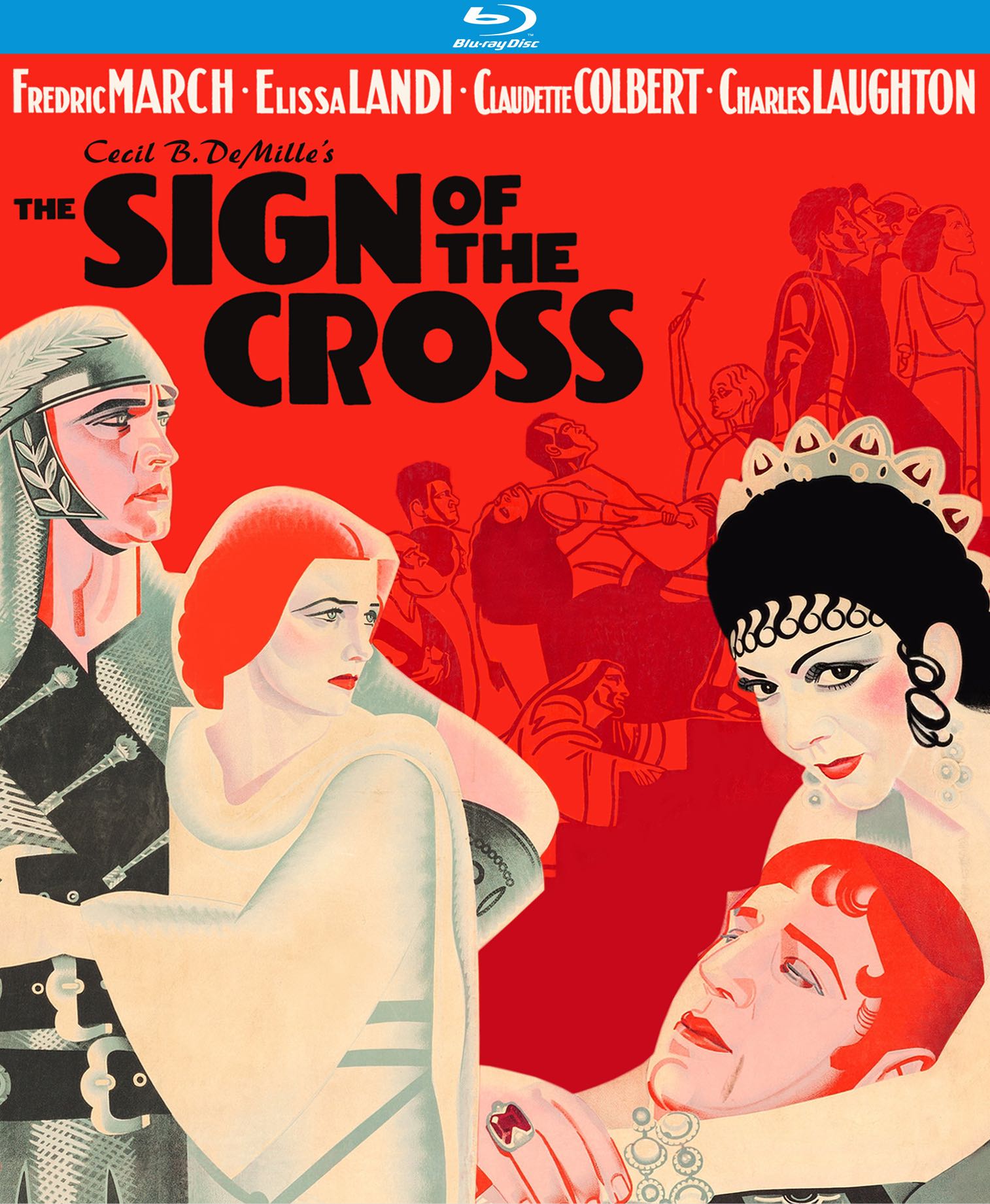
"The Sign of the Cross" (1932)

If you can't see The Sign of the Cross (1932) on the big screen, the next best thing is the new Kino Lorber Studio Classics Blu-ray, in which every lavish detail of Cecil B. DeMille's super-production is shimming in high-def detail. High visual quality is especially important for a director like DeMille who poured every dollar into his shots. If the audience couldn't see it, then it wasn't big enough for DeMille, a director who never did anything small. Born from and for the big screen, he sought to make his movies bigger than anything ever done before. Never one for subtlety, he envisioned spectacles and protagonists larger than the lives and worlds of the spectators in the theater. The Sign of the Cross is perfectly emblematic of DeMille's vision: the drama might be overwrought to the point of corn, but the production design and depictions of Roman debauchery and decadence are unarguably incredible.

"Picture Mommy Dead" (1966)

Kino Lorber Studio Classics's new Blu-ray of Picture Mommy Dead (1966) is a wonderful tribute to its producer and director, the legendary independent filmmaker Bert I. Gordon, who recently celebrated his 98th birthday on September 24th, and whose career spanned over six decades. Dubbed "Mr. B.I.G." by Forrest J. Ackerman both for his initials and his frequent use of XL-sized monsters, Gordon made his mark with a series of low-budget sci-fi pictures including The Cyclops (1957), The Amazing Colossal Man (1957), and Earth vs. the Spider (1958). Gordon's career continued into the 70s including Food of the Gods (1976), and his most recent film was Secrets of a Psychopath (2015).  Picture Mommy Dead features no larger-than-life monsters (though it does take place in a large mansion), however the film displays the director's flair for economical thrills and a cheap but effective sense of style.

"The Ape" (1940)

A decade before Dick Carroll was an editor for Fawcett's Gold Medal line of paperback originals, he co-wrote The Ape (1940) with Curt Siodmak (here credited as Kurt), a classic of Poverty Row horror starring Boris Karloff. Based on a 1924 play by Adam Hull Shirk, the plot concerns concerns a mad doctor, a killer ape, a traveling circus, a paralyzed young woman, and an armed posse. Allegedly written over the course in a weekend (at least that is what Carroll told Peter Rabe), director William Nigh brings in the picture in 62 delightfully breezy, light-heartedly macabre minutes, and now available in a restored Blu-ray from Kino Lorber Studio Classics.

Dr. Bernard Adrian (Boris Karloff), disgraced and outcast because of his experiments with spinal fluid, now practices secretly in a small town. His current patient is a young paraplegic woman, Frances Clifford (Maris Wrixon). When an ape breaks loose from a traveling circus, it severely injures its trainer who is sent to Dr. Adrian. Unable—or, perhaps, unwilling—to save the trainer, Dr. Adrian seizes the opportunity to extract his spinal fluid for use on Frances. Still hunting for its trainer, the ape breaks into the doctor's lab. Adrian defends himself and stabs the ape—but instead of telling the sheriff to call off the hunt for the killer beast, Adrian keeps it a secret in order to pursue his own deadly experiments.

"Hell Bent" (1918)

Hell Bent (1918) is John Ford's second earliest silent feature that survives, and thankfully  it is now available in a beautiful 4K restoration from Universal on Blu-ray courtesy of Kino Lorber Studio Classics. The plot's trajectory is simple enough—card shark falls for good girl; outlaw kidnaps girl;  card shark tries to rescue girl—but it is more of a framework for Ford to create marvelous little scenes that display all the hallmarks of his style: humor, action, and a magnificent eye for landscape. All in all, Hell Bent is a rollicking whirlwind of a western, blending action, comedy, and romance, freely and fluidly shifting between modes.

"Straight Shooting" (1917)

John Ford's first feature film as a director, Straight Shooting (1917), is now available on Blu-ray from Kino Lorber Studio Classics in an unbelievably beautiful 4k restoration from Universal. I never expected to see this movie looking this good. It's always a pleasure to see silent films presented restored so carefully—around 75% of all silents are lost, according to the Library of Congress, including most of the early work of John Ford. Which makes this Blu-ray of Straight Shooting all the more historic and significant. Finally we can see that from his first feature, all the artistic facets of John Ford are already on display. His majestic eye for compositions, a bold use of nature and architecture for framing, an intuitive sense of rhythm for both action sequences and quieter moments of contemplation, moments of near-slapstick revelry, and of course a loner, anti-hero protagonist.

"The Duel at Silver Creek" (1952)

After a three-year absence from the big screen following The Big Steal (1949), Don Siegel returned with his first-ever western, The Duel at Silver Creek (1952), now available in a beautiful Blu-ray edition from Kino Lorber Studio Classics. It is undeniably a Siegel film, with its themes of systemic violence and the thin-lines between organized crime and law-and-order, and with every frame gleaming with his characteristic hardboiled edge and tough-talking sensibility. The script by Gerald Drayson Adams—whose credits include such crime flicks as Dead Reckoning (1947), The Big Steal, Armored Car Robbery (1950), Between Midnight and Dawn (1950), His Kind of Woman (1951)—and Joseph Hoffmana veteran screenwriter from the 1930s—has such a gritty, urban rhythm that, if you close your eyes, you'd think it was a contemporary crime story set in Chicago, New York, or some other big city. The Duel at Silver Creek borrows many story elements from noir, such as the ominous voice-over and the lawman who plays patsy to a ruthless femme fatale. Even Audie Murphy's costume is tinged with noir—even though he's the good guy, he dons a black stetson and back leather jacket, as though to remind of the potential for violene lurking just beneath the surface. As the marshal remarks, “He didn’t have the face of a killer, but he had the cold steel look of one.”

"Ride a Crooked Trail" (1958)

In the 1950s, arguably no studio produced as consistently high quality westerns as Universal. There is a brilliance in their modesty and workmanship—Universal's westerns may not have been super productions, but in the attention to details they achieved a mastery of the form. The writing and editing were as tight as could be achieved, with not a line or a frame wasted, while the direction and photography were elegant if understated. Universal's lineup of western directors included such legends as Anthony Mann, Budd Boetticher, Raoul Walsh, King Vidor, Don Siegel, John Sturges, and William Castle, as well as lesser-celebrated filmmakers deserving of more attention like George Sherman, Lesley Selander, Hugo Fregonese, Jack Arnold, and Jesse Hibbs. It was Hibbs who directed Ride a Crooked Trail (1958), a superb Cinemascope western that is emblematic of the high level of craftsmanship that Universal put into their westerns in the 1950s, and the visual beauty of the film is on full display in Kino Lorber Studio Classics's Blu-ray.

"Red Ball Express" (1952)

Red Ball Express (1952) is a stunning example of a rare breed of movies, transportation noir, alongside Thieves' Highway (1949), The Wages of Fear (1953), Blowing Wild (1953), The Long Haul (1957), and Sorcerer (1977). While its World War II setting might superficially set it apart from its more criminally-preoccupied brethren, Red Ball Express shares with them a similar existential crisis, an almost nihilistic drive towards suicide. Trucking becomes a vessel for bringing out darker impulses in its characters, and for that reason I think it deservedly should stand alongside those other films in the transportation noir subgenre.

Red Ball Express tells the story of a group of soldiers who must create a route through mined roads in order to deliver armaments to General Patton. In order to get all the supplies to him, Lt. Chick Campbell (Jeff Chandler) insists the soldiers drive all day and all night, and turn around on another run as soon as they return. The grueling work tests the limits of his men and pits them against each other, including Corporal Andrew Robinson (Sidney Poitier) who is fighting racism within the unit, and Sgt. Red Kallek (Alex Nicol), who carries a personal vendetta against the lieutenant.

"Raid on Rommel" (Henry Hathaway, 1971)

Hollywood, for a couple decades, engaged in a continuous production cycle of WWII movies. At first it was a contemporary topic, then it was propaganda as part of the domestic homefront effort, and then, after the war was over, it was seemingly an endless well of stories for filmmakers to pull from. Well into the 1960s, WWII blockbusters continued to be massive successes, such as John Sturges's The Great Escape (1963), Otto Preminger's In Harm's Way (1965), and Robert Aldrich's The Dirty Dozen (1967). 1970 was a watershed year for American WWII movies, with Phil Karlson and Franco Cirino's Hornets' Nest, Mike Nichols's Catch-22, Brian G. Hutton's Kelly's Heroes, Franklin Schaffner's Patton, the international co-production with Japan Tora! Tora! Tora!, Paul Wendkos's Hell Boats, Robert Aldrich's Too Late the Hero, Jerry Lewis's Which Way to the Front, The Last Escape, and Underground.

Raid on Rommel (1971) was released at the tail end of Hollywood's WWII cycle. It was the only American WWII-themed movie produced that year, and none would be produced until Operation: Daybreak (1975). Hollywood was by no means done with WWII movies, and they continue to produce such movies to this day, but Raid on Rommel marked the end of an era in which WWII was a dominate topic for Hollywood cinema.

Despite being a late entry in Hollywood's WWII cycle, Raid on Rommel still feels fresh, exciting, and singular, and it manages to distinguish itself from its predecessors through its unique narrative construction. Unlike most mission-based movies that begin with a goal and then base their story around the attempt to achieve it, Raid on Rommel begins by disrupting the plan and plunging its characters into uncertainty.

Captain Alex Foster (Richard Burton) lays into the Libyan desert pretending to be injured so that he can be captured by German soldiers. He is expecting the Germans to be transporting a commando unit that he can partner up with and find a way to sabotage Rommel's forces at Tobruk; instead, he finds that his fellow prisoners are a medical unit that hasn't been trained in combat. Thus begins a series of struggles: can Foster and the medics overpower their captors; if so, are the medics capable of infiltrating Rommel's entire tank corps at Tobruk; and just how, exactly, can they sabotage Rommel so that the Allies have a chance of invading? The script is the only feature film written by Richard M. Bluel, a prolific television writer of the time, but Bluel succeeded in writing an unconventional yet still thrilling story.

Directing the picture is Hollywood heavyweight Henry Hathaway, who got his start directing B-Westerns forty years earlier. From his early Randolph Scott films like To the Last Man (1933) and Man of the Forest (1933) to mid-career films like Rawhide (1951) to late films like True Grit (1969), Hathaway always had an eye for the great outdoors, an affinity for rough, hard-lived characters, and an instinct for tense stories of physical struggle. Raid on Rommel displays all of Hathaway's hallmarks: an unsentimental, hardboiled sensibility; a highly pragmatic story acted out by rugged characters; and a pitch-perfect eye for capturing natural landscapes.

Kino Lorber's Studio Classics Blu-ray is, as usual, a spectacular presentation, with smart commentary by Steve Mitchell and Steven Jay Rubin, and an interview with Clinton Greyn, who played medical officer Major Tarkington.

"She Should'a Said 'No'" (Sam Newfield, 1949)

She Should'a Said 'No'
(1949) is vintage exploitation cinema at its finest, starring a talented actress (Lila Leeds) that should have had a much bigger career, and directed and photographed by two of Poverty Row's most prolific and capable craftsmen (director Sam Newfield and cinematographer Jack Greenhalgh).

The story is about a model who is working to put her brother through college, and how smoking marijuana destroys her personal and professional life and lands her in jail. Not coincidentally, this story bears a great deal of similarity to the real life of its star, Lila Leeds, an aspiring actress who was arrested on marijuana charges when cops busted a party that she and Robert Mitchum were at. But while Mitchum was able to resume his career after he got out of jail, Leeds's career never recovered. This was the only role she could land, and it wound up being her last film. In true exploitation style, the film was even distributed briefly as The Story of Lila Leeds and Her Exposé of the Marijuana Racket in order to cash-in on Leeds's scandal (the film was also distributed as Wild Weed and The Devil's Weed).

Kino Lorber's Blu-ray presents an astonishingly clean print and reminds of the visual artistry of exploitation films that is often overlooked. I'm so used to seeing these sorts of films in such shoddy, scratchy prints that I forgot how cinematic they can actually be, and She Should'a Said 'No' is actually quite beautiful at moments, displaying expressionistic touches in its use of shadows and montage.

Behind the camera were the team of director Sam Newfield (using the name "Sherman Scott") and cinematographer Jack Greenhalgh (who photographed that other weed cult classic, Reefer Madness). Newfield and Greenhalgh each eventually racked up over 200 credits during their career, over half of which were done as collaborations. They were all B-pictures, mostly distributed by PRC, but they are some real gems in that bunch, including His Brother's Ghost (1945), a Buster Crabbe western where Fuzzy St. John takes the lead and pretends to be his twin brother's ghost. She Should'a Said 'No' presents Newfield and Greenhalgh at their best: more than capable craftsmen with a stellar command of economic film-making techniques.

Even in its day, She Should'a Said 'No' was appreciated more for camp than its message at midnight screenings, and over seventy years later it still provides an evening's worth of pulpy entertainment and a terrific cast that includes bit parts by Hollywood stalwarts Lyle Talbot as a cop and Jack Elam as a drug dealer's thug, as well as a lead performance by Leeds that hints at greater roles that she could have—and should have—had. Maybe it's just me, but even at the film's conclusion, when everything is wrapped up nicely, there seems to be something behind her smile that knows she wouldn't get such a happy ending in real life.

Kino Lorber's Blu-ray includes a bonus feature, The Devil's Sleep (1949), that will be reviewed separately. More exploitation adventures to come soon!

"Knives of the Avenger" (Mario Bava, 1966)

Kino Lorber's on-going commitment to presenting the films of Mario Bava on Blu-ray is revelatory, displaying the Italian director's work in all of their visual majesty. Even a film like Knives of the Avenger (I coltelli del vendicatore, 1966), not heralded as one of Bava's masterworks, is simply stunning to behold. It was made right in the middle of his career as a director, in between his early career-defining hits and late-period masterpieces: behind him were Black Sunday (1960), Black Sabbath (1963), The Girl Who Knew Too Much (1963), The Whip and the Body (1964), Blood and Black Lace (1964), and Planet of the Vampires (1965), and still to come were Danger: Diabolik (1968), Five Dolls for an August Moon (1970), Hatchet for the Honeymoon (1970), Bay of Blood (1971), Baron Blood (1872), and Rabid Dogs (1974). Though he is best known for his horror films, Knives of the Avenger is not the only Viking film that he made; five years earlier he made Erik the Conqueror (Gli invasori, 1961), which also shared the same star, Cameron Mitchell.

A cinematic Poe, Bava was a poet with the camera, and his dynamic yet sensitive compositions captured the essence of the fantastic and the uncanny—both the allure as well as the grisly aspects of horror—and in Knives of the Avenger, Bava shows he's equally adept at capturing the serene beauty and the brutality of a viking revenge story. A muted palette of dull tans, grays and blues—beaches at dusk, the insides of huts and caves shrouded in darkness—is punctuated by deep greens and bright reds—lush forests, vibrant hills of grass, and of course the hellish hues of first and blood, without which no Bava film would be complete.

Filmed in Techniscope (a budget anamorphic alternative to the most well-known Cinemascope), Knives of the Avenger is a cinematic contradiction: an epic expressed as a chamber drama mainly due to economic constraints. As Bava biographer Tim Lucas explains in his characteristically detailed and illuminating commentary, Bava took over production from another director and had only a handful days to re-write the film, choosing to scrap most of what had been completed and start fresh. The resulting film was, as Lucas called it, a Viking version of Shane, in which a man longs to escape his violent past by joining a family, however his need to protect the family means he cannot forget his roots.

In Knives of the Avenger, a wandering, knife-throwing warrior, Helmut (Cameron Mitchell), approaches a farm and meets a Karin and her young son, Moki, whose father, Aarald, is away on a journey. Hagen, a ruthless warrior whose recklessness sent the region into warfare years before with rival warlord Ruric, has returned to capture Karin. He sends a band of soldiers to kidnap Karin and Moki, but Helmut intervenes to save them. What unfolds is a like a Shakespearean tragedy: Ruric longs to atone for past sins by protecting Karin and Moki, Hagen longs to steal Karin from her husband, and Aarald has vowed to kill the warlord Ruric who raped Karin and murdered his father, the former King.

I watched the film twice—first in Italian with English subtitles, and then a couple days later with Tim Lucas's commentary. The first viewing was enjoyable—Bava's visual style is always a treat for the eyes, and I found myself immersed in the film's reserved tone, solemn and grim—but the second viewing was particularly eye-opening. From the first scene, Lucas reveals artistic touches that linked the film with others throughout Bava's career, as well as highlighting subtleties in the composition, lighting, acting, and script that deeply enriched my experience, in addition to providing contextual histories about the production and the people involved.

While it might be minor work, Knives of the Avenger is nonetheless a prime example of his artistry and economy, and it is a testament to his vision that he was able to imbue such a hasty project with such personal details and dramatic depth. 

"The Town Square" by Orrie Hitt (Swank, May 1964)

"The Town Square" is one of the few known short stories published by prolific novelist Orrie Hitt, and it appeared in the May 1964...