Showing posts with label Keith Rawson. Show all posts

"30 Days of the 5-2" Keith Rawson's "$25"

First off, big thanks to Gerald So for his tireless devotion to supporting noir poetry, and for inviting me to blog as part of "30 Days of the 5-2" crime fiction poetry tour.

When he asked me to pick a poem to write about, I didn't have to think twice.

Keith Rawson's "$25"

Keith has long been one of my favorite new writers, and his stuff keeps getting better over the years. It's dark, twisted, psychotic, warped -- but also funny as hell, and deeply moving. There's a sadness and grim reality at the core of his writing that just rings so true. There's something genuine to the pain in his writing. Keith doesn't write fantasy. Even when the violence is on the fantastic side, the emotions and social circumstances driving the characters are very real.

His poem "$25" really resonates with the current economic situation in America. It's about someone donating plasma. Not out of good will, not to feel better about themselves, and not to help someone else -- but just to get by.

I'm too lazy to work
for $7.50 an hour
rent is
due

in two weeks

and giving blood is easier
than sticking a gun
in someone's
face.

That last stanza is cold. There's no love for humanity, no generosity, no hope. Like Tom Piccirilli with Every Shallow Cut, Rawson takes his main character to the brink of a crime, and leaves him there. Something might happen -- but it hasn't yet. If it doesn't, we're not going to be surprised, nor would we really blame him.

Look at the way that "in two weeks" is offset from the rest of the poem. There's still more time for things to get better, or for things to get worse, for desperation to take hold.

It's the resonance of worse things to come that makes "$25" so damn chilling.

Keith, I'm a big fan of your short stories, and I'd love to see a full-length novel by you, but if all your poems are this good, get back to the keyboard and bang out a chapbook of noir poetry asap.

Follow the rest of "30 Days of the 5-2" here.

New Story in Crimefactory 3.5

If you haven't heard the good word of the day, it is that Crimefactory 3.5 is finally live!

Keith Rawson, Cameron Ashley and Liam Jose are up to no good again, this time serving up an all-fiction issue with 12 all new stories. I feel honored to be among this issue's lineup with my story "Pursuit," and I have to say that I am both floored and humbled by the other writers included. One of my favorite short story writers Jason Duke is on the rampage again, this time with "Guns, Drugs, and a Shitload of Blood." Eric Beetner, who was previously interviewed here on Pulp Serenade, is on board with "Sins of the Father." Edgar, Anthony, and Macavity nominee Sophie Littlefield opens the issue with "Five Ways Your Mom Was Worse Than You'll Ever Be." The Night Editor himself, Jake Hinkson, appears with "A Cold Night in Murder City." New Pulp Press' Jonathan Woods has "The Old Man."

That's already one hell of a lineup, but that's only half of the loot from this big score. John Kenyon has "Clean Up," Garnett Elliott brings "The Darkest of the Debbies," Jay Stringer gives us "A Bullet for Bauser," Robert Crisman has "A Date With Gentleman Freddie," Julia Madeleine contributed "Stalker," and Naomi Johnson closes the issue with "The Persistence of Memory."

That's over 100 pages of hard-hitting crime fiction. Get yours for free here (available in both PDF and Kindle editions).

Crimefactory Interview with Keith Rawson

The second coming of Crimefactory is now in its second issue. Once again, its lineup is enough to make Ellery Queen (or any other magazine) drooling with envy. 126 pages filled with people like Craig McDonald and Charlie Stella (who interview each other about their new books), Reed Farrel Coleman on his roots as a writer, Jimmy Callaway on William Lindsay Gresham (of Nightmare Alley fame), stories by Patti Abbot, Kieran Shea, Ray Banks, and Stephen D. Rogers (who recently stopped by Pulp Serenade on his blog tour for Shot to Death). And there’s a heck of a lot more. But, before you get your ass over to Crimefactory, check out a recent conversation I had with one of Crimefactory’s editors, Keith Rawson. An original and uncompromising writer in his own right, Rawson has made numerous appearances here on Pulp Serenade with own twisted tales. Stories like "What I Lost Along With My Keys" and “Marmalade” are as noir as they come.

Pulp Serenade: You’ve been a busy man lately—BSC Review, Spinetingler, Bloody Knuckles, Callused Fingertips not to mention your own stories. And now Crimefactory. How do you even find time for everything?

Keith Rawson: It’s time management more than anything else. I have days set aside when I work on certain projects and I don’t deviate from those days unless it’s something out of the ordinary like a video interview I have to conduct, or a family holiday or event. Plus, when you get into the habit of writing every day, it does become addictive and if I skip a day, I feel guilty about it. But you know what, I’m having fun. I love it that I have so many forums like BSCreview and Spinetingler available to me to promote crime fiction. 


PS: What was the impetus for reigniting Crimefactory with your co-conspirators Cameron Ashley and Liam Jose?

KR: It all started on Twitter. Cam and I had known each other for awhile from appearing in various online zines like A Twist of Noir and Plots with Guns and the two of us would goof around a lot on Twitter and then one night Cam started updating his status as Crimefactory. I knew Crimefactory’s history and owned a couple of back issues from the original run. It was an impressive publication and I asked Cam what he was thinking about doing. We started Direct Messaging and then e-mailing about possibly reviving the magazine, but doing it online instead of as a print publication. We were both really worked up over it, so we started working on the revival. Of course, we both wanted the blessing and assistance of the publisher of the original magazine, David Honeybone, before we went full bore into the project. At first, David was very excited about the revival, but then he started getting discouraged due to some personal issues and backed out of participating in the magazine. Dave dropping out of the project was pretty devastating for Cam (who could blame him?) and we almost didn’t move forward. This would’ve sucked because I’d already lined up all of the fiction contributors for issue 1 and most of issue 2 (Steve Weddle and Frank Bill had even sent their stories in already). Luckily, Cam got over it pretty quickly and we were in business.

With Liam coming on board, I’m pretty sure Cam grew Liam in a test tube by combining the DNA of Salvador Dali and a 1970’s pornstar…but where ever he came from, he’s been a real boom for the magazine. Liam has a fantastic eye for design and layout, and the man has become the key component to Crimefactory.


PS: The war of e-readers is still going on, and since Crimefactory is available in several formats (PDF, Kindle, Nook, and Sony Reader), I was wondering what your take on the issue is. Do you own an e-reader? What format are most people getting Crimefactory in?


KR: You know, I think the whole e-reader wars are pretty exciting. It’s got people talking about and buying books and other electronic content like Crimefactory. Personally, I think it’s a great time to be apart of publishing, especially if you’re a small independent who wants to increase their reader base. I don’t think e-readers will ever replace traditional books (at least I hope it doesn’t) but it does open a lot of new doors.

I don’t own an e-reader. I have an iPhone and have all of the e-reader apps on my phone (I use Kindle the most because of the range of content available) and actually use it quite a bit.

And it shouldn’t be t a surprise to anyone that the free PDF is the way most people read the magazine. With the debut issue, the site received close to 500,000 unique visitors over two months—if you listen to Patti Abbott she’ll tell you that she’s responsible for half of the visits—and we’re trending towards the same amount of traffic since the release of issue #2.
The Kindle editions are selling well, but we’re not exactly making mega bucks off of it. The real benefit of having an e-reader edition is that the content will never disappear. As long as Amazon and Smashwords (who we distribute the nook/Sony reader edition through) are around, people will be able to go to these sites and download the back issues even if the website is no longer in existence (which isn’t going to happen for a very long time.)

PS: Considering the success of Crimefactory, this question seems unavoidable. Have you thought about expanding into print at some point, or are you planning on sticking with digital formats?

KR: Well, I was trying to keep it under wraps, but Jed Ayres let it drop that we’re working on an anthology with New Pulp Press. The project has got me pretty damn excited. I really like Jon Bassoff (Publisher/editor of NPP) and I think the press has the potential to really shake things up in the publishing world. I’m not going to go to deep into our contributors list, but we have some great writers appearing in it and much like the magazine, we’re trying to have a very international flavor to it and mix both experienced, well known authors and less established, newer writers

As far as becoming a regular print publication, I considered it for a couple of weeks as we were finishing up the final edit of issue 2, but then I decided to leave it alone. Don’t get me wrong, I have tons of respect for what Crimespree, Hardboiled, and what Steve Weddle and John Honor are going to be doing with Needle magazine (I’m also very proud to be part of the debut) but I don’t think print format is for Crimefactory. So for the time being, I think we’ll stick with being an electronic publication.

PS: One of the things I love about Crimefactory is its lineup—it’s a very democratic mix. You have people like Craig McDonald and Reed Farrel Coleman next to up-and-coming writers, our new favorites of tomorrow. What is the process like for collecting all the content for the magazine?

KR: When I started recruiting contributors for the magazine, I had an overall vision that I wanted to mix well known writers with newer ones. As a writer, there was no greater thrill for me when Anthony Neil Smith published issue #7 of Plots with Guns and I found out I would be publishing along side Scott Phillips and Stephen Graham Jones. The Walkaway by Phillips is in my top five all time favorite crime novels, and Stephen’s thriller, All the Beautiful Sinners, is a flat out masterpiece of the genre in my opinion. I nearly flipped my wig! Little pulp writing me is appearing with these two incredibly gifted, renowned novelists. And when I started searching out contributors, I really wanted to provide the same feeling to other new writers.

Now, as far as searching out contributors, well, if I read and enjoyed a writer’s books or stories, that writer got an e-mail from me inviting them to submit a story to Crimefactory. To my surprise, 90% of the writers I contacted said yes, 9% said no because of scheduling issues and novel deadlines, and an elusive 1% were just dicks and never responded. But I’ll still e-mail the dicks again, because I like what they’re writing. With features, I’d really like to see the number of these types of submissions increase. I love noir and hard-boiled scholarship and what we’ve run so far has been really innovative and well written, but we need more of it!


PS: On Facebook, we were talking about how certain website archives have recently closed and lots of stories were lost. The presumption is that once it is online is there it is there forever, but this clearly is not the case. Is this making you rethink the website (or even how to archive your own stories online)?

KR: Yes. Now, it is true that nothing online ever disappears, but data does degrade. My overall thinking lately has been to use organizations like Amazon and Smashwords to archive stories. With as wide spread as the Kindle application has become—you can download it to your PC, Mac, iPhone, and other smart phones, plus the reading devices themselves—I’d like to see more writers utilize the e-book tools available to them to make their collected stories online as an e-book. And they don’t have to charge for them—for instance, with what I’m trying to do with the Pulppusher stories and features—along with archiving them on the Crimefactory site, I’m going to compile them into a free e-anthology so that the stories, in one form or another, will be available for the reading public.

PS: You mentioned an all fiction issue coming up—anything else you can leak about that?

KR: Yeah, we’re calling it issue 3 and a half and will appear in June. We’ve got a ton of really great stories appearing in it. That’s all.

PS: Now that you are doing a lot more editing, do you see it influencing your writing styles or habits at all?

KR: Oh yeah. It used to be I would do nothing but churn out story after story (I still kind of do) and not really be too concerned with little mistakes. But, as I’ve come to find out, the little mistakes make a huge difference on how a story reads. So with the current crop of pieces I’m working on, I’m checking and re-checking all the little things before submitting them. Of course, I’m only human and mistakes are bound to happen.

PS: As for Rawson-the-writer, what’s up next for him?

KR: Oh, you know, writing novels and trying to sell novels. Writing stories and trying to place them. Writing reviews and interviews for Spintingler and BSC. Posting to the blog occasionally, working on Crimefactory. 2010 started off great and I’m anticipating that it’s only going to get better. At least I hope so?

PS: Lastly, what books should the rest of us be adding to our To Be Read piles right now? Any top picks for 2010 so far?

Damn, there are a lot of them.

With stuff that’s already come out in 2010, everyone should read Wake Up Dead by Roger Smith. I can’t say enough good things about this novel. I really enjoyed Print the Legend by Craig McDonald, very fast paced and McDonald’s most complex novel to date. A Choice of Nightmares by Lynn Kostoff, which was recently reissued by New Pulp Press, has been a big favorite of mine this year, equally funny and menacing, plus Kostoff is a hell of a writer.

Now as far as upcoming novels:

Expiration Date (which isn’t upcoming considering that it was released March 30th) by Duane Swierczynski was a fun read. I’m fairly convinced that Duane is absolutely incapable of writing a bad book. Johnny Porno by Charlie Stella, great period piece, Charlie’s really got the 70’s down pat. Jonathan Woods’ debut collection, Bad Juju and other tales of Madness and Mayhem has really impressed me. Killer by Dave Zeltserman. Wow. I’m not kidding, great fucking book. The Wolves of Fairmount Park by Dennis Tafoya. Tafoya is the next Pelecanos and I don’t say that lightly. Great writer. A Bad Day for Pretty by Sophie Littlefield. Sophie’s the real deal, very fluid writing style.

Oh, and so many more…Honestly, some days I wish I could do nothing but read.

And as far as top picks, see all of the above.

Stories for Sunday: Mega Catch-Up Edition

Work and other projects have side-tracked me from Pulp Serenade the past couple of weeks. In fact, it wasn't until a couple of days ago that I actually managed to find time to do any reading for myself. But -- last night on the job was kind of quiet, so I got some time to finish the book I was reading, so I promise a new review ASAP, and some other goodies coming up. And since I missed last week's Stories for Sunday, here's a Mega Catch-Up Edition will all the good stuff that's been going on during my absence.

First up is Nik Morton's "I Celebrate Myself" over at Beat to a Pulp. A couple months back I featured Morton's story "Spend Now, Pay Later" (which if you haven't already read, then take a break, read it, then come back). What both stories share is a keen awareness of social and economic plights that are empathetic rather than didactic, as well as a brooding anxiety over the fate of the next generation. In Morton's latest story, a police officer is called to dig through a trash compactor in the projects after someone claims to have heard a baby crying inside. Vividly caressed details make the characters and situation all the more real and relatable.
"The stench was overwhelming, a mixture of mildewed fast-food, feces, rotten fruit, used sanitary towels, crumpled tabloid sheets of the New York Daily News and God knows what. I gagged and fought back the bile that threatened to lead a revolt of my stomach as I crawled over trash in the shadows. If my husband could see me now, he'd have a fit."

Read Nik Morton's "I Celebrate Myself" here at Beat to a Pulp.

Speaking of Beat to a Pulp, Patti Abbott had a story there last week, "Esther Meaney," and it's really terrific (and we'd expect nothing less from her). In just the first paragraph of the story, a perceptive sentence like this reveals a world of pained memories outside of the story: "If other women took a baseball bat out of the basement when their husbands were away, Mom put hers down after Dad left." Reticent details like these are one of Abbott's specialities, and say more than a page full of labored lists ever could. Her latest story is about a twelve year old boy who gets a new babysitter, Esther Meaney, who surprises him by guzzling bourbon, chain-smoking cigarettes, reading comics – oh, and she robs convenient stores as well.
"Sometimes," she began, "a girl's got to do things she'd rather not." She looked at me closely. "Just to survive, that is."
Read Patti Abbott's "Esther Meaney" here at Beat to a Pulp.

You've heard me rave about Keith Rawson's stories before, and as long as he keeps pumping out stories I'll continue to push there here at Pulp Serenade. He has a new one over at A Twist of Noir called "What I Lost Along With My Keys" about a real estate salesman and his recently out-of-work wife and their growing estrangement. It's as bleak as it is hilarious, and everything comes to screeching, devastating, face-slapping halt in the last three paragraphs. I won't ruin Rawson's carefully orchestrated effect by telling you anymore, but I do want to quote one of the many pants-pissing funny moments in the story:
"I thought about buying her puppy, but I figured she’d end up drowning it in the bathtub in a fit of rage the minute the little furball took a dump on the carpet and would beat me unconscious with the corpse the second I walked through the front door; so I scratched the idea entirely and let her stew in her own juices."
Read Keith Rawson's "What I Lost Along With My Keys" at A Twist of Noir.

Another Pulp Serenade regular, Paul D. Brazill, has served up another of his specialties over at Blink Ink. This one's called "Bang!" – true to its title, it's a quick shot of Brazill's characteristic wordplay. Sometimes all you need is just 37 well-picked words.

Read Paul D. Brazill's "Bang!" here at Blink Ink.

Stories for Sunday: Rawson, Hinkson, and Brazill

Taking a nap after work on Saturday night is definitely not a good idea – nearly 5AM and I’m wide awake. Good thing the internet is abuzz with some crazy stories, and now I finally have the time to catch up with them. This week’s edition of Stories for Sunday is bigger than normal – three stories coming your way, two hot off the press and one classic.

First thing is first. Keith Rawson’s “Marmalade” over at Beat to a Pulp. I don’t know what sort of deranged rays are in that Arizona sun, but lets hope Keith keeps getting more of them. This might be his best yet – the story of the recently paroled Tom Shepard, who has exchanged life behind bars to life with his vegetable father and nagging mother and picking up dog shit off the front lawn. Life sucks just a little less than before, which should be an improvement. But then Tom starts hearing voices from his supposedly catatonic pops – and that’s where I'll stop the synopsis. Rawson takes the story in some wild and unexpected directions, reigning it all in for a gonzo finale that would do any of Jim Thompson’s warped protagonists proud. Seriously dark and funny as hell – a must read.

“He finally flashed on the face of the girl gritting her teeth, tears and terror sweat streaking her mascara, smudging her makeup. His stomach lurched into his throat; yellow bile burning his nostrils and mouth with memory.”

Read Keith Rawson’s “Marmalade” here at Beat to a Pulp.

Speaking of Beat to a Pulp – as if we needed one more reason to love that site, here’s a gut-punch from their archives, Jake Hinkson’s “Maker’s and Coke.” Officer Lowell has come to an unpleasant realization “This life is a faithless whore.” Unable to get Ellie off his mind, he buys a bottle of Maker’s Mark and Coke and locks it in his trunk before going on duty. But the thoughts of her just won’t go away, so he has a drink, which leads to two, and before he’s knows it he’s lost count. And things only get worse when he stumbles upon a robbery-in-progress. Hinkson writes about cinema and film noir over at his site The Night Editor, and you can get a sense of that cinematic sensibility in this story. The whole thing unfolds like some devastating finale, filmed in the bleakest black-and-white hues possible.

“Once I thought about it, I realized no one else loved me, either. I sat there and considered it. There was no one left on this earth who loved me. That wasn't self-pity; it was math.”

Read Jake Hinkson’s “Maker’s and Coke” here at Beat to a Pulp.

Topping off this triple bill is the latest from Paul D. Brazill “A Cold Day In Hell,” published over at Blink Ink. Brazill edits like no one else around, refining and condensing stories to their bare essentials. Embracing brevity, his stories are highly evocative, suggesting images and scenes that go beyond the bounds of the words on the page. Just take a look at the fifty words that comprise “A Cold Day in Hell” and you’ll see what I mean.

“The January night had long since waned when Nathan blasted Oliver’s brains over the snow covered street…”

Read Paul D. Brazill’s “A Cold Day in Hell” here at Blink Ink.

Stories for Sunday: Martin De Leon and Keith Rawson

I'm hoping today will be a productive day (it better be, as I have lots of work to catch up on) so, as always, I'm starting the morning by appreciating the accomplishments of others. Today's edition of Stories for Sunday is a double-feature.

First up is Martin De Leon's "1986," which was published over at Block Magazine. It's a dark story, but not about the typical crimes you might read about on this site. The crimes in De Leon's story are the ones that leave only victims and no villains: life's merciless disappointments and tragedies. The main character, Catarina Fernandez, is walking home in the rain and engages in seemingly meaningless chit-chat with her neighbor, Villoro – but even this quotidian conversation is weighted down by Catarina's deep sense of loss.

Her window screen couldn’t stop Catarina from overhearing. She stopped trying to close the window and thought about running out in the rain and shoving the water hose down Villoro’s throat.

And then she thought of her daughter again. The rain had taken her.

Click here to read Martin De Leon's "1986."

Next up is the latest from Keith Rawson – a vicious, searing piece called "The Blood, the Shattered Glass and All the Rest" published over at The Flash Fiction Offensive. Rawson, like De Leon, is investigating the unbearable pressures of everyday life, the sort that drive you over the edge and leave you with no alternatives. Even its title seems to be a bleak summation of existence, just like Jim Thompson's "This World, then the Fireworks." In Rawson's story, a cop returns home to find that his wife has decided for him that he's going to quit drinking. He begrudgingly plays along, but soon work and home-life begin to wear him down, and the itch to drink starts to return...

I wanted a beer; I wanted to drown in oceans of it.

Click here to read Keith Rawson's "The Blood, the Shattered Glass and All the Rest."

And be sure to check out both of these authors' websites, links below:
Martin De Leon's Pop, We Will Eat Your Brains and Keith Rawson's Bloody Knuckles, Callused Fingertips.

Stories for Sunday: Brazill, Brown, and Rawson

One degree shy of 90 here in Brooklyn this morning - perfect weather for murder, counterfeiting, and arson - right? Well, the protagonists in these three stories don't fare so well as they hoped. So, grab a cold drink, turn on the fan (or AC, if you're lucky enough), and enjoy the stories.

1) "In the Shower, Thinking" by Keith Rawson. Originally published at A Twist of Noir, Rawson's story was the winner of their March contest - and rightfully so. A couple of guys from the office plot to drive a co-worker "postal" in attempt to gather fame and fortune for themselves. But driving a man crazy is hard work, and insanity can be rather contagious...

2) "This Old House" by Paul D. Brazill. The only thing better than finding a writer you like is to find one so prolific as Brazill. His latest, published at Thrillers Killers 'n' Chillers, follows a man down on his luck whose bright idea - burning down the house - isn't as uplifting as he hoped.

And finally, a classic:

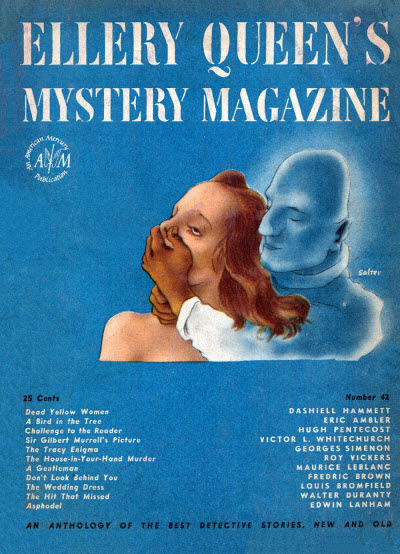
3) "Don't Look Behind You" by Fredric Brown. A small-time printer hooks up with a con-artist to start a counterfeiting operation. Things go awry, and both the police and his irate cohorts are after the phony plates - only the printer has something else on his mind: revenge. Originally published in the May 1947 issue of Ellery Queen Mystery Magazine.

Image courtesy of Galactic Central.

Stories for Sunday: Paul D. Brazill, Gary Dobbs, and Keith Rawson

It’s the end of “one of those weeks,” so I decided that this week’s edition of Stories for Sunday needs to be extra strong. A single shot wouldn’t do, nor would a double. So here it is – a triple shot of noir, three glasses of bleak poetry and macabre humor from three stellar writers: Paul D. Brazill, Gary Dobbs, and Keith Rawson. They’ve all been encouraging supporters of Pulp Serenade from the start, and they truly make the blog world seem like a real community. It’s always a pleasure reading their blog updates and their latest stories.

Line up the shots and get ready. Here are the stories.

1) “Loose Ends” by Gary Dobbs (A Twist of Noir #050). Frankie just stepped into the bar to drown his sorrows in a few (or maybe more than a few) drinks. He didn’t plan on witnessing a murder – or on recognizing one of the hitmen. This story represents the quintessential noir universe: merciless, coldly brutal, and not without an ironic sense of humor that always puts you behind the eight-ball. And none of this is lost on our antihero: reflecting on a fellow bar patron, Frankie thinks to himself, “No doubt he has a story just as I have a story but no one gives a fuck.”

2) “Pervert #16” by Keith Rawson (Powder Burn Flash #159). Talk about the world having a cruel sense of humor…the two teens at the center of Rawson’s story take others’ weaknesses and exploit them to their full advantage. They lure in lurking lechers and give them a surprise they’ll never forget. Rawson’s characters are scarily vibrant, their actions uncomfortably realistic – it’s a marvelously well-crafted story, one that is sure to disturb and fascinate at the same time.

3) “Swamplands” by Paul D. Brazill (Flashshots). Brazill’s flashfiction recalls the dark, twisted humor of Fredric Brown. In only 99 words, Brazill’s deft but evocative prose conjures up a noir nightmare in which the character’s past (literally) won’t let go of him. With the first line we are knocked straight into the noir paradigm: “Elvis awoke in a cold, dank sweat, hungover from bourbon and bad dreams.” Of course, in the world of noir, waking-up is no guarantee the nightmare will end. This is something Elvis must learn the hard way.

Be sure to check back with these authors often. I’m looking forward to reading many more of their stories. And in the case of Gary Dobbs, his first novel is set to come out this summer – The Tarnished Star under his penname of Jack Martin. Click here to order the book.

"A High School Rifle Club" by Orrie Hitt (New York State Education, May 1934)

As a teenager, Orrie Hitt not only wrote for outdoors publications like Hunter-Trader-Trapper  and Fish-Fur-Game , but he was also an office...