

"The Eagle and the Hawk" (1933)

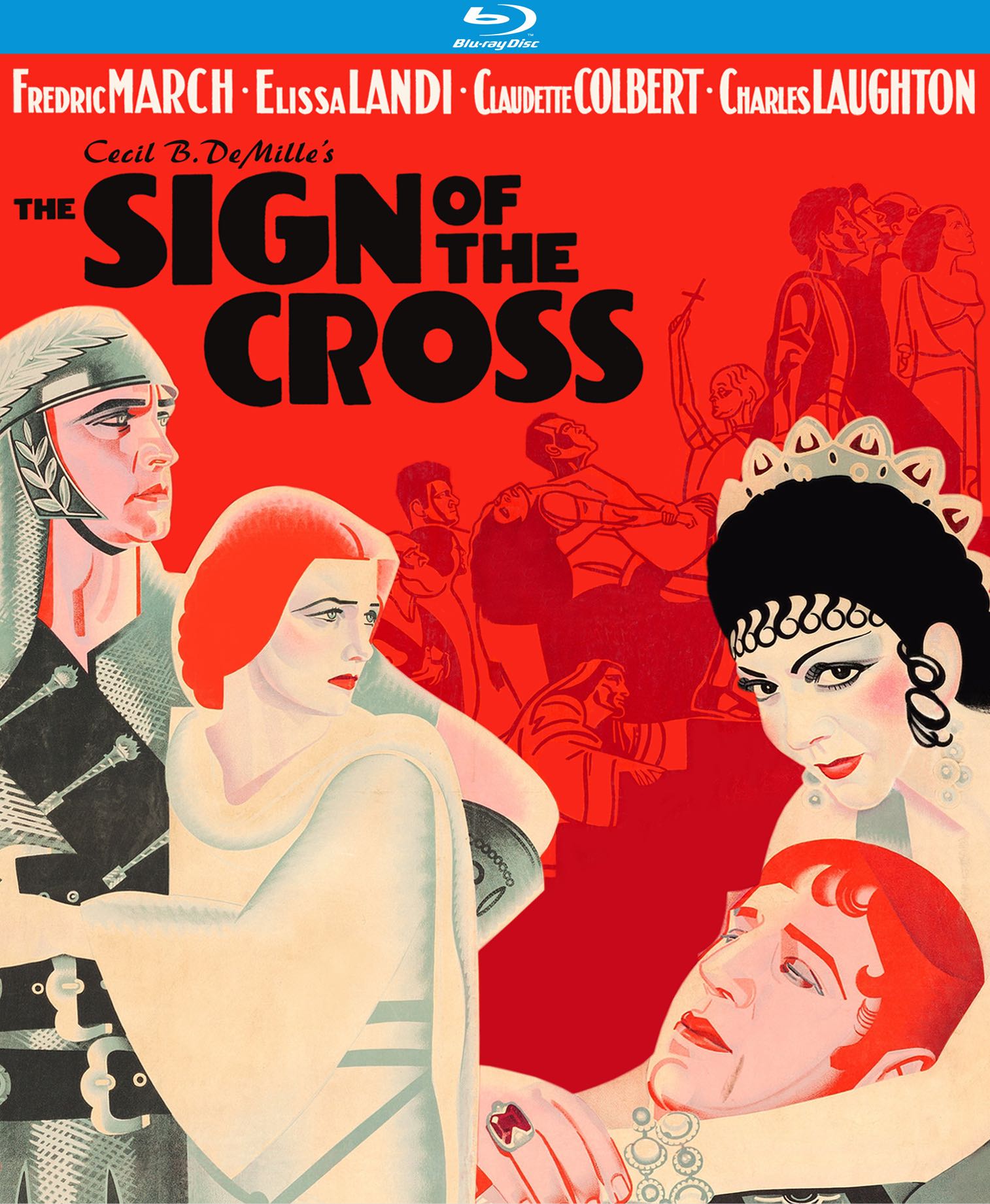
"The Sign of the Cross" (1932)
"Picture Mommy Dead" (1966)

"If the Coffin Fits" by Day Keene (1952) - FFB

Keene's choice of reviving Doyle during his paperback period is really interesting, as Keene's novels tended to focus on average joes who, through extraordinary circumstances, have to prove that they or their spouse is innocent of murder. Considering the popularity of private eyes in paperback fiction at the time, perhaps Keene was hoping a publisher would latch onto the character for a series. Doyle's description as a World War II vet with premature white hair and blue eyes, in fact, reminds of another popular series private eye of the time: Richard Prather's Shell Scott. Scott's white hair and blue eyes graced the cover of scores of Gold Medal paperbacks in the 1950s (and beyond). The similarities stop there, however, as Keene's prose is decidedly less animated than Prather's.
"The Case of the Bearded Bride: Day Keene in the Detective Pulps, Vol. #4" (2013) - Short Story Wednesday

"Kings of Midnight" by Wallace Stroby (2012)

"Mrs. Homicide" by Day Keene (1953) (FFB)

Connie Stone, wife of New York City Cop Herman Stone, wakes up naked in bed next to a dead man she claims to have never seen before. Witnesses, however, say they have seen her with the man, a blackmailer named Lyle Cary, at his apartment, as well as in bars around the city. Some of Herman's co-workers even saw them together. They tell him that all women are alike, and that he should get drunk, have a weekend fling, and forget about his wife. He tries that—but he wants to believe her, so he starts asking questions around town, from Greenwich Village to 52nd Street's Swing Alley. Just when he thinks he has found the answer, someone saps him on the head, and he wakes up next to a corpse. Just like his wife did. Now the cops are after him, and he knows that Connie was framed, but in order to prove her innocence he'll first have to prove his own.
"Death March of the Dancing Dolls and Other Stories, Day Keene in the Detective Pulps, Vol. #3" (2010) - Short Story Wednesday
 Ramble House's Death March of the Dancing Dolls and Other Stories, Day Keene in the Detective Pulps, Vol. #3 (2010) starts off with an introduction by the late Bill Crider, a superb writer and generous soul whose enthusiasm for old pulps and paperback novels was as infectious as it was enlightening. For me, this introduction had extra special meaning because Crider's blog posts were some of the earliest writings that I encountered about Keene. Reading his words brought a smile to my face, and recalled memories of reading about Keene on his fabulous blog.
Among the selections here are two stories with Keene's series character Doc Egg, a former pugilist who has hung up his gloves in order to open a Times Square pharmacy. From his counter at the Crossroads of the World, Doc crosses paths with plenty of characters, and invariably plenty of mysteries cross his path that he is compelled to solve, either to save his own hide or to help the NYPD. Keene describes Doc Egg as "a bright-eyed, bald little man in his late thirties with the suspicion of a paunch . . . reputedly worth a million dollars." An amiable fellow to his friends, always willing to loan a buck when he can, "he never forgot a favor or forgave a slight. If he couldn't whip a bully with his fists, e used whatever was handy. He and Lieutenant Dan Carter of the Times Square Homicide Detail had been friends since they had been boys." Not everyone on the police force likes Doc, however, and he usually has to outwit an officer who is trying to pin the crime on him.
"Dead Man's Tide" by Day Keene (1953) - FFB
 Day Keene's It's a Sin to Kill was one of the first books I reviewed here on Pulp Sereade, my fourth ever post. I still remember finding the 1958 Avon paperback in a cardboard box underneath the counter at Spoonbill and Sugartown bookstore in Brooklyn. 12 years later, I finally have a true first edition of the book under its original title, Dead Man's Tide, published by Graphic under the pseudonym "William Richards." Revisiting the book, I found it to be even better than I remembered.
Keene knew how to hook a reader fast by getting right to the story, and Dead Man's Tide is perhaps the fastest of them all. First sentence and he's already describing a nude corpse floating through the Gulf of Mexico, passing by schools of porpoises, then landing on a sand bar where crabs gather around it. It's macabre, grotesque, strangely erotic, and even more strangely serene. It's an elegantly written passage, among the most evocative and vivid that Keene ever penned. Keene then takes readers to a familiar set up: a man wakes up to murder and must go on the run in order to prove himself innocent.
"We Are the Dead: Day Keene in the Detective Pulps, Vol. 2" (2010) - Short Story Wednesday

Three of Keene's series characters appear here. The former pugilist-turned-pharmacist Doc Egg is represented by "We Are the Dead" and "If the Coffin Fits," which are great representations of the Dime Mystery-style of pulp story that Keene excelled in writing. What begin as a supernatural ghost stories are eventually revealed to be not supernatural at all. The design appealed to some of Keene's best qualities as a writer, a knack for strong, vivid opening scenes, as well as his gift for nightmarish logic and endurance tests for his characters. Private eye Matt Mercer appears in "Thirteen Must Die!" and police officer Herman "The Great" Stone appears in "The Corpse They Couldn't Kill."
"Rattlesnake Rodeo" by Nick Kolakowski (2020)
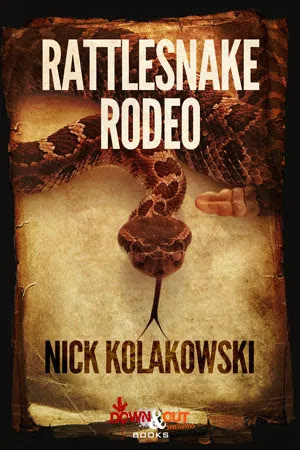
"We were dead. Although I didn’t want to say it out loud, I knew that our life expectancy had almost certainly dropped to zero, no matter what we did or where we went. When you carbonize a group of millionaires, politicians, and millionaire-politicians, the law never stops hunting you, and they make sure you’ll never have the chance to say something embarrassing at trial."
Razorback by Peter Brennan (1981)
 Chris Stachiw was kind enough to invite me to join him and screenwriter/producer Richard Hatem on The Kulturecast to discuss the 1984 Australian film Razorback. In preparation for the podcast, I decided to read the source material. The decision was totally mine, so I have no one to blame but myself. And while I can't say I enjoyed the book, I had a great time discussing the movie and book with Chris and Richard, so many thanks to them for a wonderful conversation. Hope to talk movie with them again soon!
Razorback (1981) is the second novel by Peter Brennan, who first novel was a tennis thriller called Sudden Death (1978). While the movie is a Jaws—esque story of a vicious animal terrorizing a community, the book is a beast of a different sort—a giant 378-page bloated mess.
The novel begins with a promising introduction about a kangaroo and her baby taking its first steps, a pregnant ewe, and a monstrous wild boar who has been driven to cannibalism by drought and lack of food. Unfortunately, after the promising introduction of the titular killer boar, the novel derails itself almost immediately. What begins as an eco thriller-horror novel dissolves into a missing persons-smuggling soap opera with too many competing story lines, too many uninteresting characters, and not enough wild boar action.
"Boise Longpig Hunting Club" by Nick Kolakowski (2018)
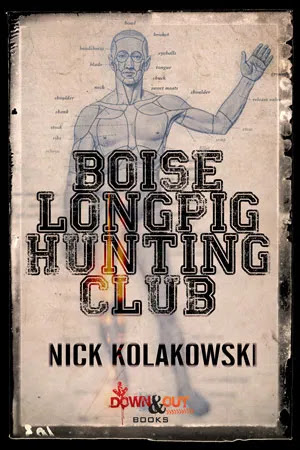
Jake Halligan is a bounty hunter and Iraq War vet living in Idaho with his ex- and future-wife Janine and their daughter. Jake's sister, Frankie, is a dark web illegal arms dealer who the police and FBI would love to throw behind bars, if they could find her, especially after she helped Jake dispense with some meth heads who robbed him by blowing them sky high with a rocket launcher. And lately the local cops have been giving Jake a hard time, since they know he's Frankie's brother.
"Strange Witness" by Day Keene (1953) FFB
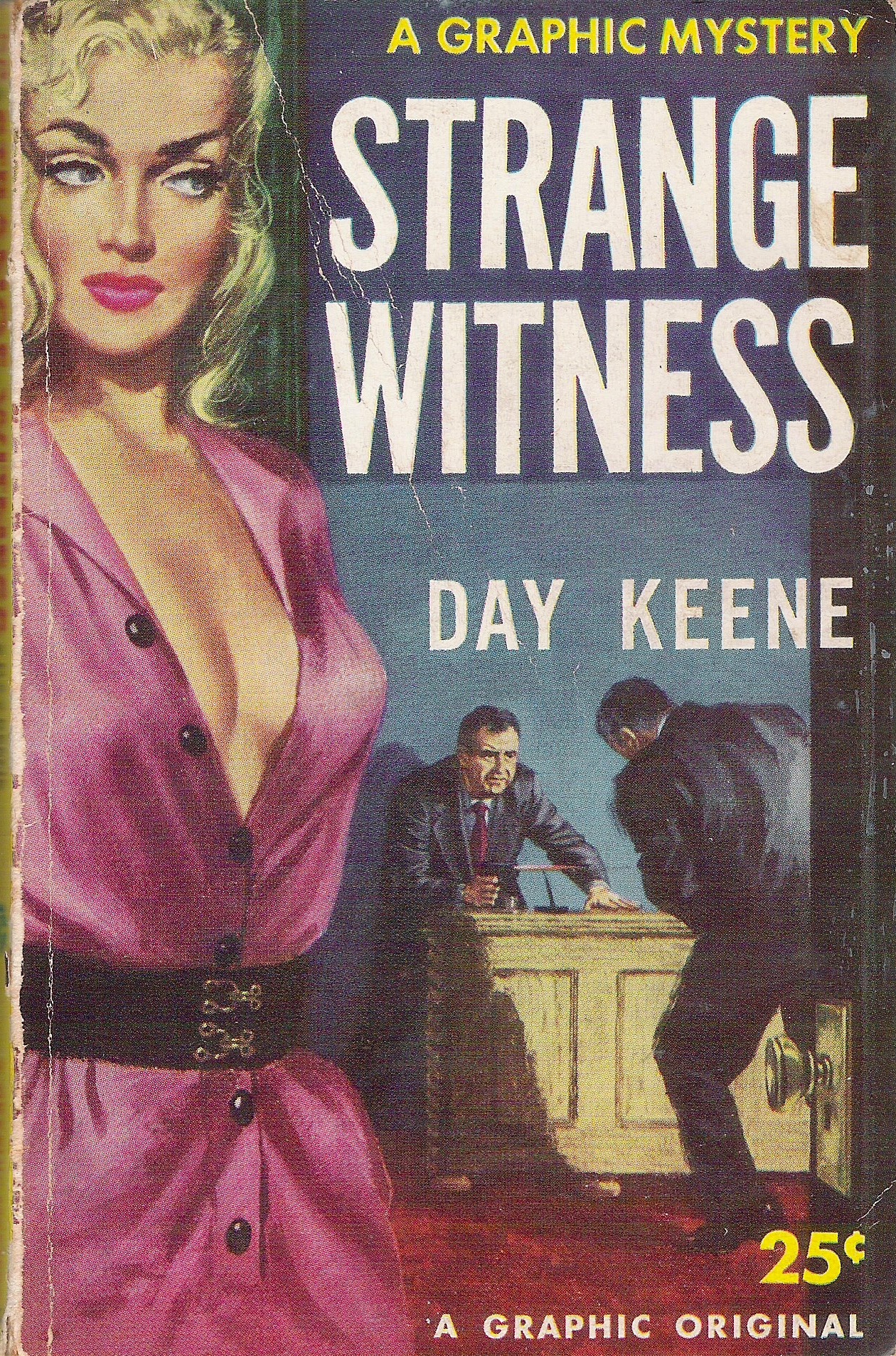
Hart Jackson used to have a successful career as an emcee and ventriloquist. Then he took the fall for his brother, who was set up for the murder of Helene, a singer at a nightclub. After serving 7 years of a 20-year sentence, he's out on parole—and he wants revenge against Flip Evans, the club owner who put the frame in place. After hocking his watch for a gun, Hart goes to a bar, where he is approached by blonde woman he's never seen before who says her name is Thelma Winston, she wants to marry him, and will give him $10,000 plus evidence to put Evans behind bars. But as soon as they are married, Thelma is gunned down. The cops want Jackson for murder, and the gangsters want to know what Thelma told him. Her dying words were something about Olga and a hotel room—but Jackson doesn't know what they mean, only that his life and proving his innocence depends on it.
"League of the Grateful Dead and Other Stories" by Day Keene (2010) - Short Story Wednesday
 Editor John Pelan and publisher Ramble House have set out to restore the long obscured history of Day Keene in the pulps, embarking on a multi-volume series inspired by Dennis McMillan's amazing Fredric Brown pulp series. The first volume in their Day Keene in the Detective Pulps series is League of the Grateful Dead and Other Stories. Released in 2010, it gathers eight tales and an insightful introduction by Pelan.
The eight stories in League of the Grateful Dead show classic crime pulp at its finest. Tough-as-nails private eyes navigating twisty (and twisted) capers, engaging in blazing shootouts with ruthless gangsters, and trying to keep their necks out of jail—all while making it home for supper without compromising their wedding vows. They're paced so quickly that it's nearly impossible to keep up or follow all the clues—but it's sure fun trying. While the private eye cases are fabulous and most indicative of Keene's characteristic style, my favorite was actually "Nothing to Worry About," a vicious quickie tale about a husband's plot to murder his wife that features a wicked twist ending.
Subscribe to:
Posts (Atom)
"The Town Square" by Orrie Hitt (Swank, May 1964)
"The Town Square" is one of the few known short stories published by prolific novelist Orrie Hitt, and it appeared in the May 1964...

-
 Test Tube Baby is the second novel from Samuel Fuller (here credited as “Sam Fuller”). Published in 1936 by Godwin, Publishers, it is among...
 -
Carroll John Daly’s short story “Three Gun Terry” is credited as being the first hardboiled mystery. It was published in the May 15th, 1923 ...
-
 Say the title, Death Wish , and most people will think of the 1974 film starring Charles Bronson as Paul Kersey, an architect-turned-vigilan...
