"The Burglar Who Met Fredric Brown" by Lawrence Block (2022)

Wouldn’t it be nice to curl up with a good book, doze off, and wake up in that world? That’s a question Lawrence Block explores in his latest novel, The Burglar Who Met Fredric Brown, the 12th novel to feature professional thief and Greenwich Village bookstore-owner Bernie Rhodenbarr. No one’s asking me to contain my enthusiasm, and so I won’t—I absolutely loved this book, and I think any of Bernie’s many fans will, too.

As a big fan of Block and his Bernie series, this didn’t disappoint in the slightest, hitting all the hallmarks of the series that readers have come to expect. The humor, the Greenwich Village setting, the warm friendship between him and series regular Carolyn, and of course the burglary. But Block also takes readers into new territory. The Burglar Who Met Fredric Brown is much more a fantasia than the earlier volumes. If you’re familiar with Brown, then you might have a little idea what’s in store, and if not, then it might help to know that Brown was an ardent admirer of Lewis Carroll, and there’s more than a hint of Wonderland in both his works and in Block’s latest. I found Block’s incursion into magical realism to be an absolute delight.

Justin Marriott Interview

Last year I had the pleasure of contributing to Justin Marriott's Paperbacks at War: 20th Century Conflict from the Front Lines of Vintage Paperbacks, Pulps and Comics, an in-depth look at over 170 wartime classics (and some not-so-classics). I wrote about Doomsday Mission by Harry Whittington, Hell to Eternity by Edward S. Aarons, The Dirty War of Sergeant Slade by Lou Cameron, Gresham's War by William Crawford, and Skylark Mission by Ian MacAlister.

Marriott is a prolific editor, writer, and publisher, and he was kind enough to answer a few questions about his work and Paperbacks at War.

Before we talk about Paperbacks at War, could you give a little background about yourself, and how your interest in literature developed?

I’m a pretty average Joe. Early 50s, married with two young daughters and living in a coastal town in the West of England. The day job is for a large financial organization where I work as a project manager in IT. 

I’ve still yet to develop any interest in literature! But I was a voracious reader from an early age, especially of comics, a habit I inherited from my dad. Growing up in the 70s in the UK, it was an age before video, and there were only 3 TV channels, all with limited programming aimed at kids. So Dr. Who was a must see on Saturday evenings, and the novelizations of Doctor Who were the first genre books I encountered. These were in the form of hardbacks loaned from the local library. I would read them cover to cover in a day. Even at that early age, I started to identify which authors I preferred—with Terrence Dicks, the creator of the Daleks, being a favourite. 

Jason Starr Interview

Back in June 2011, I interviewed Jason Starr about his then-latest novel, The Pack, and the interview was published by Spinetingler Magazine. Since the site is down, I've republished the interview below.

***

In Jason Starr's The Pack, advertising executive Simon Burns life goes into a tailspin after he’s fired from his job. Marriage counseling isn’t helping the intimacy issues with his wife, and being a stay-at-home-dad is harder than it at first seemed. Things start to look up when he meets a group of dads at the playground: Simon has guys to hang out with during the day, and his kid has other children to play with. But after a night of partying, Simon blacks out and wakes up in the woods naked, and all he can remember about his dreams is a wolf. The nightmare continues to haunt him, and as his body begins undergoing changes, Simon fears that he, in fact, might be turning into a werewolf.

Yes—a werewolf—but don’t start thinking this is another Twilight spin-off. Nor is The Pack anything close to a conventional horror novel. The story is less about physical transformation than it is emotional and psychological changes, and how they can affect—and sometimes destroy—a relationship. Simon is one of Starr’s most realistically and sympathetically crafted characters, and the slow dissolution of his marriage is harrowingly and poignantly written. Much like Panic Attack, The Pack is really about the discovery of a father’s latent violent urges and the disastrous after-affects it has on his family.

Don’t let the werewolf element throw you off. The Pack is pure Jason Starr, and it is one of his most gripping novels yet.

Exorcism (1975)

Cult auteur Jess Franco stars in Exorcism (1975) as Mathis Vogel, a defrocked priest who now makes a living writing erotic stories for porno mags edited by Franval (Pierre Taylou). After overhearing Frontal and his secretary/girlfriend Anna (Lina Romay) plan a Black Mass-themed orgy, Vogel mistakenly thinks the Satanic ceremonies to be real, and begins stalking and purifying the orgy's participants--by murdering them. 

Alternately erotic, surreal, and menacing (and often all at the same time), this is one of the strongest Franco films I've seen thus far. The narrative is fairly cohesive and straightforward, and gives structure to Franco's pscyho-sexual environs. 

The opening sequence, of two women enacting an S&M performance on stage for an audience, introduces a key theme of the movie and of Franco's work as a whole: the intertwining of performance, role-playing, voyeurism, and eroticism. Nearly every encounter in the film, whether sexual or not, involves some element of performativity. Whether its two lovers expressing submission and domination, or a college-educated cop competing with his street-wise superior, Franco seems interested in the extent to which people are always acting, and whether even the most seemingly "normal" elements of our reality are, in some ways, fictional fantasies of their own. 

The version of Exorcism streaming on Kino Cult is sourced from varying prints, and some scenes show minor damage (such as scratches), and certain sequences inter-cut between different prints in order to deliver the most complete version of the film possible. Despite this, the colors are strong and not faded, making this an overall very attractive presentation of the film. Kino's Blu-ray also includes a cut-down version called Demoniac (exclusive to the disc, not streaming), which focuses more on the horror elements of the film, and includes alternate footage and less nudity.  

The Age of Cinema (2022)

Recently I had the pleasure of participating in a feature-length essay film experiment by director Matt Barry. As part of a folk-film challenge, we decided to make our own movie during the Oscars broadcast. Filmed over Zoom, the result was The Age of Cinema (2022), a discussion about the intersection of personal collecting and film history. I also had the pleasure of writing original music for the opening sequence. 


Farewell, My Lovelies: Pt. 1

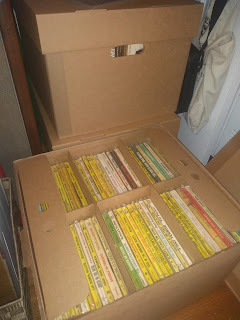
A friend once told me that I was always either in the process of accessioning or deaccessioning: talking about all the new books or records that I had found, or complaining about the arduous and emotionally taxing labor of trying to weed the collection and sell items to make space. New York City is known for many things, and spacious apartments aren't one of them. 

I've hit the saturation point again, and have no shelf space (or closet space, or floor space) left. In the past, when this has occurred, I've diminished my book to collection to make space, only to regret decisions and buy the books back (often at a higher price and lower quality). This time, I'm trying something different. And, honestly, I should have done it years ago.

I've rented storage space.

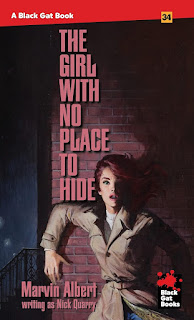
"The Girl With No Place to Hide" by Marvin Albert as Nick Quarry (1959)

The Girl With No Place to Hide gave me everything I wanted from a 1950s private eye novel—and in spades. A thoroughly hardboiled protagonist, gritty New York city ambience, wild nights in Greenwich Village bars, Bronx flophouses, incriminating photographs, two-way mirrors, blackmail, loan-sharks, shoot-outs, fist-fights, jail-house brawls, prizefights at Madison Square Garden, thugs, crooked cops, duplicitous dames—you name it, this book’s got it. But it’s also got something extra special—and that’s Marvin Albert. 

The story begins when a young woman enters a bar looking for private eye Jake Barrow’s friend, fight manager Steve Canby, who left the bar just moments before. Later, as Jake is leaving the bar, he finds a thug in the alley strangling the woman. He rescues her and takes her to his apartment for safe keeping, and she reveals that she’s in trouble, and that something bad has happened to her friend Ernie. Before Jake can find out more, he gets an urgent call to come up to the Bronx for $200. When he gets there, he realizes it was a ruse. Returning to his apartment, Angela is gone. The next morning, Jake sees in the newspaper that a photographer named Ernie was found murdered—and he fears that Angela will be the next victim.

I’ll say no more except that this is a wild ride all across New York City, with plenty of twists and turns that kept me guessing every step of the way.

Originally appearing under Albert's pseudonym “Nick Quarry” in 1959 by Gold Medal Books, The Girl With No Place to Hide was recently reissued by Black Gat Books from Stark House Press, and it magnificently captures why Albert was a writer’s writer. The Girl With No Place to Hide is the work of a real pro—a slickly designed plot that hits the right beats but not in the expected places, so readers will get what they're looking for but not in the same way they’ve read it before. Albert also shows restraint with the prose, no leaning too much on sex, violence, or slang. This is Albert’s third novel with his series character Jake Barrow—but don’t let that stop you from jumping in. If you’re like me and you haven’t read the first two yet, you’ll have no trouble following along (though you might want to rush out and find the others). 


"The Phantom from 10,000 Leagues" (1955)

The Phantom from 10,000 Leagues (1955) is the type of movie that puts title and poster first—and story and production values dead last. And that’s ok! It’s schlocky good fun with a ragged monster that’s more cute than menacing. A bargain basement Creature from the Black Lagoon with a Cold War espionage twist, Phantom also embodies the highs, lows, and everything-in-betweens of what wound up on the bottom half of double bills in the 1950s. This particular movie accompanied Roger Corman’s Day the World Ended (1955), and together they made enough money at the box office to more than double their production costs. Sure, the monster doesn’t get enough screen time, and everyone uses the same boat, and nobody has a car, and there are lots of chance encounters happen on this one particular beach…but these sorts of decisions were made in the name of keeping the budget low, the production schedule quick, and the run-time short. So, maybe Phantom isn’t the horror classic that it tries to emulate, but it has an undeniable econo joie de vivre that makes ‘50s schlock so enchanting.

"The Gang" (1977)

Making its Blu-ray debut from the Cohen Film Collection (distributed by Kino Lorber), Jacques Deray's The Gang (Le Gang) is a strikingly unusual and idiosyncratic arthouse gangster film that should hold many surprises for fans of French crime dramas. While it has moments that resemble French master Jean-Pierre Melville, as well as American films like The Godfather, The Sting, and Butch Cassidy and the Sundance Kid, stylistically the film is quite distinct from all of those. 

The Gang begins with the titular group of men gathering before a job, and then jumps to directly after the job, as they return with their leader, Robert "The Crazy" (Alain Delon), wounded. This leads into a voice-over from Robert's wife, Marinette (Nicole Calfari), who takes the story back to post-war Paris where they meet at a nightclub, where Robert holds the patrons at gunpoint after an American soldier insults one of the gang. From here, the story alternates between idyllic scenes of the gang celebrating baptisms, relaxing in the countryside, and glimpses of their crimes filmed with Melvillain sobriety. Robert becomes increasingly brazen as their success grows, and it's only a matter of time before his craziness gets him—and perhaps the gang—killed.

“The Kid I Killed Last Night and Other Stories: Day Keene in the Detective Pulps, Vol. #7,” edited by David Laurence Wilson (Ramble House, 2021)

I'm ecstatic over the seventh and most recent volume in Ramble House’s series of Day Keene’s short stories is The Kid I Killed Last Night and Other Stories: Day Keene in the Detective Pulps, Vol. #7 (2021). Expertly compiled, edited, and introduced by David Laurence Wilson, this collection is one of the most interesting and illuminating volumes released yet. Devoted to Keene’s earliest stories published under his real name Gunard Hjertstedt and later tales published under pen names (John Corbett and Donald King), The Kid I Killed Last Night sheds light on the more obscure areas of Keene’s pulp career. Fans of the author will delight in being able to access such rarities, and newcomers will hopefully appreciate the author’s wit and crackerjack plots. Early or late, real name or pen name, Keene was a master of the short story, and Ramble House and David Laurence Wilson deserve applause (and lots of orders) for keeping the author’s legacy alive. 

"Manhunter" by Arnold Hano (1957)

In Arnold Hano’s westerns, the frontier is deceitful above all things, truth is rarely simple, and resolutions never easy. Where other books end—the capture of the killer and the confession—Manhunter begins.

“Ross was no longer vitally interested in Gill. He had his father’s killer, his confessed killer. But Gill could clear up who was lying, and why.

“On the heels of that thought came a terrible doubt, streaking across his brain like a yellow comet. It had all happened so long ago. Maybe it was he—Ben Ross—who was lying.”

Originally released in 1957 under the pseudonym “Matthew Gant” and recently released by Stark House Press (paired with Slade), Manhunter is emblematic of Hano’s strikingly original approach to the western genre. Revenge and closure don't drive his protagonist forward, it’s something darker and all-consuming. These sorts of qualities separate Arnold Hano’s westerns from many of his peers, and what gives them the distinction of being labeled retroactively as “western noir.” 

"Slade" by Arnold Hano (1956)

There’s nothing heroic or romantic about Arnold Hano’s westerns. The frontier is a dark and violent landscape that doesn’t offer redemption, rebirth, or hope. In Hano’s books, the barren landscapes reveal the naked awfulness of its people. These qualities are on full display in Slade and Manhunter, two of Hano’s grim, gut-punch westerns recently reissued by Stark House Press. These great books embody why Hano deserves the title “Master of the Western Noir,” which is the name of Paul Bishop’s terrific essay-interview with the author, which is also included in the new volume.

Slade was originally published in 1956 under the name “Ad Gordon” by Lion Books, where Hano was also the editor. Hano doesn’t handle his characters with kid gloves—he puts them through hell, over and over again. Slade begins with him knocking the titular character off his high horse, and what a fall he takes. Like Icarus before him, Slade flew too close to the sun and paid for his hubris. Here, the gambler bet everything he had—including his saloon—and lost it. With only his horse, his hat, and a sock with $500 he tries to leave town, but after he’s jumped and beaten unconscious he loses even the sock. “Dilt drove both his fists to the back of Slade’s neck and kicked himself loose. Yet somehow he got up again. Finally, the wild red washed through him and turned gray and the last thing he remembered was Dilt saying hoarsely, ‘Fall, you son of a bitch, fall.’”

My new story "Death Drives By Night" is at Beat to a Pulp


I've been a big fan of Beat to a Pulp since I discovered them a little over a decade ago, around the same time I started this blog. Since then, it's been a dream of mine to have a short story included on their website. That dream has finally come true, and I'm thrilled that they've given a home to my story, "Death Drives By Night." It's about a rural veterinarian with a sideline patching up criminals who gets caught in the middle of a drug war when violence follows the trail back to his home. Zakariah Johnson described it as "Gritty, gravel-road-noir."

Click here to read "Death Drives by Night."

Image: Designed by me, photograph "129201-07" by phrenologist is licensed under CC BY-NC 2.0

"Love Like Bleeding Out With An Empty Gun In Your Hand" by Stephen J. Golds (2021)

Nothing ever lasts in Stephen J. Golds’s world—not the good, and not the bad. 

In Golds’s hard-hitting collection of noir-influenced poetry and prose, Love Like Bleeding Out With An Empty Gun In Your Hand, there’s a lot of past, not much present, and even less future. Characters look back and see what’s better left behind; they look around and don’t like what they see; and they look ahead but don’t see much of anything. Yet somehow, Golds manages to be both a romantic and a nihilist at the same time—and that’s as good as definition of noir as I can think of.

Wallace Stroby Interview at CrimeReads


I've long been a fan of Wallace Stroby's crime novels, especially his Crissa Stone series, but his latest is my new favorite. In design, Heaven's a Lie reads like something straight out of Gold Medal from the 1950s, but in feeling and tone it is completely modern, and deeply tied to the present moment. The main character is Joette, a woman who was laid off from her bank teller job when the bank downsized. Now she works a day-shift at a decaying motel during the off-season in order to pay for her trailer and support her dying mother. But that's all backstory you learn later. Stroby kick-starts the action with the first sentence of the book. A car turns over in front of the motel. Joette rushes to help rescue the driver. Inside the open trunk, she sees a bag of cash. She takes it. And, of course, the rightful owner quickly figures out she has it and wants it back. Trouble is, Joette's got nothing left to lose and is determined to keep the cash.

One of Stroby's strongest abilities is character development. He eschews archetype for realistic people made of flesh-and-blood, with urgent and relatable motivations, and who—when pushed—surprise not only those around them, but also themselves. And Heaven's a Lie is a book in which characters frequently surprise themselves. Whether it is Joette recognizing her boldness and recklessness, or Travis—the sadistic drug dealer—acknowledging his limitations and powerlessness, the cast of Heaven's a Lie face life-altering and disturbing self-realizations. 

I loved Heaven's a Lie—a tightly-knit chamber noir filled with melancholy and heartache set against a backdrop of America's struggling economy and the destructive wake of gentrification.

On the occasion of the book's release, Stroby was kind enough to speak with me about the writing process. 

Read the full interview, "Wallace Stroby on Life, Death, and Noir on the Jersey Shore," at CrimeReads.

"The Town Square" by Orrie Hitt (Swank, May 1964)

"The Town Square" is one of the few known short stories published by prolific novelist Orrie Hitt, and it appeared in the May 1964...