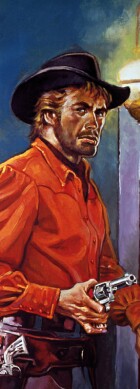
Harry Whittington Slideshow from Bill Crider

I was going to sit down this evening and compile Harry Whittington's paperback covers...but then I discovered that Bill Crider already did this back in 2006. More impressively (but not surprisingly), they're all from his own collection! I think it might be time to nominate Bill's library as the Eighth Wonder of the World.

Without further ado...here's Bill Crider's Fabulous Harry Whittington Paperback Slideshow!

Thanks, Bill!

"First Blood" by Jack Schaefer (1949)

Originally published in 1953, First Blood was Jack Schaefer’s follow-up to the immensely successful Shane, which had been published four years prior. 1953 was also the same year that the movie of Shane, with Alan Ladd immortalizing the title role, hit the big screen. Like Schaefer’s earlier book, First Blood is a coming of age story, except this time the young boy is a young man.

Jess Harker has just turned twenty, and he feels that life is passing him by while he drives an empty stagecoach with tired horses along a pointless route, while an old man who rarely speaks sits beside him with a shotgun. Jess wants to drive on the big trails, with his idol right beside him—Race Crim, the best shotgun messenger on the whole line. Jess’ other idol is Tom Davisson, the local sheriff, who is always giving the young driver advice, even when he doesn’t ask for it. Davisson treats Jess like a kid, whereas Race treats Jess like a grown man.

Jess gets his chance to prove himself when he is asked to drive an important shipment of gold. With Race sitting beside him on the box, it seems like a dream come true…until someone ambushes the stage, gets away with the money, and kills some of Jess’ passengers. As the town bands together in search of the outlaws and the money, Jess sees the divide between the lawless Race and the law-abiding Davisson grow further and further apart. Jess knows that soon he will have to pick a side, and he only hopes that he picks the right side and will live to tell the tale.

First Blood is a perfect companion piece to Shane. Even though the characters aren’t the same, both books share similar constructs and themes. They’re both about growing up, and coming to terms with the realization that even our heroes are mortal humans. There are significant differences between the books, too. Bob MacPherson, the young boy who narrates Shane, was mainly on the sidelines, studying his father and Shane. Here, Jess similarly watches and compares his two roles models—Race Crim and Tom Davisson—but the difference is that now he, too, must play a role in the drama. He has to decide which path to follow. When it comes time for the final shootout, this time the gun is in Jess’ hand, and his life depends on the choice he makes.

Another interesting aspect of these two books is the way that Schaefer deals with the archetype of the gunfighter. In Shane, Schaefer humanized the shootist, made him mortal and valiant, and turned him into a mythological icon. In First Blood, however, Schaefer demythologizes the gunfighter. While Race isn’t exactly the same wandering gunhand as Shane, they both make their living pulling the trigger. As the story progresses, Jess comes to realize that living and dying by the gun isn’t as admirable and enviable as he once thought. Perhaps it is a sign of the frontier dying, but Jess is now thinking in terms of longevity and career instead of free roaming excitement.

One of Jack Schaefer’s skills was capturing that youthful moment when one’s ideals are at their pinnacle, and then puncturing the bubble as reality sets in. He renders the moral confusion and ethical uncertainty in all their complexities, without making the dilemma seem stale or contrived. Schaefer understands young protagonists and the difficult, disorienting process of becoming a man. First Blood is a terrific novel that combines stirring Western action with a sincere coming-of-age story. Fans of Shane that haven’t delved deeper into the world of Jack Schaefer would certainly enjoy this short novel.

The Art of the Script: Sweet Smell of Success

I rewatched Sweet Smell of Success this afternoon. Clifford Odets and Ernest Lehman's screenplay, based on a novelette by Lehman, never ceases to amaze me. It's one of the best scripts I've ever seen filmed. The plotting is tight and the characters vivid, but it is the dialog that most impresses me.

Burt Lancaster (as JJ Hunsecker) and Tony Curtis (as Sidney Falco) nail the rhythm and the accents of the dialog. There's such edginess and ferocity to their banter. They manage to be both graceful and violent, just like the big city they stalk by night.

The full script is available online. Here is one of my favorite moments.

CAMERA now SHOOTS down 52nd Street. Hunsecker, back to
CAMERA, studies the evening, hearing the sound of a screech
of female laughter from one of the groups in the distance.
A drunk is being thrown out of one of the strip tease joints.

HUNSECKER
I love this dirty town.

Amused, Hunsecker turns back; he signals across the street
to the car park, indicating that the big black Lincoln
Continental should follow as he strolls with Sidney.

HUNSECKER. SIDNEY FOLLOWING.

HUNSECKER
(after a pause)
Conjugate me a verb, Sidney. For
instance, TO PROMISE!

CAMERA TRACKS with them in a CLOSE TWO SHOT. Sidney is
alert now.

HUNSECKER
(continuing)
You told me you'd break up that
romance - when?

SIDNEY
(hesitantly)
You want something done, J.J., but
I doubt if you yourself know what's
involved.

HUNSECKER
(soft and sardonic)
I'm a schoolboy - teach me, teach me.

SIDNEY
(carefully)
Why not break it up yourself? You
could do it in two minutes flat.

Hunsecker pauses, halts.

HUNSECKER
(harshly)
At this late date you need
explanations...? Susie's all I
got - now that she's growing up, I
want my relationship with her to
stay at least at par! I don't
intend to antagonize her if I don't
have to.

New Black Horse Extra Issue Online!

Chap O'Keefe has posted the latest issue of Black Horse Extra online. Lots of great news in there for fans of Western literature and culture. Here's a rundown of the contents:

-In "Real Cowboys and Reel Cowboys," Greg Mitchell (Crooked Foot's Gold) looks at how hats, gunbelts, and other cowboy regalia of the Old West is represented in movies. His insight into the practical use of rolled-brim hats, cuffs, chaps, spurs, and other aspects of the cowboy costume is very enlightening. One of my favorite parts was about the iconic bandana:
"The bandanna around the neck was not the sole domain of the cowboy and was worn by many 19th century outdoor workers and sailors. A large percentage of shirts in those days were collarless and the bandanna gave some protection from the sun, specially if the person had a narrow-brimmed hat or was wearing a cap."
-"Hoofprints" keeps readers up to date with Western news, including: BHW authors Colin Bainbridge and Carl Bernard; The Western Fictioneers anthology The Traditional West; a sneak-peak at an upcoming BHW called Fort Revenge by Ralph Hayes; a look at new "flipback" books from the Netherlands,; BHW artist Michael thomas is selling his cover art as posters; AMC has a new TV series called Hell on Wheels; and much more.

-Jack Martin (Gary Dobbs), David Whitehead, Nik (Ross) Morton and Chap O'Keefe discuss "The Rights and Wrongs of eBooks." Speaking of digital books, Chap O'Keefe's early novel, The Sandhills Shooting, is now available as an eBook.

-There's also a list of New Black Horse Western Novels.

-And Chap was also kind enough to reprint my recent review of Misfit Lil Cheats the Hangrope.

“Scream-Proof Paradise” by Harry Whittington (Adam Bedside Reader 26, Dec. 1966)

Harry Whittington short stories are hard to come by. So, when I saw one advertised in a magazine on eBay, I jumped at the opportunity. “Scream-Proof Paradise” was originally published in Adam Bedside Reader #26 (Dec. 1966).

The setting isn’t a typical one for Whittington. While he was a versatile writer, most of the books I’ve read of his centered around middle- and working-class characters. This story is set amongst the high and mighty of New York’s theatrical community, who have gathered at the grand New England home of director Cecil Hogan. The star of the party is Hogan’s latest writing discovery—a young man named Nick Jones. Jones has secretly been having an affair with the leading lady of the play, Talcie, who also happens to be Cecil’s wife. As the party winds down, Nick has to decide whether or not to go through with his plan to kill Cecil and make Talcie his forever.

Once the story kicks into gear, the style is pure Whittington. That tense mixture of gut-churning anxiety and driving neuroses that can propel a character make extreme decisions—often extremely bad ones. Here’s a short passage where his inimitable voice shines:

“Footsteps rattled behind a closed door. His heart pounded. He swore. If nerves were shot so that sudden sounds almost disemboweled him, he’d better abandon this action right now.

“He could enter Talcie’s bath, wash his hands, relieve the tension twisting his kidneys, return downstairs. No one would ever know what was burning his mind, driving him…and he and Talcie would be sentenced to go on sharing this heaven that opened upon hell.”

Whittington’s prose also has the occasional poetic flourish, such as the repeated phrase at the end of this line: “And then, with desperate irony. ‘Oh, yes – I’m lost, too. I’m lost, too.”

Though the title would indicate something a bit more lurid, the final product is on the tame side, considering the publication in which it appears. Overall, “Scream-Proof Paradise” is a very entertaining suspense story, albeit a tad conventional and predictable. But even with Whittington’s best novels you can sometimes predict the ruinous outcomes. The pleasure isn’t where the story ends, but how the characters wind up there, and the long, twisting, bleak roads they travel along the way.

"Dark Trail" by Ed Gorman (M. Evans and Company, 1990)

Book 4 of the Guild series.

Dark Trail is the grave conclusion to Ed Gorman’s Guild saga. Gorman not only saved the best for last, he also saved the darkest, most dolorous, too. Originally published by M. Evans and Company in 1990, it was later reprinted in a paperback edition by Forge in 1997.

In Dark Trail, the past finally catches up with lawman-turned-bounty hunter Leo Guild. Years ago, his wife, Sarah, left him for a gunfighter named Frank Cord. Now, she wants Guild’s help to save Frank’s life. Frank has gone and left Sarah for another woman—another gunfighter’s woman, Beth. Unlike Guild, however, this gunfighter—Ben Rittenauer—isn’t going to let his girl go so easily.

As tensions mount between Frank and Ben, a third party begins to show interest in the fight. Tom Adair, a local cattle baron and railroad tycoon, wants to throw a party for the local aristocrats and politicians. The main attraction: a real, live gunfight. The prize: $10,000. Knowing that whomever wins gets both the money and Beth, Frank and Ben quickly agree to a public duel. As the big night draws nearer, Guild struggles to convince the men to call off the fight before it is too late.

With its circular narrative and inevitable, disastrous conclusion, in Dark Trail Gorman elevates the Western to the level of Greek Tragedy. The violently sobering finale shows how little value these people had for human life, whether it was their own or another’s. In previous Guild books, Gorman has remarked about man’s inhumanity to man—“People were just people and sometimes they did terrible things. Everybody did.” (Death Ground) and “Sometimes we treat people we love pretty badly.” (Blood Game)—but nowhere is his lament for humanity lost greater or more affect than here, in Dark Trail.

One of Guild’s struggles in each of the books has been to preserve the sanctity of human life—an ironic goal, considering his job as a bounty hunter. His job, however, positions him to see just how debased and devalued life was in the Old West. People would kill, prostitute their bodies, or sell their souls for a dollar—or less, if they were desperate enough. And there would always be somebody (like Tom Adair in Dark Trail, or John T. Stottard in Blood Game) ready to take advantage of those hopeless people. Try as he might, Guild couldn’t beat the Adairs and the Stottards of the world, and he couldn’t convince the Sarahs, Beths, Franks, or Bens that living and loving was worth more than the price of a new gown or a lead bullet. Guild learned the hard way—by taking an innocent life by accident—and it has been his burden to see history repeat itself over and over again, and to be unable to stop the cycle from continuing. That is what makes Guild a tragic character—he’s as guilty as the rest, but this knowledge doesn’t allow him to enact any change in the world around him, so he just relives the same pains over and over again.

Relationships in Gorman’s novels are never romanticized or idealized—they’re as flawed and wounded as the people are themselves. For that reason, they’re very realistic and relatable. His characters have enough self-knowledge not to believe in happy endings, which allows for very frank and honest discussions about love (or love lost, as is often the case). This dialogue between Guild and Sarah is a classic example:

Guild: “There was a lot of years when I thought that would still be a good idea.”

Sarah: “Us getting back together?”

Guild: “Yes.”

Sarah: “It wouldn’t work, Leo.”

Guild: “I know. But it’s nice to think about sometimes.”

Another hallmark of Gorman’s novels are his morally ambiguous characters. There are no easy heroes and no easy villains—in fact, those “hero” and “villains” labels rarely apply to his stories. Everyone is equally capable of hurting someone else, just as everyone is equally capable of helping someone else (even if they rarely do). Just as much a hallmark is Gorman’s refusal to pass judgment. When Guild tells Sarah, “You really are good. True and honest and loyal,” there’s no irony or resentment in his voice. In a way, Sarah is the person responsible for this whole chain of events—it was her who left Guild for Frank in the first place—yet, in Guild’s eyes, she is still the person most capable of goodness. Guild is sincere because he, like Gorman, doesn’t blame Sarah. Guild knows that perhaps it was himself who drove Sarah away, and that maybe it was his own failings as a husband—and as a fellow human—that started this tragic ball rolling so many years ago. Guild has a rare sense of humility, of perception, and of understanding. He understands people because he understands himself—all the bad things he’s done, and all the good things he could have done but failed to.

Reading all the Guild stories right in a row—Guild, Death Ground, Blood Game, and Dark Trail, plus the short story “Guild and the Indian Woman”—was a moving experience. They’re a mournful, brooding bunch, but they’re all excellently written, and filled with compelling, lifelike characters. Guild is a remarkable protagonist, and it was a pleasure spending time with him. And even though the series is over, I’m sure that I will be visiting Guild again real soon.

"Guild and the Indian Woman" by Ed Gorman (1988)

Part of the Guild series.

“Guild and the Indian Woman” is the only short story to feature Ed Gorman’s series character, the lawman-turned-bounty hunter Leo Guild. It originally appeared in the 1988 anthology Westeryear, and was later included in Bill Pronzini and Martin H. Greenberg’s The Best Western Stories of Ed Gorman.

The short story begins with Guild tracking down a man believed to have died of cholera. While he is checking with the doctor, a sixty-something year old Mesquakie Indian grandmother walks through the door and shoots the doctor in the face. She then asks Guild to accompany her to the sheriff. It seems like a cut-and-dried case, but Guild suspects there is more to it than meets the eye.

“Guild and the Indian Woman” is a terrific companion piece to the four novels that make up the saga. In just a handful of pages (26, in my large-print edition), Gorman gets to the heart of the Guild novels, which is to expose the dark recesses of the Old West. The crimes are as gritty and seamy as in Noir.

The story is also remarkable for how Gorman is able to condense the essence of Guild’s personality into a mere few lines. Guild can not only recognize a man’s potential for causing pain, but also the pains that a man has already suffered, and he’s never judgmental. Take a look at this paragraph below, as it clearly shows Guild’s world-weary insight:
“The door opened and a stubby man with watery eyes and filthy, shapeless clothes emerged. He needed a shave and a bath. With the coast-to-coast railroad tracks and another cycle of bank failures, the territory was home to many men like him. Drifting. Dead in certain spiritual respects. Just drifting. Guild knew he was cleaner and stronger and smarter, but he was probably not very different from this man. So he was careful not to allow himself even the smallest feeling of superiority.”
The Guild saga is one of my favorite Western series. If you like your Westerns unconventional and with shades of Noir, like something that Gold Medal might have published back in the 1950s, then be sure to look into the Guild novels, they might just what you’re looking for.

----------------------------
Edition pictured: The Best Western Stories of Ed Gorman. Edited by Bill Pronzini and Martin H. Greenberg. Large Print Edition, published by Chivers Press (Bath, Avon, England) and G.K. Hall & Co. (Thorndike, Maine, USA), 1995.

"Blood Game" by Ed Gorman (M. Evans, 1989/Forge, 2001)

Book 3 of the Guild series.

Blood Game
is as brutal and bloody as Westerns come. In this third entry in the Guild saga, Ed Gorman gives a gut punch to the whole “man’s inhumanity to man” theme and leaves it bruised and broken, curled up in a fetal position in the corner. It’s a beautiful book, but beauty doesn’t have to be pretty, and it rarely is in Gorman’s novels.

Originally published by M. Evans and Company in 1989 and reprinted by Forge in 2001, Blood Game finds lawman-turned-bounty hunter Leo Guild working for boxing promoter John T. Stottard. Stottard wants Guild to guard the cash box during an upcoming match that involves his star fighter, Victor Sovich. Guild doesn’t like boxing because he finds it savage; but he finds human exploitation even more barbarous, and Stottard and Sovich are two of the worst offenders. Sovich is notorious for fighting black boxers in the ring, several of whom have already been killed by his savage blows. And that’s just what Stottard and the crowds are hoping will happen which Sovich faces off against Rooney, an aging black fighter whose better years are already behind him.

Tensions mount as Guild realizes that more than just money is riding on this match. There’s Stottard’s son, Stephen, who is emotionally attached to his abusive father, and haunted by the absence of his mother who ran away when he was still a child. Then there’s Clarise Watson, the sister of a man whom Rooney killed in the ring. And then there’s John T. Stottard, himself, whom Guild suspects might be up to foul play. As the countdown to the fight draws nearer, Guild witnesses just how low human nature will sink for a taste of blood.

The final boxing match is one of the most despicable presentations of society in all of Gorman’s works. The blood and the violence are matched only by the vileness and desperation of the characters. Like a cataclysmic domino effect, everyone’s plans collapse into disastrous ruin, leaving Guild to try and pick up the pieces. As one doctor tells Guild, “Sometimes we treat people we love pretty badly.” That line could be the epigram for many of Gorman’s novels. It’s simple, but it captures the tragedy of so many of the author’s books, including Blood Game. Neither John T. Stottard, his wife, their son, or even Clarise Watson could comprehend the shockwaves their actions would cause. The effects would linger long after the boxing match ended, and some pains don’t lessen with time, they only grow deeper.

Gorman’s characters frequently take a lot of physical blows. The punishment they endure is on par with some of Dudley Dean’s work that I’ve read. But in Gorman’s work, the characters that receive the most punishment aren’t the ones who get punched or shot—they’re the ones who survive, and live to remember all the pain they’ve caused in others. As Guild tells someone at the end of the book, “Hitting you would be easy. You’re going to have to live the rest of your life with how you treated him. That’s going to be the hard part.” Guild is also a survivor, one burdened with memories, and that’s where his soulfulness comes from.

One of the most prominent themes of Blood Game is control—not only over one’s own life, but also over others. John T. Stottard tries to achieve control through manipulation: he abuses son into submission; he rips off his fighters; and he stokes through crowds through bloodlust. Guild is a man who can’t be bought, which is why Stottard immediately dislikes the bounty hunter. It’s also why he trusts Guild, and looks for new ways to deceive him. The other side of the “control” theme is that of human exploitation. Blood Game explores the deep roots of racism in American society, and how even after slavery was technically over, black people were still exploited, abused, and treated as an inferior class just because of their skin color. By exploring these issues, Gorman reveals the far side of paradise. While many tend to think of the West as a mythological utopia, Gorman reminds how hypocritical, barbaric, and ugly civilization out West really was.

Gorman’s prose style is deceptively simple. His streamlined phrases are powerful without being bombastic, full of emotion without resorting to theatrics. There’s never a wasted word or an excessive adjective. The narrative flows smoothly from first page to last, and reading his books from cover to cover is not only a pleasure for the experience, but it also reinforces just how tightly constructed the book is. The book is also full of strong, poetic imagery, such as when he describes a gunshot in the back of someone’s head as “a terrible purple flower suddenly in bloom.”

Reading the Guild saga, I’ve been struck by how crucial the theme of prolonged guilt runs through all the novels. (I don’t think it’s a coincidence that only one letter differentiates “Guild” and “guilt,” either.) Much like in Clifton Adams’ The Desperado and A Noose for the Desperado, Gorman’s characters can never outrun their history. As one character admits, “I knew that at last my past had found me, the past I wonder about when I can’t sleep at night.” Guild, himself, is no exception. He understands people so well because he’s seen the worst of himself in action, and he’s never forgotten what bad things he is capable of doing with his own two hands. Another character says these words, but they summarize Guild’s own conscience: “I know that no apology can undo what I did. I must accept my blame without any attempt at justifying myself.”

For me, the most moving line was one character’s admission: “I wish I could feel good, Leo. I wish I could feel some satisfaction. I deserve what happens to me, Leo. I shouldn’t have done it. I surely shouldn’t have.” None of the characters had in mind some large scheme, or any grandiose plot. They wanted something they thought was simple—money, sex, love, revenge, happiness—but never realized the heavy cost they would have to pay to achieve it. “I don’t want to hate her anymore, Leo,” one character tells Guild. “I’m tired of hating her. It takes too much out of me after all these years.”

Gorman’s West is not about valor, redemption, or purification. It’s not about Manifest Destiny. It’s about characters who can’t take control of their lives, who can’t rule over the land, who can’t reinvent themselves, who can’t escape the past.

"Death Ground" by Ed Gorman (M. Evans and Company, 1988)

Book 2 of the Guild series.

Ed Gorman’s Guild series only gets better as it goes on. The books also get progressively darker, grittier, and more desolate, yet somehow more human and tender. Perhaps it is because the characters themselves become relatable, their misgivings more understandable, their stories more tragic. Death Ground, the second entry in the series, is even better than its predecessor, Guild. It was originally published in 1988 by M. Evans and Company, and is now available as an eBook for Kindle.

As Death Ground begins, the bounty hunter Guild has taken a job as a bodyguard for Merle Rig. But soon Guild learns that Rig has been murdered, and so has the young man, Kenny, whom Guild hired on to help protect Rig. The prime suspect is a notorious outlaw named Kriker, who is believed to have held up a bank with Merle Rig’s assistance. Two deputies, Thomas and James Bruckner, have been ordered to bring back Kriker. Guild, however, suspects the Bruckner brothers may know more about the robbery than they let on. As Guild sets out across the snowy plains, he unwittingly wanders into a grim drama of human devastation with no chance of a happy ending.

Like its predecessor, Death Ground is hard-hitting Western Noir. The characters aren’t driven by heroism so much as desperation, depression, and selfishness. They exist in a world where “good” and “evil” don’t exist, but where every action is cast in a morally complex shade of grey. Kriker, for instance, is a mess of bad deeds and good intentions. A thief and a killer, he started his own settlement where people wanted by the law could hide out and start their lives over again, but this time on the right foot. Kriker also saved a little girl whose parents were killed in one of his raids. But now both the girl and the town are in jeopardy. She has cholera, and the whole town could die if she doesn’t receive treatment. Kriker doesn’t believe in doctors, however, yet he won’t leave without her, either. This is a perfect example of the psychologically nuanced characters that Gorman excels at creating. Kriker is a living and breathing contradiction, but his complications make him believable. He’s as much a villain as he is a victim—and a hero, for that matter. He goes to great lengths to save that little girl, endangering himself and the whole town in the process. But, in Gorman’s world, redemption is never so easy to come by, as both Kriker and Guild learn the hard way.

“You live in a nice world, Mr. Guild,” says the sheriff. “It’s the only one that’ll have me,” replies Guild. Guild is an imperfect man living an in imperfect world. He’s as much capable of violence and immoral actions as those around him. And he carries as much as the rest of them, if not more. That’s why he’s the perfect Western narrator—because he understands all too well the people with whom he crosses paths: the not-so-good and the not-entirely-bad, the awful things they do to one another, and their hopes and dreams deferred. Guild, never one to waste words, says it more simply: “People were just people and sometimes they did terrible things. Everybody did.”

One of my favorite quotes from a movie comes from Jean Renoir’s The Rules of the Game: “The awful thing about life is this: Everyone has his reasons.” I’m not sure if Gorman was alluding to that line when he wrote, “We all got our ways, Mr. Guild,” but I think both he and Renoir share the same sentiment. Renoir and Gorman are humanists. They don’t seek to judge their characters, but to make sense of their actions. The more imperfect the characters are, the more sympathy these artists express towards them. Renoir and Gorman are understand, but not always forgiving. Even the Bruckner brothers are given their moments of empathy. James, the younger one, had his face scarred by his older brother, Thomas. Loveless and friendless, James clings to Thomas, following him on a dark path that leads to violence and murder. Thomas isn’t entirely the bad guy, however. He had ambitions, wanted to leave the family farm, wanted to make something of himself, and he feels bad for the way he treated his brother—that is, as much as he can feel about anything. Therein lies his problem: he doesn’t feel enough. That’s why he can do the things he does.

Guild, on the other hand, feels too much. At least, he used to. In Death Ground, the world is wearing down on the bounty hunter. Law and lawless alike can’t understand how can he do his job: track a man, and sell him to justice for money. At times, even Guild himself is struck by the inhumanity of his job. But in an inhumane world, sometimes that is the only way to survive. That is why he holds a bit of respect for men like Kriker, men who risk everything for the life of another human. Love is never idealized in Gorman’s world—love exists only in an outlaw who clings to a mute child whose parents he killed, and who he allows to suffer from cholera because he doesn’t believe in doctors; love exists between brothers who stick together, even though all they can do is cause harm to themselves and others; but love doesn’t exist for Guild. It did once, and the memories of a wife who left him linger as painfully as thoughts of the little girl he once killed while working as a lawman. Love, however, was not through causing Guild pain, and would reappear in both Blood Game and Dark Trail (my other favorite novel in the series).

If any character is redeemed through this tragedy, it is Father Healy. A former criminal, he hid out in Kriker’s settlement and posed as a priest. The tragic events depicted in Death Ground, however, give Healy the chance to finally give much needed comfort and reassurance to the community. As the cholera spreads and families are destroyed, the devastation takes begins its toll on Healy, and we really see what it means to have spirit, and the strength it takes to bear witness to such tragedies—not just the ones that are beyond our control, but the ones that we create, too. As the night draws to an end, it becomes increasingly impressive to see how Healy retains the moral resilience to stand by the community in its darkest hour.

In Death Ground, Gorman also continues a theme that he began in Guild: the anti-classical view of the West. Instead of celebrating heroism, freedom, and pastoral landscapes, Gorman focuses on corruption, guilt, and doleful environments. Gorman looks beyond the conventional, patriotic themes and sees the darker underbelly of the West. Here is one such example:
“And so it was that the Bruckner brothers learned what the frontier was all about. Not heroic or legendary gun battles. Not the beauty of the sprawling Territory. Not the sense of holding your own destiny in your own hands. Control: that’s what the frontier was really all about.”
The theme of “control” Gorman would further develop in the next entry in the Guild saga, Blood Game.

Gorman’s West is constructed from “bitter bits of real civilization.” There’s nothing majestic about it, nothing grand or celebratory, nothing ideal. His characters cling to whatever they can hold on to: abusive relationships, unethical jobs, paths that can lead nowhere but further down. They aren’t grounded so much as they’re stuck in the ground—six feet under, or at least part of the way there, anyway.

There’s a lot of hard-lived poetry in Gorman’s novels, and none of it harder to swallow or grittier than in his Westerns. Death Ground stands as one of the bleakest entries in the Guild series, but also one of the best.

"Guild" by Ed Gorman (M. Evans and Company, 1987)

Book 1 of the Guild series.

Guild is one of Ed Gorman’s most haunting and enduring protagonists, a somber guide through the umbra and penumbra of the Old West. A former lawman haunted by memories of a little girl he killed while on duty, he’s become a bounty hunter with no clear allegiance to the law or the lawless. Guild appeared in four novels and one short story, and together they articulate Gorman’s anti-classical vision of the West, a profound and original take on the genre.

Gorman doesn’t celebrate celestial skies and wide-open plains, upstanding lawmen and quick-draw gunfighters, or any of the other iconic themes of the genre. Instead of a clear division between heaven and earth, Gorman sees a morally ambiguous purgatory populated by characters of equally uncertain morals. Nobody is entirely good or all bad; everybody’s guilty of something, and they always have their reasons. Whereas for many authors the land represented the possibility of redemption and renewal, for Gorman the land represents lingering ghosts and painful memories.

Guild, the first novel in the series, was first published by M. Evans and Company in 1987. It is now available as an eBook for Kindle. The story begins with Guild delivering a prisoner to the town of Danton. Before Guild can move on, trouble rears its ugly head when an accountant at the local bank is murdered during an attempted robbery. Frank Cord, the bank manager, is quick to point his finger at a traveling magician named Hammond. As the town turns into a lynch mob, Guild takes it upon himself to try and save Hammond, keep law and order, and figure out what Frank Cord is hiding from everyone.

From start to finish, Guild is a terrific novel and exemplifies some of Gorman’s strongest traits as a writer: not only his lean plotting, deft display of action, and masterful command of language that wastes not a word, but also his intuitive feeling for character and emotion. One of Gorman’s hallmarks is his deep sympathy for humans at their weakest, most desperate moments. He understands all too well why people make bad decisions, and hurt others or themselves. When the Sheriff refuses to take a stand against Frank Cord, Gorman allows him this dignified justification: “It just means I’m old and afraid of getting turned out in the winter like some animal.” It doesn’t excuse his cowardice, but it explains it. Much of Gorman’s bitter poetry stems from all-too-human rationalizations such as these.

One of the aspects of Gorman’s writing that I greatly admire is how reluctant he is to presume to understand the extent of human suffering. A perfect example is Annie, a young woman that Hammond saved from a brothel and who travels with him as companion and assistant. Their relationship is neither as lover nor parent-child, but something deeper, more uncertain, and more sacred. Theirs is a bond based on love, support, and need. Something so natural it defies words, and which the townsfolk of Danton can’t comprehend. When Guild learns of her troubled past, Gorman doesn’t give needless, lurid explication. Instead, he offers a humble, subtle description of Guild’s reaction: “Guild made a face. He thought about her and her eyes and her grief.” Not only is there power in such understatement, but also dignity. Gorman gives Annie, and women who have suffered as she has, a respectful distance. By not going into excessive detail, Gorman conveys that real pain is sometimes beyond words.

Another quality of Guild that I like is his political commentary on the times. “There was a sense in the Territory that civilization was not only inevitable but good–yet most people still enjoyed the blood-quickening thrill that only violence brought.” Like Gorman’s later character, the political strategist Dev Conrad, Guild sees beyond party and class lines. His observations of a social gathering make his cynicism and skepticism very clear:
“Women in pink gowns and white gowns and blue gowns that cost as much as a working man’s wages floated around the three floors of the restaurant on the arms of men who talked in loud, important voices about finance and politics and local matters as if their opinions alone could change the course of things.”

“Finally, predictably, he got tired of looking at and listening to the walruslike men around him with their air of money and malice.”
In later Guild novels, Gorman would further explore the deep-seated moral, economic and political corruption of The West, but already in this first book his worldview is made clear. He has no tolerance for hypocrisy, elitism, or human exploitation.

In traditional Western lore, Manifest Destiny promised people freedom, opportunity, and a prosperous future. In reality, the land offered no such easy rewards. Gorman’s view of the harsh landscape reflects the hardships and torments that everyday people had to endure in order to survive: “This was the Territory, and all it asked for purchase was that you be able to tolerate cholera and influenza and ague and typhoid and scurvy, and that you be able to endure the fact that many of your young ones would die before they reached age five.” Gorman is a Realist, not a Romanticist, and Guild is a poetic lament rather than a patriotic celebration.

Guild is a man of principals, but he’s not morally righteous. He’s a man of rare humility and humanity. If he sees the worst in others, it is only because he has already seen it deep within himself. He uses his own troubled past—the killing of the young girl—as a measure for others. Guild is at once burdened and humbled by his own guilt. As he tells Annie, “I’m not sure I’m worth forgiving.” Whereas in a more Classical Western, characters could find redemption in the natural landscape, no such easy release from the past is possible in Gorman’s world. This is one of the novel’s most noir-inspired touches: the past stays with the characters, the bad deeds never go away, the ghosts never disappear.

One of the most heartfelt, and heartbreaking, moments of the book was between Annie and Guild. The two are full of anger and guilt, much of which stems from their own failure to make things right in the world, and the way the let down those they love. They fought with each other, but eventually they realized that all they have left is each other. “So you try not to hate me, mister, and I’ll try not to hate you,” Annie tells Guild. This is the only love that is possible in Gorman’s world. Imperfect and wounded, there’s nothing ideal about their bond, but it is sincere and honest. No relationship in any of Gorman’s novels is perfect—they’re all full of aching and loneliness, but they’re also completely believable, and all too relatable.

As a Western-Suspense novel, Guild is top-notch. The plot hooks you right away, the cast is well-rounded and compelling, and the novel builds momentum until its dark, sobering conclusion. Like in his noir novels, Gorman doesn’t soften the blows: life in the West has seldom been more bleak or blistering than in Gorman’s novels. Don’t expect a happy ending, but what you’ll get instead is a richer and more emotionally powerful experience.

Buy Guild here for Kindle.

"Fresh Pulp and Geezer Noir" at Los Angeles Review of Books


Over at the Los Angeles Review of Books, I have a piece called "Fresh Pulp and Geezer Noir" in which I review: Damn Near Dead 2: Live Noir or Die Trying, edited by Bill Crider; By Hook or By Crook, and 30 More of the Best Crime and Mystery Stories of the Year, edited by Ed Gorman and Martin H. Greenberg; The Best American Noir of the Century, edited by James Ellroy and Otto Penzler; and The Black Lizard Big Book of Black Mask Stories, also edited by Penzler.

The full review is available here on the LARB's website, but here is a sample:
Among the most unusual of the original anthologies is Damn Near Dead 2: Live Noir or Die Trying, a collection of twenty-eight tales in the self-defined niche of “geezer noir.” Edited by Bill Crider and published by the small-but-ambitious Houston-based Busted Flush Press, this follow-up to 2006’s original Damn Near Dead, manages to avoid the trappings of “gimmick” anthologies. The contributors clearly have fun with the “geezer” theme, but they focus on the story rather than the shtick. Stories range from the satiric — Joe R. Lansdale’s pithy “The Old Man in the Motorized Chair,” about a grumpy, retired detective who solves crimes between commercial breaks — to the tragic — Ed Gorman’s “Flying Solo,” about two terminally-ill cancer patients whose turn to violent vigilantism reflects their deeply rooted social and personal discontent. Anthology-opener “Sleep, Creep, Leap” by Patricia Abbott, a clever slow-burner about neighborly good intentions gone wrong, evokes the patient plotting and redolent characterization of Margaret Millar. Gary Phillips’ “The Investor” points to new directions in socially conscious crime fiction by fusing classic genre elements — mob corruption and hitmen — with timely economic and environmental concerns. And James Reasoner’s “Warning Shot” mixes pathos and action, as a Depression-era night security guard copes with the emotional and tangible consequences of an accidental shooting. Happily, Damn Near Dead 2 does without nursing home pastiche and cranky cane wielders.

Ed Gorman and Martin H. Greenberg, the editors of By Hook or By Crook, and 30 More of the Best Crime and Mystery Stories of the Year (Tyrus Books), have collaborated for over two decades and are among the most respected anthologists in the field. Their latest collection offers a thorough and comprehensive look at the contemporary crime fiction scene, ranging from established novelists to up-and-coming writers. Laura Lippman—whose Tess Monaghan novels have won nearly all the major mystery awards (the Edgar, Agatha, Shamus, Nero Wolfe, and Anthony) — gives the archetype of the suffering mother a dark twist in “Cougar,” a story about a woman whose life comes to a crossroads when her son converts her house into a meth lab. Tom Piccirilli, two-time winner of the International Thriller Writers Award for Best Paperback Original, is known primarily for his novels, but has done some of his best work is in the short form. Less bleak than his recent novella “The Last Deep Breath,” “Blood Sacrifices and the Catatonic Kid” combines a loony-bin jailbreak with a revenge fantasy, and highlights the author’s capacity for dark humor. And Anthony- and Derringer-winner Bill Crider’s “Pure Pulp” is a delightful and loving tribute to a bygone era: a locked room mystery set amidst a group of pulpwood writers.

Two of the best stories come from emerging voices and first appeared online, a forward-thinking decision on the editors’ part. Sandra Seamans’ “Survival Instincts” (Pulp Pusher) — about a young girl who hides in the walls of a hotel room while listening to a brutal murder — is a tense, existential snapshot of sudden violence, and Greg Bardsley’s “Crazy Larry Smells Bacon” (Plots with Guns) is a psychotic head-scratcher in the best possible way. Bardsley’s story is wild, unpredictable, and totally original: Crazy Larry is an eccentric neighbor who likes to play with knives on the front lawn while lathered in cocoa butter and wearing a Speedo, and revenge smells like bacon to him. Another distinguishing highlight is Jon L. Breen’s extensive year in review feature, which covers novels, stories, scholarly and reference books, as well as all the award winners; this survey will surely be a boon for future generations of readers and scholars.

"Misfit Lil Cheats the Hangrope" by Chap O'Keefe (Black Horse Extra, 2009)

Anyone who ever said the Wild West was no place for a lady clearly never met Misfit Lil! Radiating with pluck and fortitude, she’s got a winning personality that can charm even the gruffest hardcases, the brains to outsmart the most cunning villains, and the perseverance to conquer any and all of the West’s many challenges. The series character has thus far appeared in seven books by author Chap O’Keefe, the most recent of which is Misfit Lil Cheats the Hangrope. Originally published in 2009 as a Black Horse Extra paperback, it is now available as an ebook. Readers looking for an innovative and instantly likeable main character and a rousing Western adventure will find much to enjoy in O’Keffe’s book.

Lil’s latest adventure begins as a wagon train crosses her father’s range. A snowstorm is imminent, and Misfit Lil decides to come to their rescue. Her good intentions, however, get in the way of the wagon train’s guide, Luke Reiner, whose ego prevents him from taking a young woman’s sage advice. After the storm blows over, the wagon train’s captain, Winston Petrie, decides that Reiner needs some help in this rough country. So, he hires Lil’s reluctant paramour, Jackson Farrady, to complete their journey. Trouble is never too far from the trail, and after a tragic murder, everyone’s suspicions turn to the newcomer Jackson. Lil, however, has her own suspicions as to who is behind everything, and it is up to her to save the day…if she can get back to the wagon train alive.

O’Keefe has built a lot of suspense, action, adventure into Misfit Lil Cheats the Hangrope, but some of the most enjoyable moments are actually the quieter ones. Quieter, meaning there’s no gunfire, but they’re plenty loud with laughter. Along the journey, Lil befriends two young girls, Honesty Petrie and Prudence Hannigan, a preacher’s daughter. Even though Lil was educated in the East, no book learning could erase her Western wiles, and her interactions with the more straight-laced Honesty and Prudence make for some very funny moments. The two wagon train daughters are charmed by Lil’s experience, and they form a fast bond. Whether they are taking a sip of whiskey or bathing in a stream, the interactions of the girls are very human and relatable. Such tender “coming of age” moments are integrated smoothly into the story, and add both heart and humor to the action-packed narrative.

Misfit Lil isn’t just a strong character, but a strongly written one, too. Chap O’Keefe hits the right balance of spirit and vulnerability, power and weakness, and humor and seriousness. As the book explains, “In Lil’s estimation a girl had a full share of responsibilities no less than a man, in this or any country.” In a genre that is rife with male heroes, it’s a pleasure to read about a female hero for a change. I look forward to going back to the beginning of the series and catching up with all of Lil’s adventures.

Interview with David Cranmer/Edward A. Grainger

David Cranmer is a busy guy, and I for one am glad to hear it. That’s what all good writers should be – keeping busy, writing up a storm, honing their craft. But, lately, Cranmer seems to be even busier than ever. In between penning stories for Needle, Crimefactory, and a host of other publications, he runs the blog The Education of a Pulp Writer, and he’s also the editor of the webzine Beat to a Pulp. On top of that, he’s working on putting out a second BTAP print anthology, and has several other book projects in the works. And now his first solo collection of Western stories has just appeared as an eBook under the pen-name Edward A. Grainger. The book is called Adventures of Cash Laramie and Gideon Miles, and it collects seven adventures (two never before published) of these two US Marshals who patrol the Old West. The stories aren’t just about action, but about the ambiguous moral underpinnings of that violent, turbulent time period. Cranmer/Grainger brings a fresh voice to Western literature, and this is a remarkable collection. Thankfully, it is only the first of what will hopefully turn out to be several volumes in the Cash Laramie and Gideon Miles saga.

On the occasion of the book’s release, David took the time to answer some questions for Pulp Serenade.

Pulp Serenade: What was the genesis for Cash and Miles’ characters?

David Cranmer: I thought I could write a Longarm novel like James Reasoner. He makes it look effortless and I figured I should be able to do that. Dumb. Halfway through the rough draft, I laughed at how bad my story was. The biggest hurdle was writing the lone protagonist. My heart wasn’t in it and it showed. I was frustrated. Cash Laramie whispered over my shoulder, “Ready to tell my story? It’s a doozy.” Sounds weird, I know, but this white guy reared by Native Americans just flowed onto the laptop screen. I couldn’t get all the details down fast enough. That was over two years ago and he is still bothering me with new adventures.

Gideon Miles was a more calculated addition. Two of my heroes from the real Old West are Wyatt Earp and Bass Reeves. Bass who? I know. Before I worked for a spell as a special deputy US Marshal, I had never heard of this African-American lawman. I hope someday he stands as tall in our consciousness as Wyatt and Wild Bill. I modeled Miles after Reeves, figuring what better partner for an outsider like Cash to have than the ultimate unsung hero of the 19th century.

PS: How has developing series characters been different for you as a writer? What are the challenges and rewards that you’ve found?

DC: I enjoy watching these characters grow. I don’t push it and don’t sit down at the keyboard saying let's write a Cash & Miles adventure today. They just happen and that's unlike anything else I’ve written. Do I daresay, magic? Details reveal themselves in the series like secondary characters, history etc. It's fascinating to watch them unfold. That's something I don’t get when writing standalones.

PS: You mentioned on your blog that most of the stories take place in the 1880s. With all the history of the West out there, how did you choose the time period and locations for Cash and Miles’ adventures?

DC: I always loved the clash that was happening during this period in our history, with the old was giving way to the new in the wake of the industrial revolution. In the middle of all this rode knights like Bass, Wyatt, and Bat Masterson delivering justice from a horse with a six-gun.

PS: What’s the most fun part about writing Westerns? How about the biggest challenge?

DC: I love western mythology and have been itching to add a few stories of mine own to the genre. The biggest thrill is contributing to a genre I have a deep respect for. Hardest part? The time it takes trying to stay as close to the facts as possible. Westerns take a lot of research for the smallest of details.

PS: A lot of people I talk to have never read a Western. What would you recommend them to start with?

DC: Any Ed Gorman noir western. He is one our finest writers and the perfect balance between the crime and western world.

PS: This is the first Cash and Miles book…please say it won’t be the last!?

DC: There will be another eBook collection but the big news is I’m working closely with a western author on the first full-length novel that will be published in 2012. I’m not a novelist—yet—but wanted to start a series of these Cash and Miles with authors I know can deliver the noir punch. There will be more details in the coming months.

PS: To change gears a bit…you’ve announced BTAP “Round 2.” Any word when it will be out in print?

DC: I’m shooting for November or December. We have a helluva line up with Vin Packer, Vicki Hendricks, Bill Pronzini, and Anthony Neil Smith to name a few. James O’Barr will be back to do the cover art. And Matthew P. Mayo has the co-editing gig.

PS: When BTAP started in 2008, did you think it would still be going strong in 2011?

DC: I knew we'd still be going because I’m a long distance runner and I love the work. As long as there's just one other person who enjoys what we're doing, I’m in it for the long haul.

PS: BTAP is 2 ½ years old. 2 ½ years from now, where would you ideally like to see BTAP?

DC: As famous as Ellery Queen Mystery Magazine. (Insert smiley face here.)

PS: Between ebooks, ezines, and ereaders, people are spouting predictions left and right about what the future will look like. I’m more interested in the present. What things are happening right now that you are most excited and most worried about?

DC: That, perhaps, there is too much to read. Sound silly? I love all the webzine options. It seems everyday another zine is exploding across the net. This is a good thing and exciting! Realistically, though, how many stories can anyone read in a week? Thankfully, we have a supportive writing community, keeping up with us and leaving comments on stories. I also occasionally muse on how many non-writers are actually browsing our sites.

Lawrence Block and Ethan Iverson In Conversation

Ethan Iverson (of The Bad Plus) gives Lawrence Block the "blindfold test" over at Ethan's blog, Do the Math.

What exactly is "the blindfold test"? It's a jazz tradition where one listens to a record and discusses the music without knowing who is performing. Later, the musicians are revealed. Iverson adapts it to crime fiction and gives Block a number of opening chapters of novels without indication as to their titles or who wrote them. Block is as astute a reader and commentator as he is a writer, and the resulting conversation is a must-read for any lover of classic crime fiction.

I had the pleasure of transcribing the conversation, and it was a delightful experience. Thanks Ethan (and Vince) for letting me be involved!

Check out the conversation here!

Interview with Jason Starr on "The Pack"

Over at Spinetingler, I have an interview with Jason Starr about his new novel, The Pack.

Here is an excerpt:

Both The Pack and your previous novel, Panic Attack, had a lot to do with the financial and emotional pressures of the modern nuclear family, as opposed to the singles scene as presented in The Follower. Was this shift deliberate?

I wrote an earlier novel, Nothing Personal, which was also about a family with a kid, but I wanted to take The Pack in a different direction than my recent crime fiction. So, I was trying to move away from Panic Attack. After I wrote Lights Out, The Follower and Panic Attack all in order I wanted to do something a little different, more of a post-9/11 type of suspense novel where it starts off in the real world and where weirdness slowly intrudes, but with very real, viable characters. That’s what I was going for here. I don’t think I’m tying to write “family” novels, but I see that now that you point it out.

Like in many of your novels, New York City plays a crucial role in The Pack. How did you pick the locations?

I try to find the neighborhood that would be best to tell the story. So, for Simon, he starts out as a high-paid advertising executive, so I knew I had to put him in a somewhat affluent area. I chose 89th and Columbus because I used to live there on that corner, so I knew it very well from my own experience. On a side note, the building that Martin Scorsese filmed in Taxi Driver—where Robert DeNiro’s character lived and did the famous “You Talkin’ To Me?” scene—was on 89th and Columbus, the same corner where I lived, but it’s a different building now. It was a tenement, but it was torn down. The condo where I lived there in my 20s is still there. So, I knew the building very well. I’ve done that before—I’ll choose a location because I have personally spent a lot of time there. It saves having to do research, but it also keeps it personal for me in my head. I felt like I wanted the reader to identify with Simon, and I wanted to pretend I was like Simon in that situation, so thinking in an area that’s familiar to me helped me accomplish that as a writer.

"The Town Square" by Orrie Hitt (Swank, May 1964)

"The Town Square" is one of the few known short stories published by prolific novelist Orrie Hitt, and it appeared in the May 1964...