"Justice at Spanish Flat" by Brian Garfield (originally "Range Justice")

Range Justice, published in 1960 by Avalon, is the earliest Brian Garfield novel that I can find. His website says that his first novel sold was written he was 18, though the site doesn’t mention the title. Since he was born in 1939, he would have been 21 when Range Justice was published, so this very well could be what he wrote when he was 18. I’ll do some more research and find out if this is true. I read the abridged version, Justice at Spanish Flat, published as an Ace Double (along with Tom West’s The Gun From Nowhere) in 1961. Even though some scenes seemed slightly truncated, the pacing a little rushed at times, the story itself is wonderful Western excitement.

Tracy Chavis used to be the foreman at the Chainlink Ranch in the town of Spanish Flat. He and the Ranch’s owner, Jim Boyce, had gone on a trip to sell the herd. After making the sale, they got drunk and someone rolled them for the money. Ashamed, Boyce headed home—broke. Chavis stayed away, determined to earn back the money they had lost.

Four years later, Chavis has the money and he is returning to Spanish Flat. When he arrives, however, he found much has changed. He’s walked right into the middle of a large-scale range war between ranchers and nesters, and Chainlink is caught right in the middle. Since Jim Boyce has passed away, his daughter Connie has taken over the ranch, and she isn’t quick to forgive Boyce for letting the money slip away, or for being away for four years. Chavis is determined to not only win her trust, but settle the range war—and find the identity of the man who robbed him four years ago.

There’s a strong through-line of action throughout the novel, supported by nice cast of supporting characters. Garfield is good at writing ensemble narratives whose characters drive the story forward. His plots can be simple—such as in What of Terry Conniston?, Relentless, or The Night it Rained Bullets—but their clarity and focus is something to be relished by readers, and studied closely by writers. Justice at Spanish Flat may be an early novel (and abridged one, at that), but it still shows the seeds of the gifted writer that Garfield would very soon blossom into. It's not as dark as The Night it Rained Bullets or as tense as Relentless, and the characters are more likable than in What of Terry Conniston?, but even though it might be on the lighter side, there is still much to enjoy in Justice at Spanish Flat.

This is the first of several Westerns that Garfield set in the community of Spanish Flat. The other novels, according to Bernard A. Drew’s Literary Afterlife, are: Mr. Sixgun (1964), The Night it Rained Bullets (1965), The Bravos (1966), The Proud Riders (1967), A Badge for a Badman (1967), Brand of the Gun (1968), Gundown (1969), and Big Country, Big Men (1969).

On another note, there’s something sort of surreal about this cover! The riders are lost in a sea of blue-green ambiguity, and behind them is an explosion of hay. Most of the Western paperbacks from this year that I’ve seen are usually ground in realism, albeit heavily romanticized (especially grimaces, guns, and bosoms). Anyway, I like this cover!

"What of Terry Conniston?" by Brian Garfield (1971)

Brian Garfield’s What of Terry Conniston? originally appeared in hardcover published by The World Publishing Company in 1971, with a paperback from Fawcett Crest the following year in 1972. It’s about a young woman, Terry Conniston, who comes from a rich family. She is kidnapped by a down-and-out rock n’ roll band looking for a quick trip to easy street. Unfortunately for them—and for the girl—the family isn’t so quick to pay the ransom. As the kidnapper’s hapless scheme begins to fall apart, Garfield explores the deep-seated corruption of the Conniston family business.

Newgate Callendar applauded the book in The New York Times when it first hit shelves, calling it “tough, violent, complicated, and [Garfield] brings the various elements together like a virtuoso.” Forty years later, What of Terry Conniston? may be out of print, but its capacity to absorb readers remains undiminished. It’s a tour-de-force of suspense fiction, expertly crafted and riveting from page one, and full of twists and surprises right up until the last page.

Garfield’s novel affected me on two different levels.

First, it’s a superbly constructed book.

The opening chapter of What of Terry Conniston? is a paragon of craftsmanship. You want to know how to start a novel, and how to draw in readers and have them hooked before they even realize it? Study what Garfield does here. Carl Oakley, lawyer for business Arizona business tycoon Earle Conniston, is at the crime scene. A barn in the middle of the desert. Two dead men lay on the ground. Two sets of tire tracks go off in different directions. He knows the kidnapped girl, Terry Conniston—Earle’s daughter—was held captive here. But now she’s gone. So are the three other kidnappers, and so is the half a million-dollar ransom that was paid. Private Eye Diego Orozco is also on the scene, he but seems to be more interested in a land settlement dispute between Earle and the local Chicano community than the kidnapping. Earle, himself, is nowhere to be seen. The chapter ends with a telling line that will come to haunt the whole narrative—“And what of Terry Conniston?”

Garfield lays the clues in front of you right from the get go—the missing girl, the rock n’ roll kidnappers, the ransom, the tracks that lead nowhere, the disinterested family, the corrupt business—and leaves it to you to piece it all together. Without even realizing it, you’re putting two-and-two together, trying to make sense out of a crime and why the people most directly affected aren’t more concerned with the value of human life. And that’s when you know that Garfield has you hooked. You’re knee-deep in the narrative and it’s only chapter one. By the end, you’ll be up to your neck in nasty characters and their sordid motivations, and you won’t be able to turn away from it. At least I wasn’t.

The narrative drives ahead with economic precision, never wasting a word, never overstuffing a chapter, never taking the reader into unnecessary digressions. It’s trim and efficient prose, the mark of a writer in complete control. But Garfield also takes the story in several unexpected directions. The plot twists aren’t complicated—and for that they’re all the more effective. I won’t spoil them for you, but early on in the book something so simple, so natural, happens and it throws everyone—the characters in the book as much as the reader—off their guard. After that, all bets are off and anything can happen.

Second, there’s a real nastiness to the characters in the book, but there’s also an honesty in the way that Garfield describes them. The lawyer, the detective, the father—they’re white collar criminals who connive, blackmail, and twist laws to get what they want. Some of them have better intentions than others, but the methods are the same. They’re no better than the kidnappers, just smarter, and that makes them all the more repugnant. And as for the band, they’re heartless punks. Only Mitch, the guitarist, shows any hint of a conscience. Still, as the book reminds, he stood by and let it all happen. He’s dumb, naïve, and gullible—in short, he’s believable as a twenty-something crappy guitarist with a history as a petty criminal who gets suckered into a kidnapping.

As I mentioned in my review of Relentless, one of the challenges of writing a crime novel isn’t just making the crime plausible, but making the characters desperate enough to pull it off, no matter what the human cost. Garfield succeeded in Relentless, and he succeeded in What of Terry Conniston?.

“And what of Terry Conniston?”

Her character is interesting yet unexpected. She’s mentioned in the title, and she’s the inciting incident for the whole story. Everybody’s actions are based around her, yet she’s always the furthest from their minds. People treat her like an object, not a person. She’s part of an equation: the band wants to trade her for money, and the family is unsure if she’s worth the money. She’s the moral center of the book, but in an interesting twist Garfield places her off-center within the narrative. For the most part, we don’t see the story through her eyes. That is part of what makes the novel so effectively unsettling: it’s not comforting or reassuring to see the world through the eyes of so many characters that have little regard for human life. But it is also a fitting narrative technique considering the story at hand: Terry isn’t in control of her life—her family, the lawyers, and the band is—so why should she be the one telling the story? It’s another smart move on the part of Brian Garfield, an example of the subtle but skillful touches that he brings to his work.

What of Terry Conniston? is another winning suspense novel from Brian Garfield. Look for more reviews of Garfield’s work in the weeks to come on Pulp Serenade.

"On Dangerous Ground" Reviews at Spinetingler

Over at Spinetingler, I have reviews of two stories from On Dangerous Ground: Stories of Western Noir, edited by Ed Gorman, Dave Zeltserman and Martin H. Greenberg. I liked both of the stories I reviewed very much. Special thanks to Brian Lindenmuth and everyone at Spinetingler for inviting me to be involved!

Here are links to my reviews, as well as excerpts.

"Lead Poisoning" by Gary Lovisi
Lovisi can not only write it all, but already has—and in spades! Author, historian, and publisher of Gryphon Books, Lovisi is a triple threat—but also a triple treat to readers everywhere. “Lead Poisoning” shows Lovisi flexing with Western muscles and having a great time spinning a mythological yarn about outlaws, corrupt lawmen, and Indian mystics.

"Going Where the Wind Blows" by Jan Christensen

I’m a sucker for great first lines, and Jan Christensen’s “Going Where the Wind Blows” begins with this stellar hook: “It wasn’t that she liked whoring. But what else could a gal do?” The voice of her main character, Rita Mae Wilson, is immediately apparent, as are the qualities that will guide her through the story: street-smart resourcefulness, world-weary resilience, and a complete absence of sentimentality—not to mention a sense of humor about the bad hand of cards that life sometimes deals you.

Read all the reviews of On Dangerous Ground here at Spinetingler.

Click here to buy a copy of the book direct from Cemetery Dance Publications.

"The Threepersons Hunt" by Brian Garfield (1974)

Sam Watchman, the Navajo Highway Patrolman from Brian Garfield’s Relentless, makes his second appearance in The Threepersons Hunt. In the first novel, Watchman had to track five bank robbers across a mountain during a blizzard while bucking the prejudice of his colleagues and the interference of the FBI. In The Threepersons Hunt, Watchman is finally given the lateral promotion he should have gotten years ago—a trial period as a Detective. The advancement, however, is a political move and not without its undercurrent of racism. There’s no pay raise, and the job is only temporary while he locates an escaped Apache prisoner named Joe Threepersons.

Watchman’s bosses are unaware of the long-standing tribal differences, and to them an Indian is just an Indian. Watchman tries to explain the situation to his bosses:
“Do you know how much cooperation I’m likely to get up there? I’m Navajo. Maybe we all look alike to you, but before the Anglos came down here and unified the Indians by giving them a common enemy, Apaches and Navajos used to shoot each other for sport. If the Apaches are hiding him out they might not talk to a white man about it but they’d sure as hell not talk to a Navajo.”
Determined to overcome the cultural and racial objects in his path, Watchman accepts the case. The search for Joe Threepersons, however, is not as straightforward as it sounds, and along the way Watchman realizes that he has uncovered a much deeper story of political corruption and murder cover-ups.

Sam Watchman is a great character, and I'm glad that Brian Garfield revived him for this second outing after Relentless. In fact, I wish there had been a third and a fourth. It's not only great to see a Native American narrator, but also to get a glimpse of contemporary Native politics and culture, as well as the relationships between the tribes. Too often Native American characters aren't given the depth or three-dimensionality they deserve, and I like how Garfield reversed the stereotype and showed the world through their eyes rather than have an outsider narrator looking at them.

Despite sharing the same central character, Relentless and The Threepersons Hunt diverge in a number of crucial ways. Where Relentless was more action-oriented, The Threepersons Hunt unfolds mainly through dialogue that reveals increasingly complex motives and subterfuge. Threepersons is also told solely from the viewpoint of Sam Watchman, whereas the first book alternated between Sam and the criminals in a constantly shifting game of the hunted and the hunter. Each narrative approach could appeal to different readers, but I preferred Relentless for its taut narrative and sustained suspense. However, I really liked the political and cultural issues that Garfield was examining in The Threepersons Hunt.

The Threepersons Hunt also shares something in common with the plot of Garfield’s earlier book, What of Terry Conniston? In that novel (which I think is a little more successful), the title girl was kidnapped, but as her family contemplates whether to pay the ransom or not, her welfare becomes less important than the social and financial threat. Something similar happens to Joe Threepersons: the deeper Sam Watchman looks, the less he realizes that the Reservation and the authorities care about the escaped criminal. Legal water disputes between ranchers and the local reservation, and skeletons buried deep in the closet, are much more important than a man’s life.

In his review for the The New York Times, Newgate Callendar gave the novel a strong review when it was originally published in 1974 by M. Evans and Co. “His calm, relaxed prose contains a great deal of tension; he has a good eye and, equally important, a good ear. Thus his dialogue rings true. In addition to writing a thrilling chase story and building a well-plotted mystery around it, Garfield gives a fine picture of reservation Indians…” I’d agree with Newgate about the “relaxed prose” and especially about the excellent insightful portrayal of contemporary reservation life and politics, but I feel that a little concision would have helped to tighten up the plot a bit. Still, Garfield is an excellent writer, and The Threepersons Hunt has some terrific scenes. Both of the Sam Watchman novels are now out of print, but hopefully someone will think to republish them again sometime soon.

-----------------------
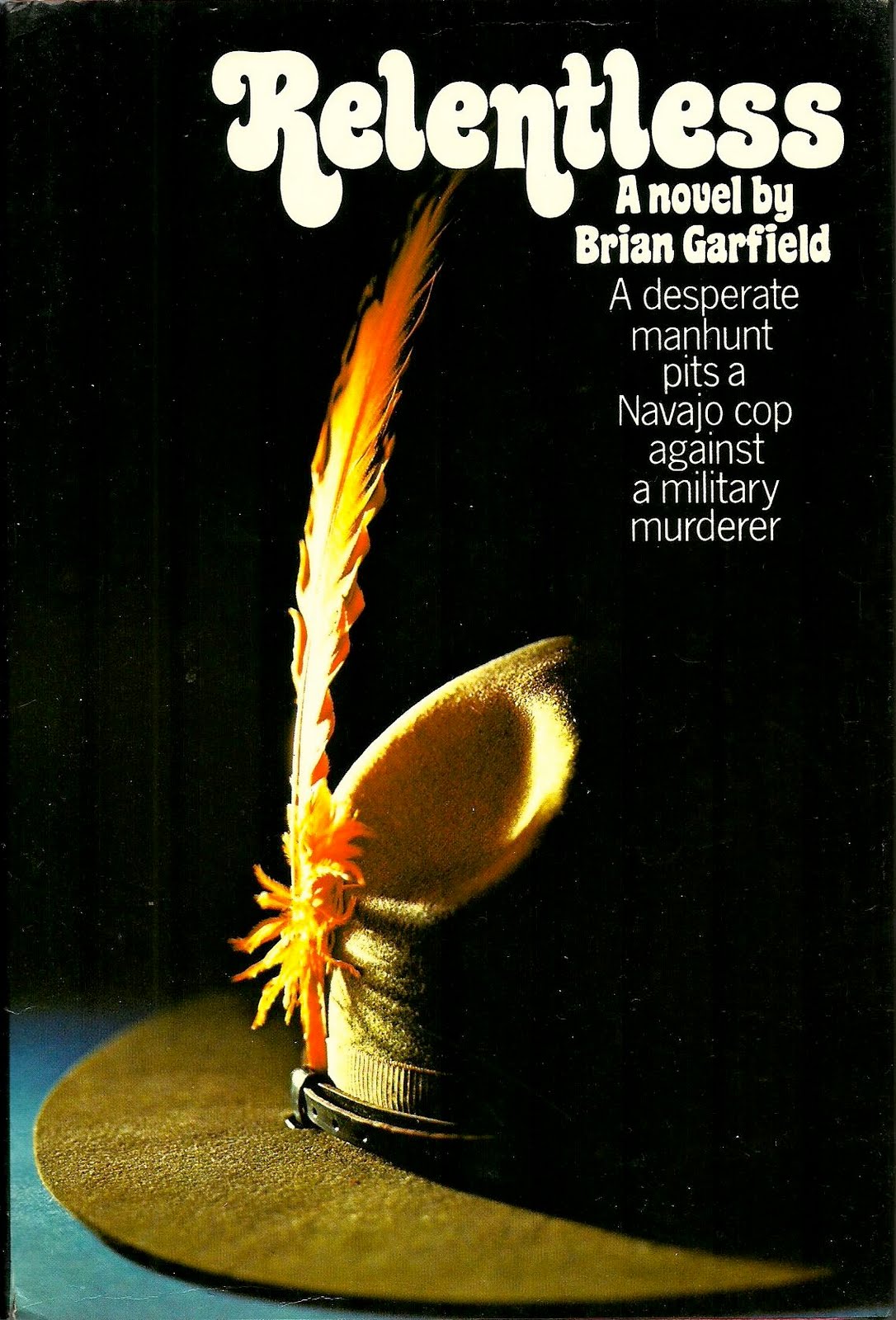
The edition pictured is the 1975 Fawcett Crest paperback.

"Relentless" by Brian Garfield (World Publishing, 1972)

Relentless is the perfect title for Brian Garfield’s 1972 novel about Navajo Highway Patrolman Sam Watchman. It captures the tenacious drive of five bank robbers who rob an Arizona bank of $1,000,000—the largest heist in the state’s history. It also aptly describes Watchman’s persistence as he chases the robbers across a perilous mountain range during a raging blizzard. Moreover, “relentless” nails the momentum and impact of Garfield’s style. The characters are strongly composed and the plot seethes pitch-perfect tension every step of the way. Relentless is a masterful novel from a writer who, at the young age of 33, was already a seasoned pro with over a dozen titles under his belt (including the terrific kidnapper caper What of Terry Conniston?). Garfield may have got his start early (his first published novel was written when he was 18), but he paid his dues, and his work shows the craft, care, and quality that comes with experience.

One of the primary challenges of writing a crime novel is not just making the crime believable—it’s making the characters desperate enough to pull it off, regardless of the difficulty. In this regard, Garfield is extremely successful. Relentless is structurally straightforward—the heist is already in motion on page one, and the rest of the book is a cat-and-mouse chase that alternates perspectives with each chapter—but with simplicity comes clarity, and precision gives power. Garfield builds his scenes with very specific, detailed knowledge about the Arizona desert, flying a plane through a blizzard, tracking people in the snow, wilderness survival. These are the marks not just of an author who has done his research, but of one who knows how to use realism for its fullest dramatic impact.

There’s a great deal of subtle, but significant, social commentary in Relentless. Foremost is its Navajo protagonist, Sam Watchman. He’s a unique and refreshing character to read about, and it’s great to see a Native American action hero in contemporary times presented with such depth and nuance. When the book was written in the early 1970s, the Native American Civil Rights movement was in full swing, and in 1972—the year Relentless was published—the American Indian Movement even occupied Wounded Knee as a protest. As Sam Watchman struggles with prejudice from his co-workers, the FBI, and even the robbers themselves, Garfield imbues his character with the political spirit of the period.

Another social aspect of the book has to do with the Vietnam War. Four of the robbers were vets, and group’s mastermind—the Major—was given a dishonorable discharge for killing innocent Vietnamese civilians. Garfield, however, doesn’t make the morality so black-and-white: he asks (not in such an obvious way) who is responsible, the grunts following orders, their officers in the field, the superiors back at the base, the training instructors, the politicians? Like David Morrell did the same year with First Blood, Garfield is bringing just a piece of the Vietnam War back home to the United States.

There’s no denying that Relentless is filled with scores of exciting, action-packed scenes, but it’s the strength of such well-developed characters that make the novel so compelling to read, and so satisfying to see through to the very last page.

Relentless was made into a TV movie in 1977 starring Will Sampson (from One Flew Over the Cuckoo’s Nest and The White Buffalo). The movie was never released on home video, but I’m trying to track down a copy…Garfield later revived Sam Watchman once more for The Threepersons Hunt in 1974, which I will review later this week.

Lee Goldberg Interview

When Lee Goldberg was still at student at UCLA, while most of his classmates were slacking off on their homework or snoozing through class, he managed to produce not just one novel…but four! The first was called .357 Vigilante and appeared in 1985, and its story followed freelance helicopter pilot Brett Macklin who goes on a city-wide rampage for justice after his cop father is burned to death by a local gang. The novel, now titled Judgment, is everything you want in an action novel: driving plot, blockbuster-worthy spectacle, fights, explosions, and just the right amount of humor to rebound from all the destruction and keep things enjoyable. Three more books quickly followed in the series (the last of which went unpublished until recently). These action classics have since been re-titled the Jury series and are available as a collection either in print and ebook formats.

That was only the beginning for Goldberg. Since then, he’s been busy not only as a novelist, but also as a writer and producer for TV shows such as Diagnosis Murder and Monk. Speaking of those shows, he’s also written a number of highly acclaimed tie-in books for both series. And speaking of tie-ins, Goldberg is the co-founder of The International Association of Media Tie-In Writers (along with Max Allan Collins).

Goldberg’s latest endeavor is The Dead Man series of novels, which originated as an idea for television with co-creator William Rabkin. (Book one reviewed here.) The Dead Man follows Matt Cahill, a lumberjack whose life suddenly changes after being nearly buried alive while skiing. Now he can literally see evil all around him—rotting flesh, maggots and worms, and a specter known only as Mr. Dark that won’t let him alone. Fusing elements action, suspense, and supernatural horror, The Dead Man series is a sure-fire bet for entertainment. The first three installments are out and—with future installments to be written by the likes of James Reasoner, Bill Crider, Mel Odom, Matthew P. Mayo, Harry Shannon, and many others—things are only going to keep getting better. Book 3 is Heaven in Hell, another winner for Goldberg and Rabkin, and it is available in print and ebook. Long live The Dead Man!

For more information, be sure to check out Lee Goldberg’s website and blog, as well as The Dead Man blog and Top Suspense Group.

Lee Goldberg was kind enough participate in a Q&A for Pulp Serenade.

Pulp Serenade: Your first novel, .357 Vigilante (retitled Judgment) has recently been reissued along with the whole Jury series. What's it like going back and reading those early works again?

Lee Goldberg: Embarrassing. Some of the writing, particularly the overuse of adverbs, make me cringe. But I am also surprised by how confident, consistent and snarky the voice is. They don’t read to me like books written by someone who had never written books before.


PS: Why the change in titles for the reissue?

LG: Actually, it was Joe Konrath’s idea. We had a little bet. You can read about it here.

PS: The Afterward mentions that you wrote this series in college, while your classmates were probably either studying or doing keg stands. Having just finished grad school, it was difficult enough to find time to blog -- yet you managed to write multiple novels! How long did each of the four novels take to write?

LG: It took me about 90 days to write each one. I wrote them in class, on the bus, in the bathroom, anywhere and anytime that I could. I put myself through school as a freelance writer, so I was already used to writing quickly under deadline and managing my time.

PS: Now that the books are back in print, did you ever consider writing a fifth book in the series and bringing Brett Macklin into the 21st Century?

LG: I have...and will...but as a book in the Dead Man series.


PS: The Dead Man is in full swing, so I'd like to ask a few questions about that series...You and William Rabkin are credited as co-writers on the first and third Dead Man novels -- how does your collaborative writing process work?


LG: We write the books differently than we write our scripts, which makes sense, given they are two very different ways of telling stories. So far, the way we’ve done it is that one of us writes the first draft and the other one does the revisions (or suggests revisions that the other writer does). But we talk to one another throughout the process. I won’t tell you who wrote the first draft of which book…you’ll have to figure that one out for yourselves.


PS: What are the advantages and challenges about writing in a team as opposed to solo?


LG: In TV, it’s being able to do twice as much work in half the time it would take a single writer. It also allows us to get a lot more work done. One of us can be writing a script while the other one is rewriting another. Or one of us can write while the other preps with the director. It also means that you have someone always making sure that you don’t take the easy way, that you do your very best. We never let one another get lazy in our writing. There are also times when I just can’t seem to get the scene where I want it to go…and I know that Bill can take a look at, know exactly what I was trying to accomplish, and take it where it couldn’t. And vice versa. It’s harder to co-write a book. But we have written together for so long now that we are very good at writing in a shared voice.

PS: What do you think are the qualities that make a good action hero, and how did you try to work them into Matt Cahill's character?

LG: Vulnerability, humor, a clear point-of-view, understandable goals, and something personal at stake in what is happening around him.

What brings out all of those aspects of his character are stories with strong conflicts and obstacles that challenge our hero in ways that make him test his own abilities, confront his fears and limitations, and question his own judgment. We really wanted Matt to be an everyman, a regular guy, someone who genuinely cares about people, feels pain, and experiences self-doubt and fear. But we also wanted him to embody the classic traits of the western hero…a personal sense of honor, rugged determination, uncommon courage, and a loner’s wanderlust… combined with a very un-Western sentimental humanity, a sadness and longing for connection that makes him sympathetic and relatable. He’s The Man with No Name combined with Dr. Richard Kimble in TV’s The Fugitive. He’s a working class, decent guy who finds himself in an extraordinary situation who wants nothing more than to just go home and lead a normal, quiet, unremarkable life again.


PS: What is your vision for the future of The Dead Man series? Is there a finite end to the story, or would you like it to go on for hundreds of volumes like The Executioner?

LG: I would like it to go on like The Executioner…but more grounded in an emotional reality, if that makes any sense. I never want Matt Cahill to become a superhero. I never want him to lose that regular guy persona, even as he becomes more accustomed to violence and to the supernatural.

PS: What does your desk/writing station look like?

LG: See attached photo.


PS: How many bookshelves do you have, and is there any rhyme or reason to how you organize them?

LG: I have 27 in my office and they are mostly filled with signed, first edition mysteries, thrillers and westerns and some reference books. On the second floor landing outside of my office, I have another 30 shelves of unsigned fiction, reference books, art books, film & TV books, etc. All the novels are arranged alphabetically by author, all the reference and art books by subject.


PS: Token goofy question: Favorite writing snack?

LG: Roasted, lightly salted almonds.


PS: What's the most challenging book you've written yet and why?

LG: I would have to say Diagnosis Murder #5: The Past Tense. It told the story of Dr. Mark Sloan’s first case. It was set present day, and told in the third person…but then flashed back for a good third of the book to one week in February 1962 and was written in first person. It was a real challenge for me to switch POV and to accurately evoke another time period. It was also the best reviewed, and best selling, of my Diagnosis Murder novels. In much the same way, I’d say Mr. Monk in Trouble was equally challenging, since half the book was set in the old west and told from a different narrator’s first-person POV.


PS: When you wake up in the morning, what makes you want to sit down and write…and on those days when you don't want to write, how do you get yourself going?

LG: The answer to both questions is the same: my mortgage. I make my living as a writer. If I don’t write, I can’t pay my bills. I don’t have the luxury of just waiting around for inspiration to strike.


PS: Big things are happening in the publishing world right now. What is the most encouraging change that you see? And what is the most discouraging?

LG: The most encouraging is the rise of the ebook and the ability now for writers to successfully…very, very successfully…self-publish. Authors have viable options for the first time in, like, ever and finding value in work they thought was valueless - namely, their out-of-print backlists. The most discouraging, and inevitable, aspect is how the rise of ebook is bringing about the demise of the bookstore. I love bookstores.


PS: What are you working on now?

LG: In books, my 13th Monk book, a crime novel called King City, and The Dead Man series. I’m also out there pitching TV series and, with luck, it looks like my feature adaptation of Victor Gischler’s novel Gun Monkeys may finally be heading towards production with a major, A-list actor attached (I can’t reveal who just yet).


PS: And lastly, any advice to up-and-coming writers trying to make their start in the writing world (like myself)?

LG: Write. No matter how bad it is. Just write. Give yourself permission to suck. Sometimes, all it takes is just hitting that one good line or paragraph to break the creative log jam. I also recommend taking a break and reading a good book. Reading forces you to work with words and your imagination.

There are mistakes I see so many aspiring writers make…and that you should avoid.

1. Looking for short-cuts. The biggest danger right now is the ease of self-publishing. So many aspiring writers are putting out their awful, cringe-inducing, unpublishable crap as e-books, simply because they can. They don’t realize that you only have one chance to make a first impression. I don’t think most aspiring writers realize how many awful, unpublished novels successful writers have in their drawers...and how many rejections they’ve received before they finally sold a book. In most cases, it’s because those early books were awful…and those authors are glad today that those books didn’t see print (that desperation for a short-cut also makes aspiring writers easy prey for scammers like fee-charging agents and vanity presses like Authorhouse, PublishAmerica, etc.)

Just because you can self-publish with ease doesn’t mean that you should. You only get one chance to make a first impression, and self-publishing a book that’s amateurish and awful and best left on your hard drive is not going to help your career. I still urge writers to do everything they can to be professionally published first… you can always go back to self-publishing. Even a bad deal with a reputable, established publisher will pay off for you in the long run in terms of editing, experience, prestige, and, hopefully, readership and name recognition that you can bring with you if you ever decide to self-publish

2. Not editing & rewriting. Believe it or not, your first draft isn’t gold. It’s probably crap. It needs work. And if you aren’t open to editing, if you can’t take a note without being offended or overly-protective, then you aren’t going to make it as a writer and you aren’t going to grow creatively. As one mentor once told me, writing is rewriting.

3. Doing too much self-promotion. Some authors forget that it’s the writing that counts the most, not the relentless salesmanship. It’s also a major turn-off to readers and your fellow authors. It’s a delicate balance, one I haven’t always managed well myself.

William Heffernan Interview

The Dead Detective, published by Akashic Books in September 2010, is William Heffernan’s seventeenth novel. It ranks not only among his best works, but also one of his darkest. The novel’s protagonist is Harry Doyle, a detective for the Pinellas County sheriff’s department known as “The Dead Detective.” As a child, he had been momentarily dead before being resuscitated, and since becoming a detective he’s felt a strange connection with the deceased. His latest case is the murder of a woman who was a convicted child molester. As more bodies begin to appear around town and Doyle gets deeper into the case, he is forced to face the ghosts of his past that he had spent a lifetime suppressing.

A former journalist, three-time Pulitzer nominee and winner of the Robert F. Kennedy Journalism Award, Heffernan’s novels are steeped in realistic crime on both the micro and macro levels. Whether focusing on the global or local stage, Heffernan has the ability to craft compelling dramas that engage with history and politics while still entertaining readers and without falling into the trappings of didacticism or dilettantism. He does his research, and it shows in the strong details and compelling dramas of his novels. The Corsican (1983), which looks at international drug smuggling in Laos in the mid-20th century, reaches Graham Greene-like heights of political intrigue. Blending cultural anthropology and crime fiction, Beulah Hill (2000) is Heffernan’s masterpiece, an investigation into a racially motivated murder in a small Vermont town during the Great Depression. And The Dinosaur Club (1997), about the corruption of corporate America, is as timely as ever and remains one of the author’s most popular works.

Broderick, his first novel, was published in 1980. It is based on the real-life figure of Johnny Broderick, a tough New York cop as legendary as he is notorious. Nicknamed “The Beater,” Broderick is anything but your conventional heroic policeman; he’s as corrupt, violent, and as crooked as the gangster and hoods he hunts down. Heffernan’s worldview is decidedly realist: his characters are imperfect, their worlds harsh and violent, and justice is rarely achieved on either the individual or judicial level.

Heffernan intertwines the personal and the political in complex dramas in which characters are involved with issues that are larger than they fully comprehend. Heffernan’s background in journalism shows through in his analysis of the roles that individual people play in national and global dramas. In Acts of Contrition (1986), when reporter Jennifer Brady begins to investigate up-and-coming politician Tony Marco and his background with the local waterfront union, she discovers that if finding out the truth is difficult, reporting it is even harder. Corruption isn’t a single cancerous cell than can be excised with one article—it’s a living cancerous organism with an extended family tree.

In Heffernan’s world, individuals may have the power to make or break history—but that power is not always in their control. You can see this at play in the political struggles in The Corsican and Acts of Contrition. Even in Cityside (1999), a journalist finds that writing an expose on medical malpractice in order to help save a child's life is not so morally cut and dry, and that saving a life isn't the top priority for either the doctors or his editors. A more personal version of this desire appears in A Time Gone By (2003), whose narrative is split between a cop in 1975 looking back at one of his first murder cases in 1945, and the long string of tragedies that all began with a decision he made back then. Heffernan is a subtle stylist, and one of his finest touches is using the past tense for the 1975 narration and the present tense for the 1945 section. So haunted is the protagonist that the past is more immediate than the present—a perfect evocation of noir’s lingering and nagging sense of regret.

At NoirCon 2010, I had the immense pleasure of meeting Heffernan and having an on-stage dialogue with the author. Following the convention, Heffernan was kind enough to do a follow-up interview with me regard his long career as a writer.

Pulp Serenade: At NoirCon, you mentioned that The Dead Detective was based on a true story. What was the original story, and what attracted you to it?

William Heffernan: A true story in the sense that the woman who was killed was real or at least based on a real woman. Shortly after I moved to Florida in 2005 the media exploded with the story of an extraordinarily beautiful middle school health teacher who had seduced one of her 13 year old students. What intrigued me was that she seemed to relish the publicity. You could see the little glint in her eyes. She dressed extremely well, was a former swimsuit model and had just married six months earlier. She made love to the student in her own bed while her husband was at work, in her automobile while the boy’s 15-year old cousin drove them along back roads – all the time watching the driver watch her in the rearview mirror. The boy she seduced was ultimately devastated by the publicity that ensued, and as I watched her on television I would look over at my own 13-year old son and wonder what was going on in the mind of a woman who could obviously have any adult male she wanted.

At the same time, there was another story about two young boys whose mother had decided to kill them by drugging them, placing them in her garage and starting the engine of her car. Both boys were clinically dead when police, alerted by a neighbor, found them. The younger, smaller boy, who was six, could not be revived. The older boy was brought back to life. The mother, who belonged to evangelical church, claimed she wanted her sons to “Go to Jesus and wait for her.” The media ate up the story, quoting the older boy extensively, when the state’s attorney claimed he would testify and help put his murderous mother in the gas chamber. The boy told the media he was prepared to testify but all he really wanted was to be sure his mother never got out of prison. He was ten years old.

Of course the “what if” hit me immediately. What if the 10 year old grew up to be a homicide detective, who could (because he had been there himself) feel what murder victims felt at the time of their death, and what if he now had to investigate the murder of a child abusing woman, who had done precisely what this Tampa school teacher had done. Add to that the emotional problem of having his mother coming up for parole. I couldn’t wait to get to the computer.

PS: You’ve been writing novels for three decades now. Do you feel like you have a comfortable routine down, or does each new novel still pose a certain challenge? If so, what challenge did The Dead Detective pose?

WH: My routine is well established but each novel always presents its own challenge. In the case of The Dead Detective the challenges were many. I was new to Florida and had to learn the area, it’s police procedures, etc. I came here from Vermont and New York City, and Florida is a far cry from either, from its flora to its overwhelming abundance of strip clubs and near fanatical Christian churches (often, I suspect, populated by the same people). So it was a long learning experience.

PS: On a similar note, after writing novels for so long, what is the most fun part of the process for you?

WH: I love the writing, of course, feeling the characters develop until they are as real as any person I might meet, perhaps even realer because they live with me 24 hours a day. The research is the most fun because it helps me develop that little world that I will live within for a year or more.

PS: At what age did you start writing, and who were some of the early influences?

WH: I started writing seriously in college and was influenced by Henry Miller at first; then Joyce and Faulkner, Hemmingway, Jim Thompson, Graham Greene, Alain Robbe-Grillet, an eclectic bunch. In truth, almost anyone I read in high school and college influenced me and filled me with the desire to do what they were doing.

PS: As a journalist, you were awarded the Robert F. Kennedy Journalism Award and nominated for three Pulitzer Prizes. What were the news stories which won and were nominated?

WH: The Kennedy Award and one of the Pulitzer nominations were for a series of articles I wrote for the Daily News exposing corruption and abuse in the Foster care system in New York City. The series resulted in 11 new federal laws. It also won a Heywood Broun Award. The other Pulitzers were for articles detailing corruption in the New York State prison system and the other for political corruption in Buffalo, New York, which also won another Heywood Broun Award.

PS: What prompted the shift from journalism to writing novels?

WH: Writing novels is what I always wanted to do. Journalism, which I loved, was a way to earn a living as a writer until I found a way to crack into the world of book publishing.

PS: Tarnished Blue, which won the Edgar in 1996 for Best Paperback Original Novel, was the fourth Paul Devlin novel. How do you sustain a character for that long and what keeps a character and his actions fresh?

WH: With great difficulty. That’s why the Devlin books ended with the seventh book. I couldn’t keep the characters fresh any longer.

PS: Beulah Hill is not only one of your darkest books but, in my opinion, one of your best. Can you talk about how you discovered this forgotten piece of American history and what drew you to it as a writer?

WH: I was looking for a house in Vermont in 1988 and the realtor had given me a map so I could follow the rural areas we were traveling through. As we headed for a house she wanted to show me I saw on the map that the road was called “Nigger Hill.” When I questioned this, she told me the name had been changed to “Lincoln Hill” in 1985 (Vermonters were slow with their political correctness in those days). When I reached the house I questioned the owner about it and was told she knew little but there was an abandoned African-American cemetery in the woods behind the house. I went looking and found it and the names of the African-American characters in the book were taken from those gravestones. This little discovery began six years of research to find the story that eventually became Beulah Hill.

PS: Many of the characters in Beulah Hill are filled with hate, bigotry, and ignorance. As a writer, how do you cope with these emotions, particularly when you do not personally side with them?

WH: In my mind I become each character and they show me where the hate and bigotry comes from. Sounds spooky but it’s true and if the characters don’t do that for you, become that real in your mind, the book will fail.

PS: One of the things that struck me about A Time Gone By is its unconventional structure that switches between first and third person narrators. In the 1970s, as an older man, Jake’s story is told through third person. But when he is remembering back to the 1940s, the story is told through first-person perspective. Why the switch?

WH: I wanted to move back and forth without having to alert the reader about what I was doing. I also wanted to write 1940 sections in the style of the great Noir writers of that time, and the 1970 section in my own literary voice. As Marilyn Stassio noted in the New York Times review, it was a clear homage to those great noir writers – Gardner, Thompson, Hammet, etc.

PS: I saw that you reviewed several books for the Washington Post a few years back. What was the experience like for you as a critic?

WH: I started reviewing books at the request of the editor, who was a close friend. I found it very difficult, especially when I had to gently pan Mario Puzo’s last book, which was published after his death. I admired him so much, and I’m still convinced he did not finish that book himself. At least I hope he didn’t. I decided to give up reviews after that.

PS: You are mainly known for your novels, but do you also write short stories?

WH: I started out writing short stories, but have given them up. The novel is where I belong.

PS: For Tarnished Blue you went on tour with Mickey Spillane. At NoirCon you told me a wonderful story that involved both of you answering a question about how long it took to write a book. Could you recount the story again?

WH: Mickey and I were appearing at a bookstore, largely before a crowd of middle aged and older women. One woman asked us how long it took us to write a book. I went into a long (too long) and convoluted answer about it depending on how much research was needed, etc. Mickey, God love him, just looked her in the eye and gave her the truest and most honest answer I have ever heard flow from a writer’s mouth. Mickey who had a number of ex-wives still collecting alimony said: “It depends on how much I need the money.”

PS: Lastly, what is up next for you? Any projects you can let us know about?

WH: I just finished a book set during the civil war, and I’m starting the research for another “Dead Detective” book, this one set within the Scientology community in Clearwater, Florida.

Talmage Powell on Words and Writing, Part 2


This is third-hand information, and perhaps more than a tad apocryphal, but nonetheless amusing.
"Day Keene, when he first introduced me to Talmage Powell...told me that Powell only wrote on Friday afternoons. With the volume of work he's turned out over the years, this had to come under the heading of a base canard, but Powell apparently thought it amusing enough not to deny it." --Robert Turner, Some of My Best Friends Are Writers, But I Wouldn't Want My Daughter To Marry One!, page 176-177

Even More Love and Admiration for W.C. Fields

Over at AltScreen, my outpouring of love and admiration for W.C. Fields continues.

"Speaking Fields: The Gift of Gab" is an appreciation of Fields' inimitable, bizarre vocabulary.
"Equal parts carnival barker and poet, Fields made ballyhoo sound like opera. As he grew older and his frame bulkier, his voice became increasingly lithesome, exhibiting an uncommon playfulness and range. Fields could shout at the top of his lungs, speak out of the sides of his mouth, or insult you under his breath, but he always brought a melody to his speech, such that one often thinks of Fields as much as a vocalist as a humorist."
I also pay tribute to my favorite Fields movie, "The Fatal Glass of Beer."

Earlier in the week, I posted a link to this paean to Fields' two most recurring character types: "The Con-Man Philosopher and the Everyday Sucker."

Crime Fiction is Everywhere This Week!

Too much great crime fiction articles and interviews on the net this week! Time to catch up over the weekend.

--Two of my favorite novelists, Reed Farrel Coleman and Daniel Woodrell, go mano a mano over at Mulholland Books. Part 1 and Part 2.

--Speaking of Woodrell, have you checked out Jed Ayres' interview with the author yet?

--Over at The Los Angeles Review of Books, Megan Abbott reviews Robert Crais' The Sentry: A Joe Pike Novel.

--Also at LARB, Richard Schickel reviews Stefan Kanfer Tough Without a Gun: The Life and Extraordinary Afterlife of Humphrey Bogart.

--Paul D. Brazill interviews Gordon Harries about his upcoming writing projects and the future of Needle Scratch Static.

--Over at Needle Scratch Static, Harries talks Robert B. Parker, Ace Atkins, and Spenser.

--Bill Crider writes about Private Eyes and Westerns.

--Jake Hinkson has two pieces of great interest over at Criminal Element: "Spenser: A Look Back at Robert Parker" and "Memento and Amnesia Noir."

--Oh yeah, you check out the latest Plots With Guns? No? Then why are you reading this!

"The Dinosaur Club" by William Heffernan (William Morrow & Co, 1997)

Abandon all hope all ye who enter corporate America...or so it seems to Jack Fallon when rumors of downsizing and layoffs start to spread. As the 49-year-old Vice President of Sales for Waters Cable Corporation, he knows that he and other people in his age bracket are the targets of downsizing. But with his personal life falling apart, his wife leaving him for a wealthy dentist, his kids blaming him for the separation, and his mother’s incessant nagging, Fallon decides to strike back. With the aid of his fellow middle-aged colleagues, Fallon forms “The Dinosaur Club,” a covert group that sets out to terrorize the top brass at Waters Cable Corporation. Even if they go down, they’ll go down fighting.

William Heffernan's The Dinosaur Club was published in 1997, but its prescient story could easily apply to the contemporary economy and the financial worries that many are still facing today. It is about workers who are afraid of losing their jobs, and the greater fear of what life will be like when they have to start over. Heffernan also blends comedy with darker elements of revenge fantasy and mid-life crisis. We cheer on as Fallon and co. make their own investigations into fraud and other illegal activities going on behind-closed-doors, and especially as they figure out the perfect poetic justice to deliver to the ruthless, cocky executive Carter Bennett who is behind the layoffs.

But if we laugh along side them, we’re also never sure if The Dinosaur Club will succeed. The troubles they go through are real, and the pressures felt ones that many can relate to. How to pay for their kids’ university tuitions and nursing home fees for their parents, and how to sustain a marriage frayed by work stress that followed them home from the office. It is joyful to watch Fallon flirt with the younger, attractive company lawyer Samantha Moore, but we can’t help but wonder if this is just part of a mid-life crisis, and will it too just come to pass?

If there is anything positive about Fallon’s turmoil, it's that it woke up him from a mindless existence of routine. He lost control of his life long ago and became what others expected of him. Fallon's realization offers a hint of optimism amidst what would otherwise be a dour, hopeless situation. I appreciate that Heffernan sees the possibility of a light at the end of a tunnel. Who knows how long that tunnel may be, but such hope from a socially perceptive writer such as Heffernan is certainly encouraging.

Here is one of my favorite passages from the book, which captures Heffernan’s outrage at the ruthlessness of corporate America:

“I see them laying off hundreds, thousands of people, and I wonder what the hell is going on in their minds. Isn’t anyone saying: Hey, wait a minute, if we all do this, who the hell is going to buy our TV sets and our cars and our toasters? Where’s our talent pool going to come from when all those families can’t afford to send their kids to college anymore? What’s going to happen to our economy when those kids grow up and are never able to buy a house? And you know what’s even sicker? Nobody’s asking those questions. Not even guys like me.”

The New York Review of Books April 28, 2011

The latest issue of The New York Review of Books (April 28, 2011) has several articles that caught my eye.

--Geoffrey O'Brien reviews Iphigenia in Forest Hills: Anatomy of a Murder Trial by Janet Malcolm. A true crime book about the trial of Mazoltuv Borukhova, who hired Mikhail Mallayev to murder her husband, Daniel Malakov in 2007. What I liked about O'Brien's review is that he pays attention to not only Malcolm's reportage, but the way that she analyzes the real-life courtroom drama in an almost literary manner.
"The truth is messy, incoherent, aimless, boring, absurd," Malcolm has written elsewhere. "The truth does not make a good story; that's why we have art." The paradox of Malcolm's writing is that all her art is deployed to reveal the seams and interstices of the art-making process, to lay bare the details fudged or blurred or condensed, the inconvenient incongruities and confusions regularized or omitted, the bias by which certain details are foregrounded and others tossed aside.
--"Killing Orson Welles at Midnight" by Zadie Smith is a review of Christian Marclay's film The Clock. A 24-hour museum installation piece, The Clock reconstructs an entire day solely from moments from existing movies that feature clocks. I like how Zadie Smith deconstructs the subtle role of editing in movies and its relationship to the passing of time, something that often goes overlooked in most film reviews.
The Clock makes you realize how finely attuned you are to the rhythms of commercial (usually American) film. Each foreign clip is spotted at once, long before the actor opens his mouth. And it’s not the film stock or even the mustaches that give the game away, it’s the variant manipulation of time, primarily its slowness, although of course this “slowness” is only the pace of real time. In commercial film, decades pass in a minute, or a day lasts two and half hours....A parsing of the common enough phrase “I don’t like foreign movies” might be “I don’t want to sit in a cinema and feel time pass.”
--Joyce Carol Oates reviews James Ellroy's The Hilliker Curse: My Pursuit of Women. What a pleasure it was to read this review. Oates is a rare talent. Brilliant novelist, short story writer, and critic. I haven't read her recent memoir about the passing of her husband, but I'm sure that is also terrific. She fearlessly engages with Ellroy's style, his ego, and his own self-constructed mythology. She's not afraid to call him out when she feels he is being repetitive, narcissistic, or inaccessible to readers not already familiar with the World According to Ellroy; but she's an insightful enough reader to recognize the personal depths of The Hilliker Curse, Ellroy's trail-trailblazing original style, and his ability to transmit his own fevered passions and obsessions through the page.

--Edward Mendelson reviews Saul Bellow: Letters edited by Benjamin Taylor. Mendelson compares and contrasts excerpts from Bellow's published novels with his personal letters to show how deeply personal his work was. I only know Bellow from reputation and am not familiar with his work, so reading this review was rather confusing. I have a few Bellow novels back in Maine at my folks' place; the next time I visit I will have to take one off the shelf and take a gander.

"The Follower" by Jason Starr (Minotaur, 2007)

The Follower shows why Jason Starr is one of the great contemporary writers of New York City. He has an instinctive feel for the city’s pulse, its labyrinthine layout, and the neuroses and delusions of its inhabitants. Books like Panic Attack, Fake I.D. and the graphic novel The Chill chart the geographic diversity of New York and instinctively locate the natural terror inherent in every city block. In The Follower, Starr seizes upon the emotional torment of a young woman and communicates to the reader the fear of feeling alone and vulnerable while being surrounded by millions of people—each of whom contain the potential for unrealized terror.

One of the great ironies of New York City is that, despite being a big city, sometimes it feels as intimate—or claustrophobic—as a small town. Especially Manhattan. The skyscrapers and apartment complexes may tower higher and higher into the sky, but the size of the island remains the same. With such a dense concentration of people, it’s not uncommon to run into someone you know on the street, at the corner bodega, or at the gym.

Or so Katie Porter thinks when she sees Peter Wells at her gym. In fact, she’s strangely comforted by seeing someone from her hometown of Lenox, MA. Things aren’t going well with her boyfriend Andy, and she needs someone to talk with. Peter seems so caring, so sensitive, so attentive. But soon, all this attention starts to seem creepy and their meeting at the gym too convenient, as if it were planned. Paranoia takes over as Katie is convinced that someone is following all over the city, and Manhattan’s grid-like network becomes as entrapping as a rat’s maze.

Starr’s gifted ability to blend absolute panic with razor sharp humor is on full display in The Follower. More than just a suspense story, it’s also a satire on the New York singles scene, with twenty-something post-grads bar hopping and drunkenly flirting with anything on two legs. Starr shifts perspectives between his three main characters—Peter, Katie, and Andy—and the contrast of their unique perceptions is frequently funny. There’s also a hubristic arrogance to Peter’s observations that seems to embody noir’s dark humor: “Killing people and getting away with it was so easy. You had to be a total moron to get caught.”

Starr writes of the optimism of losers. Peter’s recurring hopefulness—“Everything could work out perfectly” and “But he reminded himself that this was only the beginning”—belie the hopelessness of their missions. Starr’s protagonists frequently mix the defeatism of David Goodis with the psychopathy of Jim Thompson. Like the down-and-out bartender Tommy Russo in Fake I.D., Peter Wells is a model of this noir mixture of someone too delusional to realize how depressed they are. If he weren’t so goddamned homicidal he’d probably be suicidal. Unlike the debt-ridden Tommy, Peter has money to burn, time to lose, and dreams to realize—dreams which quickly turn into nightmares of repressed desire and frustrated failure.

If Peter were just an obsessive stalker, he would be a one-dimensional character. Starr, however, adds an innovative twist to Peter’s personality. As part of his job at the gym, Peter has to go out onto the street like a barker and sell gym memberships to passersby. For a sociopath that can’t connect with people without stalking or killing them, Peter is ironically great at relating with people on a superficial level. As his boss tells him, “You know how to relate, know what I’m saying? Even some stranger on the street—man, woman, it doesn’t matter. They like you right away, and when they like you they trust you. That’s the whole key with sales.” There’s a Highsmithian duplicity to Peter Wells, a chameleon-like capacity for changing his personality, only Peter isn’t as diabolically clever as Mr. Ripley—Peter’s not a genius, his plans frequently fail, and there’s something very ordinary about him, which makes his character all the more frightening. There’s only one Ripley, but Starr gives the impression that there could be any number of Peter Wells out there.

Catching up with Greg Shepard and Stark House Press

Greg Shepard is like a literary archeologist, digging into depths of forgotten fiction and unearthing bookish treasures. Through Stark House Press, Greg shares his discoveries with readers around the world. Classic crime fiction is the Stark House forte, but they’re not afraid to branch out to sci-fi, fantasy, film scholarship, or original novels, as long as they’re well written. Stark House has superb taste. If you see their logo, you can bet it’s going to be well worth reading.

Back in Fall 2009, I interviewed Greg about the start of Stark House, as well as the Harry Whittington trio that had just come out. Almost two years later, Stark House is still going strong. 2011 has already seen the release of Peter Rabe’s The Silent Wall / The Return of Marvin Palaver and a collection of rarities by Don Elliott (an early pseudonym of Robert Silverberg), and there is more Day Keene, Harry Whittington, and Orrie Hitt to come. Greg was kind enough to answer a few more questions for Pulp Serenade about the recent Elliott/Silverberg publication, as well as what Stark House has in store for readers.

Pulp Serenade: How and when did you first encounter Nightstand/Midwood paperbacks?

Greg Shepard: As a collector, I’ve been aware of Nightstand/Midwood for a while. I’ve acquired a few of their books over the years, including some of the Elliotts. I never sought them out as such, but I’ve certainly been intrigued by them as publishing’s forbidden fruit for at least 25 years.

PS: What was it like working with the great Robert Silverberg?

GS: Bob is a pleasure to work with. There isn’t much else that needs to be said. He is one of the great gentlemen of the publishing world. And I hope to work with him again.

PS: Was it difficult to convince Silverberg to reprint these? Did he have any reservations?

GS: Curiously, I had contacted Bob about 3-4 years ago about reprinting some of the Elliott books, but he wasn’t interested. Polite but firm. Then out of the blue, he contacted me a year ago and asked if I were still interested. If he had any reservations, it was about how to market the books. He didn’t feel that he wanted the Silverberg name on the books as in “ROBERT SILVERBERG WRITING AS DON ELLIOTT.” He has a keen sense of his audience and didn’t want to confuse the sf readers with his erotica writings. Nor did he want them marketed as “Sleaze Classics” as many of these books are known today. He feels, quite rightly, that the books stand on their own, and that there is nothing inherently sleazy about them. So once we worked out the parameters, the project went very smoothly.

PS: Why Gang Girl and Sex Bum? Were there other titles you considered?

GS: Bob picked out the titles. Considering how many books he’s written as Elliott, not to mention his other adult pseudonyms, I thought I’d bow to his greater knowledge in this case. Once I read them, Gang Girl appealed to me because it was one of the first Elliotts, and Sex Bum because of its obvious crime angle. I’m not sure if there’s a perfect way to pick two titles out of 150 and come up with the ideal selection, so going with Bob’s choices seemed a good way to start.

PS: Did you hear from Earl Kemp (who originally published the Elliott books) at all while you were working on this reprint? If so, did he have anything to say about seeing these works in print again?

GS: Didn’t hear from Earl. I’d love to hear what he thinks about the reprints.

PS: What is the total amount of time it takes to put something like this Don Elliott anthology together, from conception to seeing the final bound product?

GS: That’s an interesting question. In this case, it took almost exactly a year between Bob’s initial email and the publishing of the book. It doesn’t have to take that long due to production, but because Stark House is only publishing four books a year, I have a schedule that is always at least two+ years out. I slotted the Elliott book in as soon as I could once the contract was signed, but if I were publishing more books a year, I probably could have had it out in less time--8-10 months easily. And if it ever becomes possible to publish Stark House full time, I probably will have the books out sooner.

PS: These two books were reprinted over fifty years ago. Do you think anyone involved thought they would be around today?

GS: Man, I seriously doubt it. I never asked Bob, but at the rate he was cranking them out back then, I can’t imagine he thought these books were going to have another shelf life 50 years on. I wouldn’t have.

PS: What is it about them that makes them still interest readers today?

GS: Bob Silverberg is just basically a great storyteller. You get caught up in his books. I recently re-read The World Inside. Completely different experience from the Elliott books. In the case of the Elliott books, story predominates. In the case of World Inside, theme is more important. But in both cases, the characters matter and the story propels you on. Gang Girl is the story of a woman who tries to manipulate her way into leadership of a gang. Sex Bum is about a guy who wants to be head of the mob. They both want power. They reach for it and fail. But in their reaching for it, they touch upon that basic instinct in us all to better ourselves, to strive, to achieve. I think they both have stories that are pertinent to today for the simple reason that they both involve the conflict between not having and wanting. It doesn’t get much more basic than that.

PS: And now for a couple questions about some upcoming Stark House Releases…You are working again with David Laurence Wilson on two collections: one of Day Keene and one of Harry Whittington. They both have so many great books out of print, how did you decide on these three?

GS: You can blame the Day Keene collection on me. I read a bunch of Keene books, and picked my three favorites. I’m not saying that there aren’t better Keene books—David is a big fan of Joy House, for example--just that these were my three picks from the books I read at the time. As for the Whittington collection, David and I discussed this back when we did the last Whittington book. I particularly like Rapture Alley and Strictly for the Boys, two of Harry’s social novels. David thought they’d work well with A Taste of Desire, one of the “lost” novels he wrote about earlier. So we put them together in one volume, another 3-in-1.

PS: I also see you have an Orrie Hitt collection coming up later this year. What can you tell us about the two novels that you are reprinting?

GS: The Cheaters is one of Orrie’s best noir novels, with a great crooked cop antagonist pitted against a guy who just wants to manage his bar while having his way with the previous owner’s wife. Dial M for Man has the distinction of having a TV repairman as noir hero Hitt’s characters are a bit larger than life, but they’re a lot of fun to read. I have no idea how well these books will do, but I’ve enjoyed working with Orrie’s daughters and some of the Hitt fans like Brian Ritt and Michael Hemmingson to produce the book.

PS: Lastly, does Stark House have any plans to offer ebooks in addition to print volumes in the future?

GS: I don't want to say anything against progress, but I'm not much interested in ebooks personally, and have a hard time getting excited about offering Stark House Books in this format generally. I could change my mind. It's not inconceivable. But at present, I don't have any plans to create an ebook line.

PS: Thank you very much for your time, Greg. It’s always a pleasure to have you at Pulp Serenade.

Jed Ayres Interviews Daniel Woodrell

Jed Ayres cornered Daniel Woodrell and made him spill the beans over at Ransom Notes. Head on over there for the full interview.
Jed Ayres: Does it bother you any that the "country noir" a label that stuck to you for better or worse and which has been popularized largely through you, is being taken up by young writers, perhaps untested, whose point of view is perhaps un-earned?

Daniel Woodrell: Country noir was not a term I expected to survive long and become attached to me forever. There is no point in my wishing it was gone, since it won't be anytime soon. Younger writers should grab onto anything that gives them a foundation, or sense of what they are trying to do, and if the term is congenial to them, have at it. The worrying aspect of said label is that you may feel that whatever you write needs to fit the term, and thereby limit your own investigation of other things that interest you in order to continue being the writer that the label says you are. Remember that with any luck, life is long, and you might want to change your hat someday, and perhaps on many days.
Woodrell's The Bayou Trilogy comes out two days from now from Mulholland Books. (Pulp Serenade Review here)

"The Town Square" by Orrie Hitt (Swank, May 1964)

"The Town Square" is one of the few known short stories published by prolific novelist Orrie Hitt, and it appeared in the May 1964...