"Guns of North Texas" by Will Cook (Gold Medal, 1958)

Will Cook’s Guns of North Texas (1958) opens with Lon Cordeen returning from the Civil War to his home in Elk Crossing, Texas. Upon arrival, he finds that his father (fittingly named Temple) and brothers (the older Paine and younger Hoby) are on a mission to lynch or run out of town everyone who is black or a Yankee. When he is asked to kill his sister’s fiance, Lon must reconsider the value of family and the cost of betrayal.

The book was well reviewed by Nelson Nye in the New York Times, who commented “The story has been told and told again, but Cook's harsh version discovers new meanings, an immediacy and humorless depth seldom achieved in pulpwood fiction.”

I wasn’t as enthusiastic about the book as Nye was. Lon is such a fair and understanding character that he tends to be unexciting. Even when he’s drawing a gun against his own cousins, he’s so sympathetic to his enemies that I would lose interest in what he was doing. Lon’s younger brother, Hoby, on the other hand, is a very compelling character. Hauled off to war while still a teenager, then forced into a lynch mob, and then dragged into a bloody family feud, Hoby ages faster than boys his age should. We watch him turn cynical and cold-blooded, and grow more intelligent and insightful into the best and worst parts of his family than Lon is ever capable of. Hoby would have been a much more exciting main character to focus on, and it would have pushed the novel more into the territory of something Harry Whittington might have written.

William Everett Cook was born in 1921 and died in 1964. He published a number of stories in the pulps (bibliography here at Fictionmags Index), and several other Westerns for Gold Medal including Badman's Holiday (1958), Last Command (1964), Outcast of Cripple Creek (1959), The Wind River Kid (1960), and The Wranglers (1960).

A quote from the book:

“You’re a dumb animal,” Lon said. “But how much of this can you take, cousin? You know what I’m going to do? I’m going to pound on you until your brains are scrambled and you’ll walk the rest of your life on your heels and every time you see me you’ll take off my hat and put it back on again; it’ll be the only thing you’ll ever be able to do.”

"Home is the Outlaw" by Lewis B. Patten (Gold Medal, 1958)

In Lewis B. Patten’s Home is the Outlaw, notorious gunman Morgan Orr has decided to trade in his irons for an honest living breaking cattle in his hometown of Arapaho Wells. But starting over isn’t as easy as it seems. No one in the town is ready to forget Morgan’s past; his girl has gone and married the local banker who harbors his own dark secrets that, if revealed, would send the town into a bloody uproar; and a number of young gunmen are anxious to lure Morgan back to his old life for their own shot at bringing down the infamous shootist.

The story becomes progressively darker as the narrative unfolds. There’s a real pulse to the story, and it quickens as the tension and drama increase, culminating in an exciting and frenzied finale. Patten’s characterization of mob violence is particularly frightening, but also insightful into human behavior, ranking right alongside Fritz Lang’s Fury.

The novel has a bleak worldview that crosses the border into noir territory in a number of ways. Foremost is the circular journey of a protagonist who runs from his past only to wind up back where he started, as well as the feeling of utter helplessness, that his downfall was predestined and out of his control. It wasn’t greed or lust or vengeance that drove Morgan Orr to the gun, but a fateful accident. The capacity for violence was always there, he just needed to be pushed. And try as he might, Morgan can never fully bury that impulse.

That’s only the tip of the iceberg – the deeper one looks at Home is the Outlaw, the more noir the story becomes. The whole town of Arapaho Wells, in fact, has that same violent streak running just below the surface. Once the skeletons start coming out of the closet, the town quickly erupts into a bloodthirsty mob. Hypocrisy and corruption are as second nature to these people as breathing, but perhaps they are just better at hiding it than Morgan. Or perhaps he’s just more honest about it. And it is this openness and self-knowledge that makes the Western anti-hero so appealing and so sympathetic, and also so timeless.

The motif of a youthful outlaw who comes home to make good but whose dark past follows him reoccurs in other Patten books, such as The Odds Against Circle L. Likewise, the major conflict in both stories are ignited by fractured families and the threat of hidden pasts coming to light. Morgan still hasn’t atoned with his alcoholic, neglectful father, and the feud between the brothers at the Circle L Ranch endangers the whole family and its business. While The Odds Against Circle L suffers from poor pacing, redundant details, and somewhat clueless characters, there are certainly redeeming elements to the book, one of which is this noir-ish tone that we also see (perhaps more clearly) in Home is the Outlaw.

Patten was born January 13, 1915 in Denver, CO. During the 1930s he served in the US Navy, and later worked as a ranch operator before turning to writing. He was a busy author, eventually publishing over 100 books and many short stories for publications such as Ranch Romances. To my knowledge, he only did 9 books for the Gold Medal imprint: Five Rode West, Gunsmoke Empire, Home is the Outlaw, Massacre at San Pablo, Rope Law, The Ruthless Men, Showdown at War Cloud, Top Man with a Gun, and White Warrior. Patten passed away May 22, 1981.

As is tradition on Pulp Serenade, a few quotes from the book that strike me as particularly noir:

“Broke and hungry, hounded and defeated, sick of the past and all the memories stored in the past. Would it be any different here?”

“By the time Morgan saw where his life was leading, it was too late.”

“Nothing was all bad, or all good either, for that matter. People were people, reacting to a lot of different things. Like fear.”

“He could see no hope, no future for himself. Even if he survived the night, even if he succeeded in turning back the mob, the events of the night would make it impossible for him to stay in Arapaho Wells. Hatred for him would be too strong.”

"The Name's Buchanan" by Jonas Ward (William Ard) (Gold Medal, 1956)

In 1956, hardboiled writer William Ard turned his pen westward and introduced one of the genre’s most enduring characters: Thomas Buchanan, better known as just “Buchanan,” a drifter as likeable as he is deadly. The first novel in the series was called The Name’s Buchanan and appeared under the pseudonym “Jonas Ward.”

When Buchanan rescues a young woman after being raped, he doesn’t realize that he is getting in the middle of a violent clash between two powerful families, one on either side of the US/Mexican border. Returning the girl to her family, Buchanan heads north to Agrytown, where he meets the young girl’s brother, Juan, who is hell bent on revenge. But when Buchanan lends a helping hand, he winds up in jail with Juan, and on the bad side of the greedy, backstabbing Agry family. With danger all around him, Buchanan must figure out how to save his and Juan’s necks while avoiding the wrath of the Agry clan.

William Ard’s hardboiled background shows through. The writing is both tough and funny, which makes for an entertaining read. There is a lot of great action, and plenty of twists, especially with the Agry family ready to sell each other out at the drop of a hat. I also like how Ard gives Juan and his family a lot of attention in the novel, which makes for a richer tapestry of character, action and drama.

Buchanan is a classic example of the Western anti-hero – a hired gun with a mysterious past who rides into town as the story begins, and rides out when it ends. Trouble is never more than an arm’s length away, and excitement seems to follow Buchanan wherever he may roam. The girls like him, and the men (at least the honorable ones) respect him even more. While we get hints about his past as a hired gun for the Mexican Revolution, it is clear that his days as a gunman are behind him. His code of ethics is more noble than any law book, but he’s not indignant about morality. He helps the underdog, never takes advantage of anyone, never shoots anyone in the back, and won’t sell himself out for any price. How can you not be charmed a guy like that?

Before dying too young at the age of 37 from cancer, William Ard completed four more Buchanan novels: Buchanan Says No, One-Man Massacre, Buchanan Gets Mad, and Buchanan’s Revenge. A fifth, Buchanan on the Prod, was completed after his death by Robert Silverberg. Brian Garfield did one and then William R. Cox took over the series and it continued until 1986. For more information, check out Mystery File and this William Ard website created by Dennis Miller.

This book was also turned into a movie called Buchanan Rides Alone (1958), starring Randolph Scott as Buchanan, and directed by Budd Boetticher. Scott is a perfect Buchanan, at once rugged and delightful. The screenplay by Charles Lang streamlines the book, focusing more on Buchanan rather than the peripheral characters, which makes it move along at a nice, brisk pace. It’s a very enjoyable movie, and the DVD is terrific quality.

Here are three quotes that I particularly liked:

“His fists beat down remorselessly on that face below him, watched it change shape, felt the bones snap, stopped hitting only when he was too arm-weary and knuckle-sore to continue.”

“The big .45 came clear and jumped and roared death in Juan’s slim hands until there was no more vengeance in it. Even then the smooth-working hammer clicked three times on empty shell cases.”

“The little gun with the big caliber rocked the room with sound. Three times the Colt gave answer. Then it, like everything else, was quiet.”

"Some Must Die" by Gil Brewer (Gold Medal, 1954)

Take one step and you’re almost dead. That’s how Gil Brewer’s blistering snowbound Western Some Must Die begins. Setting the tenor for the rest of the novel, Brewer refuses to let go of the fevered sensation evoked by the first two sentences: “After the first bright moment of agony, he felt no pain. He lay there in the thinly sifting snow and listened as the smashing echo of the sprung trap chuckled back and forth against the canyon walls and went away.” Tension and paranoia steadily build as the story unfolds largely in a single, claustrophobic house in the mountains over the course of 3 sleepless days as its inhabitants wait like a coiled snake.

This noir-tinged Western novel was originally published by Gold Medal in June 1954. Lost in the mountains of Monata, Clay Hardan is caught in a bear trap. He’s got $150,00 in his saddlebags, and he’s running from both the law and his two partners he ripped off. Freeing his leg, he manages to crawl to a nearby house where even more trouble lies behind closed doors. There’s Hall, an alcoholic has-been doctor who spends his evenings shooting pistols at flies; his embittered wife, Marla, who will flirt with any man able to help her escape; and her fanatical sister, Leona, who harbors secret feelings for Hall. Even if Clay could stand, with his ex-partners nipping at his heels and a raging blizzard outside, there’s nowhere for him to run.

Brimming with intensity and isolation, Some Must Die is twice as forsaken and twice as fiery as Brewer’s breakthrough novel 13 French Street. The two share a lot in common: they are both chamber dramas mostly set in one location, which fuels the sexual tension and forces the latent violence to rise to the surface. But instead of the single triangle of characters of 13 French Street, Brewer makes the plot more complex by having two separate triangles – the criminals (Clay, Sam and Stewart) and the family (Hall, Marla and Leona) – that intersect, multiplying into twisting, ever-growing vines of deceit. It makes for a dramatically superior book, but also gives the human interaction greater psychological depth and a wider range of emotions.

The snowy, mountain setting is suggestive of Walter Van Tilburg Clark’s Track of the Cat, but the action and characters of Some Must Die are pure Brewer. While they fit perfectly in the Western setting, there’s something primal about their actions that would make them right at home amidst any of Brewer’s contemporary settings, whether in urban cities or backwoods shacks. It is also a terrific fusion of Western and Noir sensibilities – lines like, “There was nothing here now, nothing inside him, only a great darkness,” add a melancholic shade to an otherwise exciting story.

Despite its excellence, Some Must Die “sold the fewest copies of his early books,” according to Bill Pronzini’s essay “Forgotten Writers: Gil Brewer.” It is a shame that it is out of print (and only went through one paperback printing in June 1954), not only because it is Gil Brewer’s only Western, but because it is an all-around excellent novel, and a distinctive member of the Gold Medal family.

Here on Pulp Serenade I've also reviewed Brewers novels Flight to Darkness (reprinted by New Pulp Press) and 77 Rue Paradis.

Here are some of my favorite quotes. The first one, in particular, is pretty bleak, even for Brewer.

“I knew it would come to something like this – the slow disintegration, the eternal creep toward primeval club and cave.” He belched, looking sadly out into the room, his slack-jawed face haunted with a kind of serious resignation. “The ubiquitous purple twilight raining down on all the unfettered souls living a liberty that never existed in the first place – gagged and bound with strips of their own hides in the second place. Life in death amid suffocation out of decay.” Again he belched. “Excuse me,” he said. “Amen.”

“It was like moving in a dream. The tight brink of disorder; deliberately rebelling against the instinct to do things quickly, to know, to finish the job at hand. Forcing it back and waiting some more with every muscle as taut as the thinnest guitar string , the nerves singing with strain.”

“Says I ain’t alive no way, Sam. Says I been dead ever since I was born. Says a man ain’t got no freedom without he kills himself someway and life is a slaughterhouse, o’ny it ain’t that neither. Hell. You got to stop it. He’s a damned – Where’s the whisky at?”

“Honesty is where you find it, like truth. The same thing. Only I have become a spectator who doesn’t care anymore. That’s the only way to watch, you know? You may wonder at me all you wish. I don’t care about that, either. What’s done is final. I quit ticking, like the old clock, years ago. Like the old clock, it doesn’t really matter whether I run or not. Time goes on just the same, it’s irrevocable. And there will always be other frantically ticking clocks around to carry on. It simply doesn’t matter, that’s all.”

-----------------
Cover art by Ray Johnson.

"The Man From Riondo" by Dudley Dean (Gold Medal, 1954)

Dudley Dean McGaughey was a prolific writer who published under many names, including Dean Owen, Dudley Dean, and other similar variations. He began writing for the pulps in the 1930s, appearing in a number of magazines including Street & Smith's Western Story, Ranch Romances, Cowboy Stories, Real Western – an extensive bibliography is available here at The Fictionmags Index. He went on to have a long career as a novelist, including several titles for Gold Medal (and another Fawcett imprint, Crest). The Man From Riondo, published under the name “Dudley Dean,” originally appeared in 1954, and it was his second title for the imprint. It would ultimately go through numerous printings, so it would appear to be one of his more popular titles.

Brack Ventress lives in the shadow of his fast-draw, hard-livin’ old man. Everywhere he goes, people either loved or revile his father – the latter, more often than not. But when Kyle Gannon and his captive redhead, Nila, pass through Cornwall, Kansas on their way to Riondo, skeletons come out of the closet, and guns come out of their holsters. Gannon’s hatred for Brack’s father runs so deep he wants the boy killed, and Brack won’t stop until he uncovers the truth behind his father’s life, as well as his death.

James Reasoner characterized Dean as “one of those authors who really liked to torment his heroes.” The Man From Riondo certainly fits that description. With its complex genealogies, concealed siblings, and blood loyalties and feuds, The Man From Riondo reads like a Greek Tragedy with Spillane-levels of torture. Rape, murder, lynching, lashing, kidnapping, ambushing, double-crossing – the list goes on. Dean doesn’t write the romantic West of larger-than-life heroes and their black-shirted villains, not by a long shot. Instead, Dean writes of a morally corrupt West where friends, lovers, and family are capable of the worst betrayals.

I liked Dean’s hard-edged style of writing and found the characters and stories compelling. But with so many characters with such intricate histories introduced all at once, I found the first few chapters to be overly expository and too dense. Once the introductions were over and the story got rolling the pace picked up and I was on board right to the very last page.

For more information, be sure to check out Mystery File’s “Dean Owen: A Checklist,” written by Steve Lewis, James Reasoner, Victor Berch, and Bill Pronzini.

Here’s a sample of the torment that Dean puts his characters through:

“He felt the intense pain of the wet rope across his ribs. So great was the blow that it caused his body to spin at the end of the taut rope. Hardly had he recovered from the shock when the other three were upon him. They came in a single file, expertly wielding the wet ropes, and each blow seemed greater than the last. The rough hemp cut through his shirt and his underwear and in a matter of seconds they were stripped from his upper body. A rope caught him under the armpits and he cried out at the sheer agony of it…”

"Red Runs the River" by William Heuman (Gold Medal, 1952)

William Heuman was born February 11, 1912 in Brooklyn, NY. He was a prolific writer who wrote for a number of the pulp magazines in a variety of genres, though it appears that Sports and Westerns were his two most consistent. Among the magazines he published in are Dime Sports Magazine, Thrilling Sports, Fifteen Western Tales, Street & Smith’s Western Story, Dime Western – the list goes on. His first full-length novel was Fighting Five (another sports-themed story) in 1950, and he would go on to write over 70 more novels, many of them Westerns, and many of them for Gold Medal.

Red Runs the River was published in 1952, and it’s a terrific story set along the Missouri River. Kirby Trent and his steamboat The River Queen are making the last trip down river from Steamboat Bend before winter begins. As soon as he arrives, however, problems arise. First, there is new competition in town – a rival steamboat and its hot-tempted but beautiful captain Judy Greene. And then there are the threatening notes from The Combine, who want Kirby to join up with them or else face the wrath of their phantom-like gunboat that haunts the Missouri looking for uncooperative independents like Kirby. And if Judy and The Combine don’t do Kirby in, there are always the Sioux, waiting just around the bend to ambush the passing boats.

I really liked the river setting of Red Runs the River, which was a nice change of pace from the other Westerns I’ve been reading, which have largely taken place in Texas and other parts of the American Southwest. The steamboat and the port town make for a great, atmospheric setting, which Heuman brings to life with wonderful detail.

Heuman’s style is certainly different from the other Gold Medal Western writers that I’ve read. Unlike the frenetic energy of Whittington and the hardboiled sensibility of Clifton Adams, Red Runs the River is fueled by a slow-burning tension. Heuman is patient but deliberate with action, often choosing to steadily build suspense that he is able to maintain throughout the book. Each new character introduced brings new possible conflicts, double-crosses, or betrayals. What Heuman does share in common with Whittington and Adams (and many other Gold Medalists) is a streamlined plot, a smartly constructed novel, and intelligent, three-dimensional characters.

Kirby, in particular, stands out as a unique and compelling character. He’s plenty brave and plenty tough, but more than anything he is a strategist. When we are first introduced to him, he is figuring how to preemptively defend the boat against an attack from Indians that could come at any moment. Throughout, Kirby approaches conflict first through intelligence, sizing up The Combine’s threats and the hidden threats of Steamboat Bend.

Among Heuman’s other novels for Gold Medal are: Guns at Broken Bow, Heller From Texas, Hunt the Man Down, Keelboats North, On to Santa Fe, The Range Buster, Ride for Texas, Roll the Wagons, Secret of Death Valley, Stagecoach West, Violence Valley, and Wagon Train West. There is a nice cover gallery here. He passed away on August 21, 1971 in Huntington, NY.

Some quotes from the book:

“He lashed out with heavy fists even as he retreated, and several times he caught Barabee full in the face with the blows. It was the sound of a meat ax hacking at a chunk of meat.”

“The air had left his lungs in one long gasp, and the water was coming in. He tried again, but his efforts were weak. The blackness closed in around him. He felt as if he were being compressed into a very small space.”

Yellowstone Sam squinted through the rifle barrel. “You expect it,” he said sagely, “an’ you never get it, Captain. It’s when you ain’t expectin’ it. That’s when they make you sweat.”

“It was wrong and unnatural to be thinking of river landmarks as a man kissed a woman, but Kirby Trent was doing that. He felt her lips respond, and he heard her murmur, and then he heard another sound in the doorway behind him.”

----------
Cover by Barye Phillips

"A Noose for the Desperado" by Clifton Adams (Gold Medal, 1951)

Originally published in 1951, Clifton Adams’ A Noose for the Desperado is decidedly darker than its predecessor, 1950’s The Desperado. And, for my money, it's also a little better. In the first book, Talbert “Tall” Cameron was a 19-year-old Texan forced into the life of an outlaw after he exacted vengeance on a Yankee officer that unjustly murdered his father. Now, Tall has made it to Arizona, and to earn some money he takes up with an outfit of criminals who hijack smugglers bringing over silver across the Mexican border. But when Tall is double-crossed, he is faced once again with the dilemma of running away from his problems, or standing up for himself and heading deeper into a life of crime.

Radiating with noir-ish overtones, A Noose for the Desperado fits right in there with the classical Gold Medal crime novels of the early 1950s. Clifton Adams melancholic writing reminds of David Goodis, at many points. Tall is as self-loathing as any of Goodis’ protagonists, and he is obsessed with increasingly nihilistic impulses the more he gives himself over to the criminal element. “Nothingness” and “no future” are frequent preoccupations that only depress Tall more and more. Nothing signals Tall’s downward spiral more than this realization, which would be right at home in Goodis’ Down There: “Then it hit me that maybe I could feel the day coming when I would look around me and discover how far down I had gone.”

The most significant difference between the two books is that in The Desperado, Tall was running from the law, and he killed only in self-defense. Now, in A Noose for the Desperado, he is running from himself: he’s abandoned any hope of returning to his hometown and reuniting with his family and the girl he loves, and so for the first time he commits crimes for personal profit, something unfathomable in the first book. Adams really lets Tall hit rock bottom in this book. Whereas in the first novel, Tall’s relative innocence and his friendship with the aged outlaw Pappy Garret helped to redeem his character, A Noose for the Desperado doesn’t offer such easy absolution. Yet this makes Tall all the more fascinating and complex a character, especially when you read the two books back to back and you can really see how far his character has gone. And even though we abhor his actions, Tall remains sympathetic because he recognizes his corruption, and his powerlessness to enact any personal change makes him all the more tragic an anti-hero.

A gripping, action and suspense filled Western, A Noose for the Desperado is even better than The Desperado. I’d put it up there as one of my favorite Gold Medal novels of any genre. And considering this novel’s affinity with noir, it comes as no surprise that Clifton Adams also wrote some terrific sounding crime novels, two of which are called Whom Gods Destroy and Death’s Sweet Song. I haven’t read them, but Bill Crider is enthusiastic about them in this essay he wrote for Mystery File.

Some particularly noir-ish quotes from the book:

“Her dark eyes were full of hell, and when she flashed her white teeth in a grin you got the idea that she would like to sink them into your throat.”

“It was a nightmare of screams and smoke, and men wandering aimlessly with bullet holes in them like lost souls in limbo.”

“I felt completely lost. A bundle of loose ends dangled in a black nothingness.”

“Now I understood how a man could be so sick of himself that the most important thing in the world could be just forgetting.”

"The Desperado" by Clifton Adams (Gold Medal, 1950)

Clifton Adams’ The Desperado was one of the earliest Westerns in the Gold Medal roster. It's also one of their best that I've had the chance to read. Published in 1950, it is number #121 – taking into account the imprint began at #99, this would be their 23rd book. The novel is set immediately after the end of the Civil War, when carpetbaggers and the Yankee army are overrunning Texas. Talbert Cameron, also known as “Tall,” is only nineteen, but already he is on the run. After taking a few swings at a Yankee, he and his friend Ray Novak find themselves hitting the trails to avoid the work gang. But when Tall hears word that the Yankees are roughing up his family and friends, he must decide whether to keep running, or to risk being captured or killed in the name of vengeance.

The Desperado is a gripping novel, and Adams finds the right balance between Western action and a coming-of-age narrative set amidst the social upheaval in the aftermath of the Civil War. This context is more than just background, however, as it becomes a prime motivating factor for the characters and their actions. Circumstance compels Tall to make decisions he would have otherwise never made. As Tall explains, “I hadn’t asked to get in trouble. It was like playing a house game with the deck stacked against you. The longer you played, the harder you tried to get even, and the more you lost. Where would it stop? Could it be stopped at all?” The cosmic injustice of this passage would not be out of place in a Noir crime novel, and it makes me think of the average joes of Harry Whittington or Day Keene who, because of circumstance, are turned into criminals on the run.

Adams brings a unique and interesting perspective to The Desperado. Tall and Pappy Garret, the notorious fugitive who becomes Tall’s mentor and friend, may be outlaws, but they aren’t criminals in the normal sense. They kill out of self-defense, they draw fast and shoot quicker than the next guy only so they can live to fight another day, but never for their own gain. “Most men got something out of their crimes… Men like me and Pappy, we didn’t get anything.”

The relationship that develops between Tall and Pappy is really quite touching, and it speaks to Adams’ gift as a writer that he can switch gears so smoothly between thrilling gunfights and reserved and tender moments between the two outlaws. Their shared moments are always sincere and never cloying, perhaps because Pappy is wise enough to leave the most significant lessons unspoken, while Tall is still young enough that he doesn’t quite understand the importance of what Pappy is teaching him. Tall thinks that Pappy is just passing along the tricks of the gunfighter trade – how to pull back the hammer and draw in a singular motion – but really he is imparting the importance of unequivocal trust between two people. Whenever Tall meets people from his past, they can never recognize the person they used to know, whereas Tall and Pappy seem to have an implicit understanding of one another, because only they can see beyond the prices on their heads and the notches in their guns.

The Desperado delivers exciting Western action, well-rounded and sympathetic characters, and a spellbinding story. Adams continued Tall’s story the following year with A Noose for the Desperado, a novel even more touched by Noir overtones than its predecessor. A review of the sequel will follow later this afternoon.

Adams was born December 1, 1919 in Comanche, OK. Before becoming a writer, he was a drummer and also spent time in the US Army, where he was a sergeant and received five battle stars. He passed away on October 7, 1971.

Here are a few of my favorite quotes:

“Bad pistols are like bad friends. They let you down when you need them most.”

“I backed up and swallowed to keep my stomach out of my throat. I hadn’t known that a man could die like that. Just a flick of the finger, enough to pull a trigger, and he’s dead. As easy as that. The night was cool, almost cold, but I felt sweat on my face, and on the back of my neck.”

“I felt an emptiness inside me. A kind of hopelessness. I felt as if I had cut away the very last remaining tie to the kind of life I had known before. This was living like an animal, killing instinctively like an animal.”

Clifton Adams Birthday Tribute

Clifton Adams was born December 1, 1919 in Comanche, OK, and he passed away due to a heart attack on October 7, 1971 in San Francisco, CA. The author of nearly 50 books and over 125 short stories, it is truly a shame that he died so young at age 52. He was still in his prime as a writer, having just won two consecutive Spur Awards for Best Western Novel from the Western Writers of America, first in 1969 for Tragg’s Choice and in 1970 for The Last Days of Wolf Garnett. He had also recently been named “Oklahoma Writer of the Year” in 1965 by the University of Oklahoma, his alma mater. In addition to his own name, he also published under the pseudonyms Clay Randall (the excellent Amos Flagg series of Westerns), Jonathan Gant, and Matt Kinkaid (sometimes spelled Kincaid).

Clifton Adams (left) accepts the Spur Award for Best Western Novel for The Last Days of Wolf Garnett from another legendary Western writer, Lewis B. Patten (right) (image courtesy of The Roundup, Vol. XIX, No. 7, July 1971)

In honor of Adams’ legacy, I will be posting reviews of two of his earliest Western novels for Gold Medal, The Desperado (1950) and A Noose for the Desperado (1951). I’ve also collected a few links to articles about Adams’ work, as well as uploaded scans of a rare obituary and remembrance, as well as an article by Adams on his favorite hobby – cooking!

Internet Resources

The Gold Medal Corner by Bill Crider, which discusses Adams’ crime novels Death’s Sweet Song, Whom Gods Destroy, and Never Say No to a Killer

Bibliography of Clifton Adams’ short stories (Fictionmags Index)

Ed Gorman on Clifton Adams

Ed Gorman's Forgotten Books post on Adams' Death’s Sweet Song

James Reasoner’s review of The Hottest Fourth of July in the History of Hangtree County

August West’s review of Death’s Sweet Song at Vintage Hardboiled Reads

Free eBooks of Clifton Adams novels at Munseys

The Cowboy Directory short bio

The Critics on Clifton Adams:

"Pure narrative vigor is the great virtue of Clifton Adam's Whom Gods Destroy…There's a certain flaw in the psychological build-up of the criminal protagonist: he seems simply not to have existed between the ages of 18 and 32. But if you can bridge this gap, he's a well-conceived louse, depicted with an objective absence of creampuff sympathy; and familiar though the essentials of the story may be, it moves with an irresistible forward impetus." –Anthony Boucher (New York Times, May 3, 1953)

"Killer in Town is Clifton Adams' rousing good story of how far a man may go out of regard for the past, and what can also come of it." –Nelson Nye (New York Times, March 13, 1960)

"Stranger in Town by Clifton Adams is a sample of what can happen when the law breaks down. Told in hard-hitting prose, authentically colored and crammed with suspense." –Nelson Nye (New York Times, July 10, 1960)

When Oil Ran Red: "A grim, almost completely chuckleless story of how oil drowned out the cattle industry in Oklahoma to the tune of bloody gunplay and violence. A sombre romance and a startlingly unexpected ending add to the tale's tragic undertones. Recommended as an exciting, clean-cut picture of the development of one great industry at the expense of another." –Al Chase (Chicago Daily Tribune, July 5, 1953)

“My Secret Sideline” by Clifton Adams from The Roundup (Vol. XIX, No. 8, August 1971)


“Over the Range” Obituary from The Roundup (Vol. XIX, No. 11, November 1971)


“A Real Caring” by Jack M. Bickham from The Roundup (Vol. XIX, No. 12, December 1971)

"Stretch Dawson" by W.R. Burnett (Gold Medal, 1950)

W.R. Burnett’s Stretch Dawson was published in 1950. #106, it was not only the eighth book published by Gold Medal (since the numbering began at 99), but it was also their first Western. At the time, Burnett was the biggest name to appear in the Gold Medal line up to that point. His first success was the gangster epic Little Caesar in 1929, and after that he continued to appear in hardcover, while also penning some terrific movies in Hollywood. The year before Stretch Dawson, Knopf published a hardcover edition of The Asphalt Jungle, which would become one of the best film noirs by John Huston the following year.

Stretch Dawson is the leader of a band of outlaws that crawls its way out of the badlands only to find themselves trapped in a ghost town with an aging miner and his gun-toting granddaughter (curiously nicknamed “Mike” because of her tomboy image). Right away, Stretch finds himself torn between his gang, who wants to steal the old man’s gold, and his affection for Mike, who is equally conflicted between her loyalty to her grandfather and her newly awakened sexuality.

With its swift moving plot and stirring action, Stretch Dawson is an entertaining and worthwhile read. The first third is very strong, especially the opening horse chase through in the badlands, as well as the tense run ins with the trigger-happy granddaughter; the second third hits a slump with too much dull romance (Stretch’s male magnetism and Mike’s swooning are too one-dimensional), but the book finishes up with a solid finale and a rousing gunfight. It isn’t the best Burnett that I’ve read (the Stark House double with It’s Always Four O’Clock and Iron Man are both superior), but it still stands out as an interesting facet of Burnett’s career.

Hollywood made a terrific movie out of the book called Yellow Sky, which was directed by the legendary William “Wild Bill” Wellman and adapted by Lamar Trotti. As good as the book is, this is one instance in which the movie is better. The location shooting in Lone Pine, California looks beautiful in black-and-white, while Death Valley has never looked so desolate. Also, the stellar cast really brings the characters to life. Gregory Peck finds the right balance of charm and darkness as Stretch; Stretch’s rival is played by Richard Widmark, one of my favorite actors, and certainly one of the best villains in film history; and Anne Baxter’s Mike is tougher and less naïve than in the book, and just as ruthless as Stretch, which makes her character more interesting.

As always, a few quotes from the book:

“That blasted gold’s harder to get at than a nun in a convent. From here on in, I stick to bank robbing.”

“Fears and suspicions chased each other through his mind like rats behind a wainscoating. Nervousness grew in him and he began to shake. All at once he took himself in hand, disgusted at the state he was in.”

“Savage shouts rose near the top of the lower slope, then a ragged volley crashed out with stunning violence in the still desert night, and buzzed around the house like a swarm of bees, thudding into the adobe walls and the stout wooden posts, which shuddered under the impact.”

Gold Medal Western Marathon Begins Tomorrow

Pulp Serenade is going Westward!

Over the next couple of weeks, I will be hosting a retrospective of Gold Medal Westerns. It will be a book festival featuring reviews, artwork and quotes for twenty-three books that span nearly half a century.

The festival will begin tomorrow! Please check back daily for updates.

Here is the complete bibliography of books that will be covered. Special thanks to Ed Gorman and James Reasoner for sharing their knowledge and suggestions for this feature.

Stretch Dawson by W.R. Burnett (1950)
The Desperado by Clifton Adams (1950)
A Noose for the Desperado by Clifton Adams (1951)
Red Runs the River by William Heuman (1952)
The Man from Riondo by Dudley Dean (1954)
Some Must Die by Gil Brewer (1954)
The Name’s Buchanan by Jonas Ward (1956)
Dakota Boomtown by Frank Castle (1958)
Guns of North Texas by Will Cook (1958)
Home is the Outlaw by Lewis B. Patten (1958)
Wyoming Jones by Richard Telfair (1958)
Day of the Gun by Richard Telfair (1958)
Buchanan on the Prod by Jonas Ward (1960)
Gunswift by T.V. Olsen (1960)
Texas Fever by Donald Hamilton (1960)
Yellowleg by A.S. Fleischman (1960)
Desert Stake-Out by Harry Whittington (1961)
Lawman by Clay Randall (1964)
High Gun by Clay Randall (1965)
The Rare Breed by Theodore Sturgeon (1966)
Iron Men and Silver Stars edited by Donald Hamilton (1967)
The Lawmen edited by Bill Pronizni and Martin H. Greenberg (1984)
The Railroaders edited by Bill Pronizni and Martin H. Greenberg (1986)
Wolf Moon by Ed Gorman (1993)
The Sharpshooter by Ed Gorman (1994)

Stark House Press Newsletter


Greg Shepard just forwarded me the following Stark House Press Newsletter, which has some fantastic forthcoming titles, including Peter Rabe and Day Keene, as well as a Stark House Bookclub. Read on for more information.

------------------

“Hitch was with this great, high-heeled monster of a woman and the only reason I was along, I spoke Italian and Hitch did not. It turned out that the woman was not Italian at all, she was Sicilian, and her glue-voiced accent was so heavy that I understood almost as little as Hitch. Not that it mattered.”

Hello Everyone--

Stark House Press is happy to announce the long-awaited publication of the late, great Peter Rabe’s final manuscripts, The Silent Wall and The Return of Marvin Palaver. Along with a very rare Rabe short story, “Hard Case Redhead,” the books will appear in a single volume this coming January. The above passage is the opening from The Silent Wall, which Booklist calls “a claustrophobic noir, at times almost unbearably tense.” And it is certainly that. Matty Matheson has the run of an entire town but he is not allowed to leave, held captive by the Mafia for reasons he only thinks he knows.

The Return of Marvin Palaver is a darkly comic, highly complex short book about a swindle, payback and the incredible lengths one man will go to get his revenge against the man who ruined him. Rabe never wrote the same book twice and even with his talent for writing different kinds of crime fiction, the story will leave you breathless with its unique voice and dark sense of humor.

Shortly before his death in 1990, Rabe had sent these manuscripts to friend and author Ed Gorman, who’s had them in his possession until now. We’re ecstatic to be the ones who are finally bringing these books, along with the short story “Hard Case Redhead,” into the world. In “Redhead,” two thieves and their uninvited guest try to wait out the aftermath of a troublesome heist. It’s hard-boiled and noir and shows that Rabe could write just as well at shorter lengths.

Donald E. Westlake named Rabe and Hammett his two major genre influences, Bill Pronzini called him “a kind of fictional surgeon,” and Bill Crider said, “Few writers are Rabe’s equal in the field of the hardboiled gangster story.” If you’ve never read Peter Rabe, there’s no better time to start.

We’re also announcing the creation of the Stark House Book Club with a special offer of free shipping on all our books to everyone who signs up now. No minimum to buy, no obligation, just sign up and you’ll receive each new release, hassle free and with no shipping, as they are published. For a limited time, each new member can order as many backlist titles as they’d like for 15% off list price and again, free shipping. To sign up for the club, e-mail us at griffinskye3@sbcglobal.net. And to check out our list of authors and titles, visit our website at www.starkhousepress.com.

On tap for the near future are a two-in-one volume of vintage sleaze crime novels from the famous (under his real name) Don Elliott and a nice trio from Day Keene, and many other exciting titles. So sign up now and don’t miss a book!

To receive this newsletter automatically, please send your e-mail address. We look forward to hearing from you.

Cheers,
Greg Shepard, publisher
Stark House Press

Gabriel Hunt Updates

Just received this update from Charles Ardai, the creator of Gabriel Hunt, about the publishing plans for the final volume in the series. I'll hand things over to Charles to explain.

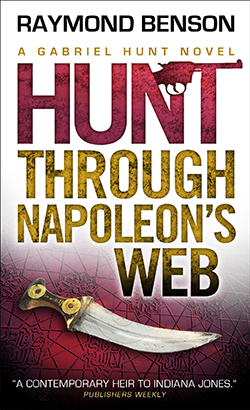
Apologies for the long silence on the Hunt front. As some of you may know, Dorchester Publishing, the publisher we've been working with over the past half dozen years, first to put out our Hard Case Crime line of crime novels and then, more recently, to publish the Gabriel Hunt series of adventure novels, fell on hard times this past summer and is still digging out from under. As a result, they temporarily stopped publishing new books, and the consequence was that the sixth Hunt novel -- HUNT THROUGH NAPOLEON'S WEB -- didn't come out in October as scheduled. We've been in talks with Dorchester about the fate of that book and the line as a whole, and I wanted to bring you up to date.

Happily, the news is good: In a classic, Hunt-like example of snatching survival from the jaws of certain doom, Dorchester will resume publishing paperback novels in 2011, albeit in the larger 'trade' paperback format (typically about 5 inches by 8 inches) rather than the smaller 'mass market' format (about 4 by 7 inches). You wouldn't think that extra inch in either direction would make much difference, but apparently it does for various distribution-related reasons. Alas, it also means that anyone who has the first five Hunt novels in mass market format won't be able to get the sixth in matching size -- and being a collector and a purist myself, I know how annoying that is. But on the positive side, the plan is to reissue all the earlier Hunt books in the new, larger trade size, which should give the whole series a new chance to reach a wide audience.

We don't have a definite date from Dorchester yet for when the trade editions will start arriving in stores, or what the schedule will be, but as soon as we do, we'll let you know. (Yes, if you look on Amazon.com, you'll see a projected pub date of August 8, 2011 for HUNT THROUGH NAPOLEON'S WEB. I'm not sure whether to believe that or not. We'll keep you posted.)

In the meantime, you might be interested to know that a company called AudioRealms is releasing the Hunt novels in audiobook format. They started with HUNT THROUGH THE CRADLE OF FEAR (a personal favorite of mine...), and I have to say that the performance by reader Jim VanDusen is first rate. The unabridged reading runs 8 hours, so you've got several car rides worth of adventure in store for you! And AudioRealms is working on the other Hunt novels as we speak -- hopefully you'll be able to get all six before too much longer. If you'd like to try CRADLE OF FEAR, you can get it on CD or download it to your computer immediately as an mp3. Just go to www.audiorealms.com and click on the Hunt cover on their home page. (It's in the third row.)

And e-book editions of the first 5 titles are still available, with the e-book of #6 scheduled to come out at the same time the paperback edition hits stores.

So...Gabriel Hunt is still alive and kicking. He's taken a bit of a beating, but this is one man who knows how to get up again when he's down. Stay tuned for more news -- and for more adventure.

Rancho Diablo Interview with Bill Crider

A new Western series is here -- Rancho Diablo! A collaboration between writers Bill Crider, James Reasoner, and Mel Odom, and featuring artwork by Keith Birdsong, the Rancho Diablo series will center around main character Sam Blaylock. The first book, Shooter's Cross (published under the house name "Colby Jackson"), is now available in print and as an ebook. One of Rancho Diablo's collaborators, Bill Crider, was kind enough to answer a few of Pulp Serenade's questions about his latest endeavor.

Pulp Serenade: Can you tell us a bit about your cohorts in Rancho Diablo and how you all came together?

Bill Crider: The Rancho Diablo crew is me, James Reasoner, and Mel Odom. Mel is the driving force. He's very into the e-book market, and he thought we should get into it as soon as we could. He thought it would be fun to do something in the spirit of the old pulps. Instead of, say, THE RIO KID WESTERN MAGAZINE, we'd have RANCHO DIABLO WESTERN MAGAZINE, and instead being a print magazine, it would be an e-publication. Mel knew that James and I were big fans of the fiction in the pulps, so he asked what we thought. We thought it was a great idea, and we jumped at the chance to be part of it.

PS: How did you all come up with the main character of Sam Blaylock?

BC: This was a group project from the beginning. We used e-mail to bat around ideas, and everybody contributed. Mel originated the concept, and then we hashed things over until we had characters and a setting that everybody liked. I think I've saved all the e-mails for posterity.

PS: How are you all splitting the writing duties for the Rancho Diablo books?

BC: Mel wrote the first one, James will do the second, and I'm in line to do the third. The idea was that sometimes we might do just a short story instead of a novella, and who knows what might happen as we go along? I'm eager to read James's contribution. After I do mine, we'll see where we stand, and if things are working out, we'll keep going.

PS: Is there a story behind the house name "Colby Jackson" that is attached to SHOOTER'S CROSS?

BC: That's the same story as above. We went over everything together, including all the names, locations, and so on.

PS: Can you divulge any hints about the upcoming books? There’s an advertisement for the next one, HANGROPE LAW at the end of the first book.

BC: Well, I have James's plot summary right here, but I haven't see the completed story, so I don't want to say much. Sometimes an outline and the final product differ considerably. I'll just say that you can count on some more action, some more good writing, and some complications in the relationships with characters from the first episode. This time some of Sam's kids will be involved.

PS: I know you're a big fan of gators and they appear frequently on your blog. Any chance of a gator cameo in a Rancho Diablo book?

BC: I'm not sure gators got up to that part of Texas in the 19th century, but you never know what somebody (namely me) might do.

PS: What is the most fun part of the Rancho Diablo project for you?

BC: Since I haven't written my story yet, I had the most fun during the planning. Mel and James are great to work with, and they're both pretty funny guys. So we had some laughs and we got a lot done at the same time. Which is always fun.

PS: Lastly, what’s up next for you?

BC: There's a big secret project that I'm connected with, along with a few other writers. All will be revealed soon. Of course I'll be working on my Rancho Diablo story soon, too. Next year there'll be another Sheriff Dan Rhodes book, THE WILD HOG MURDERS. And there's always my world-renowned blog [Bill Crider's Pop Culture Magazine]. I keep pretty busy for an old guy.

PS: Thanks so much, Bill.

Day Keene: Critical Perspectives 1

So, what did the critics make of someone like Day Keene back in the day?

This is the first in what I hope will become an ongoing series of explorations into criticism on classic writers, and how their works were received in their own time. For my first posting, I chose one of my favorite novelists: Day Keene (real name Gunard Hjerstedt).

When going through newspaper archives online, I was surprised by how often Day Keene’s work was reviewed in the New York Times. What wasn’t surprising was that it was mostly the work of Anthony Boucher, one of the most famous and important mystery reviewers of the 20th century, and perhaps one of the best critics in general. His reviews may have been short, but they were unerringly perceptive, and often pretty damn funny.

The one thing that kept popping up from review to review was the amount of sex and violence in Day Keene’s books – apparently the critics were sufficiently shocked enough to warn readers in advance. Oh, Gunard…

Without further ado, I am handing things over to the critics!

Framed in Guilt: The story is a great deal better than the atrociously punning title might lead one to hope. –Unsigned (New York Times, Jan 16, 1949)

Death House Doll: Action-crammed, legitimately sexy, with some ironic bite to its hardness, it’s a strong job of good pulp story-telling, in the “Black Mask” tradition. –Anthony Boucher (New York Times, Jan 24, 1954)

Joy House: A bit more conventional than usual… but the story of a murderer on the lam who seeks concealment in a curious sexual alliance is well constructed and sharply twisted in the James M. Cain manner. –Anthony Boucher (New York Times, Jul 25, 1954)

Who Has Wilma Lathrop? Day Keene manages to treat a vivid and violent plot with unusual restraint and quietly convincing realism… Sex and brutality are here integral to the plot and handled with skill and taste, and the writing, in characterization, prose and movement, is the best I’ve read from the always interesting Mr. Keene. –Anthony Boucher (New York Times, Jul 10, 1955)

Bring Him Back Dead: It’s all somewhat oversexed and oversimplified, but fast and concise. –Anthony Boucher (New York Times, Oct 21, 1956)

Passage to Samoa: Combines murder-mystery with the unfailing appeal of ship-wrecked treasure in a lively and enjoyable adventure tale, in which the copious lashings are necessary to the plot. –Anthony Boucher (New York Times, Jan 18, 1959)

So Dead My Lovely, Dead Dolls Don’t Talk, and Take a Step to Murder: Day Keene, recently elected Vice President of M.W.A. for Southern California, has come out with three novels within a matter of weeks… and all are worth reading if you’re not shocked by explicit sexual detail or offended by lapses in taste or careless writing. Keene invents good strong plots, in something like the Williams-Thompson tradition if with less subtlety, and tells them vigorously; but his crudities are sometimes tiresome. I have the impression that Keene was writing better books a few years ago, and the conviction that he’ll be writing still better ones in the future–there’s a lot of unguided talent here. –Anthony Boucher (New York Times, May 10, 1959)

Too Hot to Hold: It’s all a mite too Mittyish, but told with an ease and a speed that are hard to resist. –Anthony Boucher (New York Times, Dec 6, 1959)

Too Hot to Hold: Short, simple, well-written little New York thriller about unhappily married ad-man who stumbles on $200,000 being carried for gangster by lost girl Linda. Chase, passionate love affair and rather a lot of torture. –Maurice Richardson (The Observer, Jan 8, 1967)

Chautauqua: Not all of this first novel by Day Keene and Dwight Vinson is quite that heavy. There is a great deal of good humor, and probably a dose of nostalgia for provincial senior citizens. … The prose is steady, with the viewpoint shifting form person to person like an intelligently handled movie camera. (Both the authors are veteran Hollywood and TV alumni.) “Chautauqua” is good swift melodrama. It belongs somewhere between “Payton Place” and “Winesburg, Ohio.” –George Lea (New York Times, Mar 26, 1960)

World Without Women (with Leonard Pruyn): Keene and Pruyn do an excellent job of sustaining interest and suspense. “World Without Women” is a paperback original, but in entertainment it is a good deal richer than many a hard-cover novel. –Robert R. Kirsch (Los Angeles Times, May 27, 1960)

Payola: Familiar enough in its sex and violence and in its expose of criminous goings on in the pop-record business; but it’s fast, lively and professional, and Irish-Hawaiian Johnny Aolha is better company than many of ficiton’s private eyes. –Anthony Boucher (New York Times, Sept 4, 1960)

The Brimstone Bed: The pornographic-picture gambit has been badly overworked in paperbacks; but Day Keene manages to make it interesting again in The Brimstone Bed, largely by the awesome scale of the business operations and the orgies involved. The story’s fast and effective, but such intensive contemplation of the nasty side of sex may not be to every taste. –Anthony Boucher (New York Times, Oct 9, 1960)

Bye, Baby Bunting: The terror and tribulations of Jennifer’s giving birth to her first child–in prison–and then standing trial for her life, are presented in spade-calling terms that may dismay the queasy. –Vivian Mort (Chicago Tribune, June 30, 1963)

Bye, Baby Bunting: Rather unlikely in spots, but holds up beautifully. –Unsigned (Tucson Daily Citizen, June 29, 1963)

"The Town Square" by Orrie Hitt (Swank, May 1964)

"The Town Square" is one of the few known short stories published by prolific novelist Orrie Hitt, and it appeared in the May 1964...