A few recent additions to the library: Beach Bodies (2022) by Nick Kolakowski, Say Goodbye When I'm Gone (2020) by Stephen J. Golds, and Corruption City by Horace McCoy (1959).


A few recent additions to the library: Beach Bodies (2022) by Nick Kolakowski, Say Goodbye When I'm Gone (2020) by Stephen J. Golds, and Corruption City by Horace McCoy (1959).
Anybody got a light? Not that I smoke, but I am looking for a special matchbook created by Samuel Fuller to commemorate the publication of his 1936 novel Burn, Baby, Burn. According to the Pottstown, Pennsylvania Pottstown Mercury, one million of these promotional tchotchkes were produced. Maybe one of them is out there, somewhere.


I decided to make an out-of-the-way pit-stop at the Mysterious Bookshop on my way home from work to pick up a signed copy of Lawrence Block's The Burglar Who Met Fredric Brown. As expected, I found a couple other things I had been looking forward, and several I didn't know that I had been looking for but clearly should have been. Stark House Press/Black Gat's reissue of Robert Silverberg's Killer, a whole ton of vintage A.A. Fair paperbacks, a reprint of Day Keene's Homicidal Lady that I didn't have, and lots more.


Harry, if you don’t sit yourself down and write the honest to God book of your guts very soon, I’m sure as hell going to bash you over the head with a sledge hammer.I mean it.

 Wouldn’t it be nice to curl up with a good book, doze off, and wake up in that world? That’s a question Lawrence Block explores in his latest novel, The Burglar Who Met Fredric Brown, the 12th novel to feature professional thief and Greenwich Village bookstore-owner Bernie Rhodenbarr. No one’s asking me to contain my enthusiasm, and so I won’t—I absolutely loved this book, and I think any of Bernie’s many fans will, too.
As a big fan of Block and his Bernie series, this didn’t disappoint in the slightest, hitting all the hallmarks of the series that readers have come to expect. The humor, the Greenwich Village setting, the warm friendship between him and series regular Carolyn, and of course the burglary. But Block also takes readers into new territory. The Burglar Who Met Fredric Brown is much more a fantasia than the earlier volumes. If you’re familiar with Brown, then you might have a little idea what’s in store, and if not, then it might help to know that Brown was an ardent admirer of Lewis Carroll, and there’s more than a hint of Wonderland in both his works and in Block’s latest. I found Block’s incursion into magical realism to be an absolute delight.

Marriott is a prolific editor, writer, and publisher, and he was kind enough to answer a few questions about his work and Paperbacks at War.
Before we talk about Paperbacks at War, could you give a little background about yourself, and how your interest in literature developed?
I’m a pretty average Joe. Early 50s, married with two young daughters and living in a coastal town in the West of England. The day job is for a large financial organization where I work as a project manager in IT.
I’ve still yet to develop any interest in literature! But I was a voracious reader from an early age, especially of comics, a habit I inherited from my dad. Growing up in the 70s in the UK, it was an age before video, and there were only 3 TV channels, all with limited programming aimed at kids. So Dr. Who was a must see on Saturday evenings, and the novelizations of Doctor Who were the first genre books I encountered. These were in the form of hardbacks loaned from the local library. I would read them cover to cover in a day. Even at that early age, I started to identify which authors I preferred—with Terrence Dicks, the creator of the Daleks, being a favourite.

***
In Jason Starr's The Pack, advertising executive Simon Burns life goes into a tailspin after he’s fired from his job. Marriage counseling isn’t helping the intimacy issues with his wife, and being a stay-at-home-dad is harder than it at first seemed. Things start to look up when he meets a group of dads at the playground: Simon has guys to hang out with during the day, and his kid has other children to play with. But after a night of partying, Simon blacks out and wakes up in the woods naked, and all he can remember about his dreams is a wolf. The nightmare continues to haunt him, and as his body begins undergoing changes, Simon fears that he, in fact, might be turning into a werewolf.
Yes—a werewolf—but don’t start thinking this is another Twilight spin-off. Nor is The Pack anything close to a conventional horror novel. The story is less about physical transformation than it is emotional and psychological changes, and how they can affect—and sometimes destroy—a relationship. Simon is one of Starr’s most realistically and sympathetically crafted characters, and the slow dissolution of his marriage is harrowingly and poignantly written. Much like Panic Attack, The Pack is really about the discovery of a father’s latent violent urges and the disastrous after-affects it has on his family.
Don’t let the werewolf element throw you off. The Pack is pure Jason Starr, and it is one of his most gripping novels yet.

Alternately erotic, surreal, and menacing (and often all at the same time), this is one of the strongest Franco films I've seen thus far. The narrative is fairly cohesive and straightforward, and gives structure to Franco's pscyho-sexual environs.
The opening sequence, of two women enacting an S&M performance on stage for an audience, introduces a key theme of the movie and of Franco's work as a whole: the intertwining of performance, role-playing, voyeurism, and eroticism. Nearly every encounter in the film, whether sexual or not, involves some element of performativity. Whether its two lovers expressing submission and domination, or a college-educated cop competing with his street-wise superior, Franco seems interested in the extent to which people are always acting, and whether even the most seemingly "normal" elements of our reality are, in some ways, fictional fantasies of their own.
The version of Exorcism streaming on Kino Cult is sourced from varying prints, and some scenes show minor damage (such as scratches), and certain sequences inter-cut between different prints in order to deliver the most complete version of the film possible. Despite this, the colors are strong and not faded, making this an overall very attractive presentation of the film. Kino's Blu-ray also includes a cut-down version called Demoniac (exclusive to the disc, not streaming), which focuses more on the horror elements of the film, and includes alternate footage and less nudity.
Recently I had the pleasure of participating in a feature-length essay film experiment by director Matt Barry. As part of a folk-film challenge, we decided to make our own movie during the Oscars broadcast. Filmed over Zoom, the result was The Age of Cinema (2022), a discussion about the intersection of personal collecting and film history. I also had the pleasure of writing original music for the opening sequence.
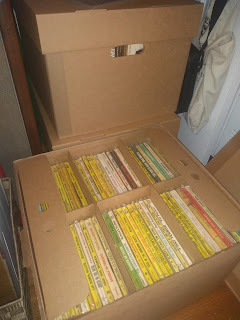
I've hit the saturation point again, and have no shelf space (or closet space, or floor space) left. In the past, when this has occurred, I've diminished my book to collection to make space, only to regret decisions and buy the books back (often at a higher price and lower quality). This time, I'm trying something different. And, honestly, I should have done it years ago.
I've rented storage space.
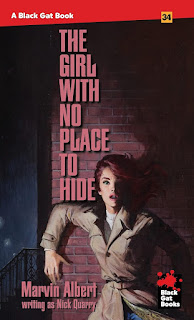
The story begins when a young woman enters a bar looking for private eye Jake Barrow’s friend, fight manager Steve Canby, who left the bar just moments before. Later, as Jake is leaving the bar, he finds a thug in the alley strangling the woman. He rescues her and takes her to his apartment for safe keeping, and she reveals that she’s in trouble, and that something bad has happened to her friend Ernie. Before Jake can find out more, he gets an urgent call to come up to the Bronx for $200. When he gets there, he realizes it was a ruse. Returning to his apartment, Angela is gone. The next morning, Jake sees in the newspaper that a photographer named Ernie was found murdered—and he fears that Angela will be the next victim.
I’ll say no more except that this is a wild ride all across New York City, with plenty of twists and turns that kept me guessing every step of the way.
Originally appearing under Albert's pseudonym “Nick Quarry” in 1959 by Gold Medal Books, The Girl With No Place to Hide was recently reissued by Black Gat Books from Stark House Press, and it magnificently captures why Albert was a writer’s writer. The Girl With No Place to Hide is the work of a real pro—a slickly designed plot that hits the right beats but not in the expected places, so readers will get what they're looking for but not in the same way they’ve read it before. Albert also shows restraint with the prose, no leaning too much on sex, violence, or slang. This is Albert’s third novel with his series character Jake Barrow—but don’t let that stop you from jumping in. If you’re like me and you haven’t read the first two yet, you’ll have no trouble following along (though you might want to rush out and find the others).


The Gang begins with the titular group of men gathering before a job, and then jumps to directly after the job, as they return with their leader, Robert "The Crazy" (Alain Delon), wounded. This leads into a voice-over from Robert's wife, Marinette (Nicole Calfari), who takes the story back to post-war Paris where they meet at a nightclub, where Robert holds the patrons at gunpoint after an American soldier insults one of the gang. From here, the story alternates between idyllic scenes of the gang celebrating baptisms, relaxing in the countryside, and glimpses of their crimes filmed with Melvillain sobriety. Robert becomes increasingly brazen as their success grows, and it's only a matter of time before his craziness gets him—and perhaps the gang—killed.

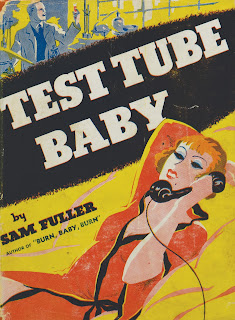
Test Tube Baby is the second novel from Samuel Fuller (here credited as “Sam Fuller”). Published in 1936 by Godwin, Publishers, it is among...